OpenAI Codex Fully Explained: The Paradigm Shift from ChatGPT Conversations to Autonomous AI Programming

OpenAI Codex is an AI agent that autonomously writes code, unlike ChatGPT which only explains how.
OpenAI Codex represents a paradigm shift from conversational AI to autonomous programming agents. While ChatGPT acts as a knowledge consultant explaining code concepts, Codex actually reads your codebase, writes code, fixes bugs, runs tests, and delivers working solutions in cloud sandboxes. Developers must adapt from writing code to directing AI, with skills in precise requirement specification and output evaluation becoming the new competitive advantage.
What Is Codex? Not Just Chat — It Does the Work for You
Codex is an AI programming agent launched by OpenAI. The keyword here is "agent" — it doesn't simply answer your programming questions; it autonomously completes programming-related tasks.
The concept of an "Agent" is one of the most important technical paradigms in AI over the past two years. Unlike traditional conversational AI, an Agent possesses three core capabilities: perceiving the environment (reading code, understanding project structure), autonomous decision-making (planning the steps to complete a task), and executing actions (actually writing code, running commands). Traditional ChatGPT is more like an "input-output" function — you give it a question, it returns an answer. An Agent, on the other hand, is like a worker with a toolbox who can invoke external tools such as the file system, terminal, and testing frameworks, forming a "think → act → observe → think again" loop until the task is complete. This leap from "answering questions" to "completing tasks" is the fundamental distinction between Codex and ordinary AI chat tools.
Specifically, Codex can:
- Generate code: Automatically write code based on requirements
- Read and understand code: Analyze existing project structure and logic
- Fix bugs: Locate issues and autonomously repair them
- Execute tests: Run test cases to verify code correctness
- Execute commands and scripts: Complete operational tasks like deployment
It's worth noting that when Codex performs these tasks, it doesn't run on your local machine. Instead, it works in a cloud-based sandbox environment provided by OpenAI. Each time you submit a task, Codex clones your code repository in an isolated virtual environment, installs dependencies, and then writes, modifies, and tests code within this secure sandbox. Once the task is complete, it generates a change list similar to a Git Pull Request for you to review and merge. This design ensures both security (the AI won't directly modify your production code) and a complete code review workflow.
If you just want AI to generate a code snippet for you to copy and paste, tools like Doubao, DeepSeek, or ChatGPT itself are sufficient. But Codex has a completely different positioning — it's a programming assistant that can "get its hands dirty."
The Core Differences Between Codex and ChatGPT
Many people are confused when they first encounter Codex: isn't this just ChatGPT? After all, Codex does rely on ChatGPT's large model capabilities under the hood. But the two have fundamentally different positioning.
From a technical architecture perspective, Codex uses a model specifically optimized by OpenAI for programming tasks (codenamed codex-1, fine-tuned from the o3 model through reinforcement learning for software engineering tasks). This model not only has powerful code comprehension and generation capabilities, but more importantly, it's trained to follow "the style and conventions of real codebases" — meaning it tries to keep generated code consistent with the existing code style in your project, rather than producing "textbook-style" standard code.
ChatGPT = Teacher (Talks the Talk)
ChatGPT's interaction mode is conversational. When you ask it "How do I implement a login feature in Spring Boot," it will:
- Explain the principles and approach
- Provide example code
- Answer your follow-up questions
But ultimately, you need to Ctrl+C, Ctrl+V the code yourself, paste it into your IDE, debug it yourself, and get it running yourself. It's essentially a knowledge consultant.
Codex = Programmer (Walks the Walk)
Codex works in a completely different way. When you tell it "Build the login feature for me," it will:
- Read the project code on its own and understand the project structure
- Write and modify code on its own
- Run tests and debug on its own
- Tell you "It's done" once everything passes
More importantly, Codex supports parallel processing of multiple tasks. You can issue multiple instructions simultaneously — such as "Fix the login bug in the user module," "Add unit tests to the order module," and "Refactor the error handling logic in the payment interface" — and it will spin up multiple independent sandbox environments to work in parallel, with each task isolated from the others. This means a single developer can "direct" multiple AI programmers at once, multiplying development efficiency.
In one sentence: ChatGPT talks; Codex acts. ChatGPT tells you how to do it; Codex does it for you.
Why Developers Must Master Codex Now
The Development Model Has Fundamentally Changed
We are experiencing a fundamental transformation in how programming is done:
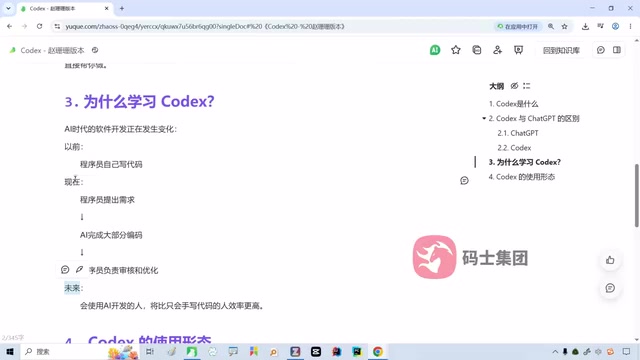
- Before: Programmers wrote all code by hand, typing every single line themselves
- Now: Programmers define requirements, AI programming agents complete most of the code, and programmers review and optimize
This isn't a future trend — it's happening right now.
Looking back at programming history, this "continuous elevation of abstraction levels" has always been happening. In the 1950s, programmers used assembly language to directly manipulate CPU registers; in the 1970s, C freed programmers from worrying about specific hardware instructions; in the 1990s, high-level languages like Java and Python further abstracted away low-level details like memory management; in the 2010s, various frameworks and low-code platforms let developers accomplish more with less code. Each elevation in abstraction level triggered discussions about "whether programmers would become obsolete," but the actual result was: the number of programmers increased rather than decreased, because higher efficiency unlocked greater demand. The emergence of AI programming agents is essentially the latest step on this evolutionary path — the abstraction level of programming has risen from "code" to "natural language."
Programmers Won't Be Replaced, But Their Role Is Being Redefined
Some worry that AI programming agents will replace programmers — this is a misconception. After Codex completes code, humans are still needed to:
- Review code quality: Does the AI-generated code conform to architectural standards? Does it introduce unnecessary dependencies? Are there security vulnerabilities (such as SQL injection, XSS attacks)? Current AI models can still produce code that appears correct but contains hidden risks when dealing with complex distributed systems, high-concurrency scenarios, and security-sensitive business logic.
- Optimize performance: Are there potential performance bottlenecks? AI might choose the most intuitive but not optimal algorithm implementation — for example, using an O(n²) approach instead of an O(n log n) solution in large-data scenarios.
- Control business logic: Did the AI correctly understand the requirements? When dealing with complex business rules, compliance requirements, and edge case handling, AI's understanding is often imprecise and requires experienced developers to judge and correct.
If you know nothing about programming, you simply cannot perform these review tasks. So programming skills remain important — only the way they're applied has changed.
The Most Valuable Skill of the Future: Giving AI Precise Requirements
The standard for measuring a programmer's ability used to be "how many lines of code can you write per day." But in the AI programming era, the truly valuable skills are:
- The ability to describe requirements precisely: In the AI field, this is called "Prompt Engineering." In programming contexts, a good prompt isn't simply "write me a login feature" — it means specifying the tech stack (Spring Boot + MyBatis), authentication method (JWT Token), security requirements (BCrypt password encryption), exception handling strategy (unified error response format), and other key constraints. The more precise the requirement description, the higher the quality of AI output, and the lower the cost of subsequent modifications.
- The ability to decompose complex tasks: AI agents currently excel at tasks with clear boundaries and well-defined scope. An instruction to "refactor the entire e-commerce system" is far less effective than breaking it down into "refactor the caching strategy for the product search module" or "optimize the state transition logic of the order state machine." This systems thinking ability to decompose large problems into smaller ones is precisely the core competitive advantage of senior engineers.
- The ability to evaluate AI output quality: Being able to quickly identify potential issues in AI-generated code, including but not limited to architectural soundness, maintainability, testability, and security.
People who can use Codex, Claude Code, Cursor, and other AI programming tools will far outperform those who write code purely by hand. This isn't a multiple-choice question — it's mandatory.
It's worth mentioning that the competitive landscape of AI programming tools is evolving rapidly. Codex (OpenAI) is positioned as a cloud-based asynchronous programming agent, suitable for handling larger-granularity development tasks; Claude Code (Anthropic) is a command-line tool that interacts with developers directly in the terminal, closer to traditional developer workflows; Cursor is a complete AI-native IDE that deeply integrates AI capabilities into the editor, providing real-time code completion and inline editing experiences. There's also GitHub Copilot (Microsoft/GitHub), Windsurf (Codeium), and other products. These tools each have different focuses, but share the same core philosophy: let AI handle more code writing so developers can focus on higher-level decisions. Mastering the methodology of any one of them allows you to quickly transfer those skills to other tools.
Summary: The Paradigm Shift from "Writing Code" to "Directing AI to Write Code"
Codex represents a paradigm shift in programming — from "writing code yourself" to "directing AI to write code." Its relationship with ChatGPT is similar to the difference between a "construction crew" and a "design consultant": one does the hands-on work, the other provides strategic advice.
For developers, mastering AI programming agent tools like these as early as possible isn't icing on the cake — it's a fundamental skill for staying competitive. Whether it's Codex, Claude Code, or other similar products, the core logic is the same: let AI be your programming executor while you focus on higher-level architectural design and requirement management.
This shift also means that software engineering evaluation systems need to be redefined. Traditional metrics like Lines of Code and Commit Frequency will gradually lose their meaning, replaced by requirement conversion efficiency (speed from requirements to working code), AI collaboration ability (effectiveness in leveraging AI tools), and system design quality (soundness of architectural decisions). The excellent developers of the future won't be those who write code the fastest, but those who are best at "directing" AI while possessing deep technical judgment.
Key Takeaways
Related articles

Disaster and Glory of the Apollo Program: The History We Must Revisit Before Returning to the Moon
From the fatal Apollo 1 fire to Apollo 8's daring lunar orbit to Apollo 11's successful landing—revisiting the disasters, fears, and compromises of the Apollo program and their lessons for today's return to the Moon.

Netflix Trust Exercise Turns Into Firing Trap: Where Are the Boundaries of Corporate Trust?
A Netflix employee was fired after sharing private info in a trust exercise. We analyze the risks of corporate trust exercises and how employees can protect themselves.

AMD CDNA5 Architecture Deep Dive: Technical Evolution and the AI Computing Competition Landscape
Deep analysis of AMD's CDNA5 architecture covering Chiplet packaging upgrades, HBM memory evolution, and low-precision compute optimization, examining how AMD challenges NVIDIA's AI chip dominance.