OpenAI Codex Global In-Person Meetups Now Open for Registration, Accelerating Developer Community Ecosystem

OpenAI launches global in-person Codex developer Meetups to build its AI coding community ecosystem.
OpenAI recently invited developers worldwide to attend in-person Codex Meetup events, aiming to build a developer community ecosystem around its AI coding agent tool. Codex has evolved from a code completion tool into a cloud-based AI agent capable of independently completing complex programming tasks using a multi-step "plan-execute-reflect" architecture. Facing intense competition from Cursor, Claude Code, and other rivals, OpenAI is pursuing differentiation through its in-person event strategy to solidify its leading position in AI coding.
OpenAI Launches Global Developer Meetups for Codex
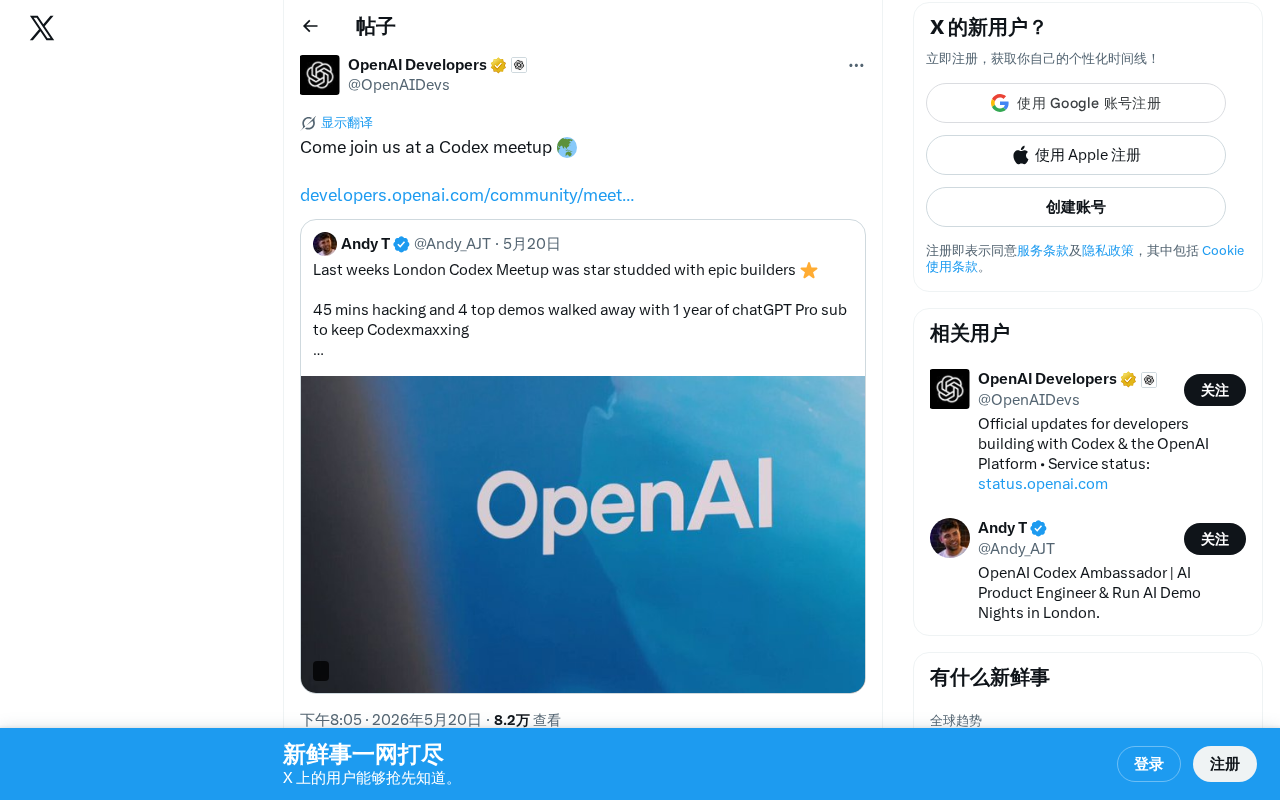
OpenAI recently posted an invitation on social media, calling on developers worldwide to attend in-person Codex Meetup events. This move signals that OpenAI is actively building a developer community ecosystem around its AI coding tool Codex, pushing product promotion and user engagement into a new phase.
What Is Codex? OpenAI's AI Coding Agent Tool
Codex is OpenAI's AI coding assistant product, capable of understanding natural language instructions and generating code. As the core technology behind GitHub Copilot, Codex has already gained widespread attention and adoption among developers globally.
Codex's Technical Evolution: Codex was originally released by OpenAI in 2021, built on the GPT-3 architecture with specialized fine-tuning for code scenarios, trained on billions of lines of public code from GitHub. It was one of the first commercial products to systematically bring large language model capabilities into the programming domain, supporting dozens of programming languages including Python, JavaScript, and Go. GitHub Copilot, powered by Codex as its underlying engine, officially launched commercially in 2022 and quickly accumulated over a million paying users, validating the market viability of AI-assisted programming. The 2025 upgrade of Codex marks a paradigm shift from "code completion" to "task-executing agent," powered by the enhanced capabilities of OpenAI's o-series reasoning models.
Recently, OpenAI made a major upgrade to Codex, releasing an entirely new cloud-based coding agent version. The new Codex is no longer just a code completion tool—it's an AI agent capable of independently completing complex programming tasks in a sandboxed environment. Its specific capabilities include:
- Writing complete feature modules
- Automatically fixing bugs
- Performing code reviews
- Handling multi-file collaborative tasks
Technical Principles of AI Coding Agents: The "AI coding agent" represented by the new Codex is fundamentally different from traditional code completion tools. Traditional tools (like early Copilot) used a single-turn interaction model of "input prompt → output code snippet," while AI agents introduce a multi-step "plan-execute-reflect" loop architecture. Specifically, the Codex agent can autonomously run code in a sandboxed environment, read error messages, adjust strategies, and re-execute, forming a closed loop. This capability relies on key technologies including tool use, long context windows, and reinforcement learning alignment. The sandbox isolation mechanism ensures the agent operates in a safe, controlled environment, preventing unintended impacts on production systems. This architecture enables Codex to handle complex engineering tasks across files and modules, rather than merely completing single lines of code.
This upgrade elevates Codex from an "assistive tool" to a "programming partner," allowing developers to delegate more repetitive work to AI.
The Significance of Codex Meetup Events
Community Building in Full Acceleration
OpenAI's choice to gather developers through in-person Meetups reflects several important trends:
- Shifting from product to ecosystem: Competition in AI coding tools is no longer just about technology—community and ecosystem building are equally critical
- Collecting real user feedback: In-person interactions allow product teams to directly understand developers' pain points and needs
- Promoting best practice sharing: Experience exchange among developers helps uncover more use cases for Codex
Strategic Value of Developer Community Ecosystems: In the AI tools space, the strategic value of developer communities far exceeds that of traditional software products. On one hand, developers are both direct users and significant influencers in enterprise purchasing decisions—the "developer word-of-mouth → enterprise adoption" pathway has been well validated with products like Slack and GitHub. On the other hand, in-person Meetups generate high-quality use cases and best practice content that, when spread by developers, creates organic word-of-mouth marketing effects. Historically, developer conferences like AWS re:Invent and Google I/O have significantly strengthened platform stickiness through community operations. OpenAI's move to take Meetups global aims to replicate this proven approach while leveraging in-person settings to collect deep user insights that are difficult to obtain through online channels, providing real evidence for product iteration.
Intensifying Competition in the AI Coding Space
The current competitive landscape in AI coding is fierce, with products like Cursor, Windsurf, and Claude Code all iterating rapidly. From a competitive landscape perspective, the market has formed multi-layered differentiation: at the IDE plugin layer, there's GitHub Copilot and Tabnine; at the standalone AI editor layer, there's Cursor (deeply modified from VSCode, with monthly active users exceeding one million) and Windsurf (a Codeium product); at the command-line agent layer, there's Anthropic's Claude Code and OpenAI's Codex CLI. The core differences between products lie in underlying model capabilities, context management strategies, agent autonomy levels, and depth of integration with development workflows. Notably, Cursor and Windsurf both adopt a "model-neutral" strategy, allowing users to choose between different models like Claude and GPT-4, while OpenAI's Codex is deeply tied to its own model ecosystem, forming a differentiated competitive path.
By hosting global developer events, OpenAI aims to solidify its leading position in AI coding while accumulating user insights for continuous Codex optimization. Compared to competitors who primarily rely on online community operations, OpenAI's in-person event strategy is more differentiated and is expected to build stronger developer stickiness.
Implications and Participation Recommendations for Developers
AI coding tools are rapidly evolving from "assistive completion" to "autonomous agents," which will profoundly impact how developers work. The value of participating in such community events includes:
- Getting first-hand information on Codex product updates and roadmap
- Exchanging practical AI coding experiences with peers
- Building industry connections and discovering collaboration opportunities
For developers interested in attending, you can find specific Meetup times and locations through OpenAI's official social media accounts and website. Early registration is recommended, as spots in popular cities may fill up quickly.
Key Takeaways
- OpenAI has launched global in-person Codex Meetup events, inviting developer participation
- Codex has been upgraded to a cloud-based AI coding agent capable of independently completing complex programming tasks, powered by a multi-step "plan-execute-reflect" agent architecture
- This reflects intensifying competition in the AI coding space, where community ecosystem building has become a key differentiator
- AI coding tools are evolving from assistive completion toward autonomous agents, bringing fundamental changes to how developers work
Related articles
 Tech Frontiers
A Rare Quiet Day in AI: Recursive Self-Improvement Stirs Beneath the Surface
A rare quiet day in AI sees multiple sources go silent simultaneously. Behind the calm, Recursive Self-Improvement (RSI) research continues. What this means for the industry.
 Tech Frontiers
Reve 2 vs. Ideogram 4: A Deep Dive into Layout Control in AI Image Generation
A deep comparison of Reve 2 and Ideogram 4's layout control capabilities, covering technical approaches, real-world use cases, and industry trends for designers and creators.
 Tech Frontiers
In the Weights: Check Your Influence Score in the AI World
In the Weights is an AI influence search engine that quantifies your presence in the AI world with a score. Explore how it evaluates practitioners and what it means for digital identity.