OpenAI Codex Launches One-Click Migration and Pet Feature: Full Breakdown of AI Industry News on May 2, 2026

May 2, 2026 AI roundup: Codex migration & pets, xAI voice cloning, Anthropic's $900B push, DoD AI deals.
On May 2, 2026, OpenAI Codex launched a one-click migration tool and pet feature to boost retention, xAI unveiled alarmingly easy voice cloning, Anthropic's valuation pushed toward $900 billion while the White House resisted expanding its model access, and the U.S. DoD signed classified network AI deployment deals with seven major companies. Meanwhile, Musk admitted in court to using distillation from OpenAI, and new U.S. legislation targets AI companions for minors.
OpenAI Codex Launches One-Click Migration and Pet Feature: Full Breakdown of AI Industry News on May 2, 2026
When AI platforms start using pet features to compete for user attention, you know the war has shifted from the technical layer to emotional lock-in. The May 2, 2026 AI news roundup is packed — OpenAI Codex's one-click migration feature and pet system officially launched, xAI's voice cloning has a terrifyingly low barrier to entry, Anthropic's valuation is pushing toward $900 billion, and the U.S. Department of Defense has plugged AI directly into its top-secret networks. Let's break it all down.
OpenAI Codex Rolls Out Switch to Codex Migration: One-Click User Siphoning from Competitors
OpenAI officially launched the Switch to Codex migration feature, allowing users to transfer their complete workflows — including settings, plugins, skills, and even conversation history — from other agent platforms to Codex with a single click.
Put simply, this is the classic "siphon tactic" that big tech companies have deployed countless times — reduce migration costs to zero, and you've maximized the difficulty of user retention for your competitors.
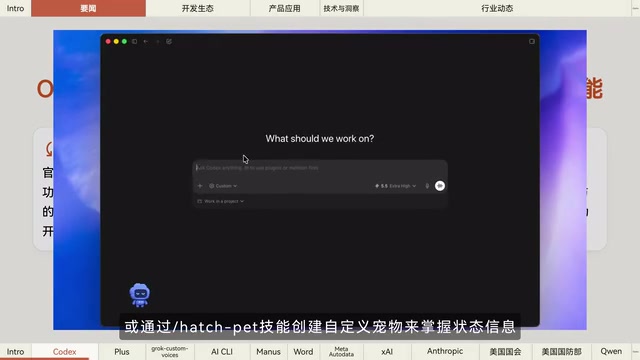
Even more interesting is the simultaneously launched pet feature: users can adopt a default pet by entering a Prompt command, and can create custom pets through Prompt skills to track various status information.
When a platform positioned as a professional coding agent starts raising digital pets, what does that tell you? It tells you OpenAI has realized that tool utility alone can't build a moat — they need emotionally-driven design to create user stickiness. Clever as it is, this also exposes an awkward truth: Codex's differentiation advantage in core functionality might not be strong enough yet, requiring "pet raising" to retain users.
Codex Login Verification Tightened: Even Paid Members Must Verify Phone Numbers
Codex now has a high probability of displaying a phone verification page during login. Even GPT Plus paid members who were previously exempt are now required to verify their phone numbers.
This almost certainly isn't a technical upgrade — it's that abuse and freeloading have gotten severe enough to force OpenAI's hand. API abuse, multi-account arbitrage, geographic restriction bypassing — the scale of these gray-area operations is likely far beyond what outsiders imagine. For regular users, being treated as a suspect after paying for a subscription is definitely a negative experience. But for OpenAI, the willingness to alienate some users to plug these holes shows that cost pressure has genuinely reached the operational level.
xAI API Launches Voice Cloning: 1 Minute of Audio, 2 Minutes to Complete
xAI's API has added custom voice and voice library features. Users only need to provide approximately 1 minute of natural speech to complete verification and clone a personalized voice within 2 minutes. Over 80 preset voices covering 28 languages are also available.
The technical barrier is disturbingly low. One minute of audio, two minutes to clone — when anyone can replicate someone else's voice with such a short sample, the cost of telecom fraud and deepfakes drops by yet another order of magnitude. Musk preaching AI safety on one hand while pushing features like this on the other — the irony is off the charts.
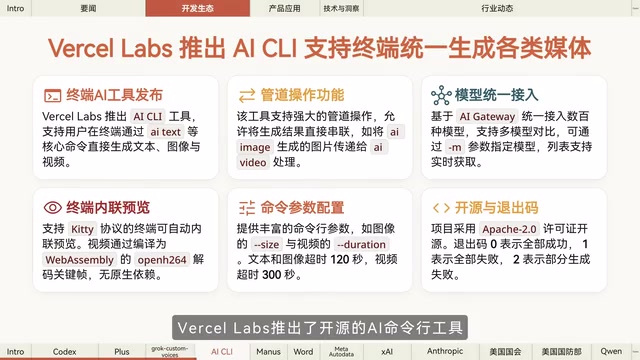
Worlds Labs Open-Sources AI Command-Line Tool: The Right Way to Return to Unix Philosophy
Worlds Labs released an open-source AI command-line tool that lets users generate text, images, and video directly in the terminal through simple commands. It supports piping operations to chain generation steps, multi-model comparison, requires no additional dependencies, and offers native in-terminal preview.
This is a severely underrated move. Embedding AI capabilities into the terminal command line means developers can invoke AI generation as naturally as using grep or curl, chaining them through pipes to form workflows. This is what true "AI-native development experience" looks like — not flashy GUIs, but a return to Unix philosophy's composable toolchain.
The multi-model comparison feature hits a real pain point: when developers can compare outputs from three models with a single terminal command, competition among model providers becomes far more transparent and brutal.
Manus Launches Cloud Computer: Agents Move from Demo-Grade to Production-Grade
Manus launched its Cloud Computer feature with persistent environments and file systems, enabling bots, Python scripts, and various software to run 24/7 without interruption.
This is Manus's critical leap from "demo-grade agent" to "production-grade infrastructure." The biggest pain point with agents has always been statelessness — the environment disappears after a task completes, and you have to start from scratch next time. Persistent file systems and always-on capabilities solve this fundamental problem. But the flip side: when your bot runs ceaselessly in the cloud, cost metering, security auditing, and loss-of-control risks all amplify exponentially. Whether Manus can properly manage this "perpetual motion machine" determines whether it's infrastructure or a ticking time bomb.
Microsoft Embeds Legal Agent in Word: Junior Lawyers Should Be Worried
Microsoft launched a legal-specialized Lego Agent within Word, designed specifically for legal professionals to handle contract review and clause negotiation. It's currently available only to users in the United States.
Microsoft's choice to enter vertical agents through the legal domain is precise and ruthless. Contract review and clause negotiation are among the most labor-intensive, most standardized, and highest-billing tasks at law firms. The U.S.-only restriction isn't a technical limitation but a legal system barrier — common law contract logic is relatively structured, making it more suitable for AI processing.
The real ambition: when Word transforms from a document editor into a legal workstation, Microsoft upgrades from selling software to selling professional services, directly eating into legal tech companies' market share. Junior lawyers and legal assistants genuinely should start worrying.
Meta AI Launches AutoData Framework: Using AI to Produce AI Training Data
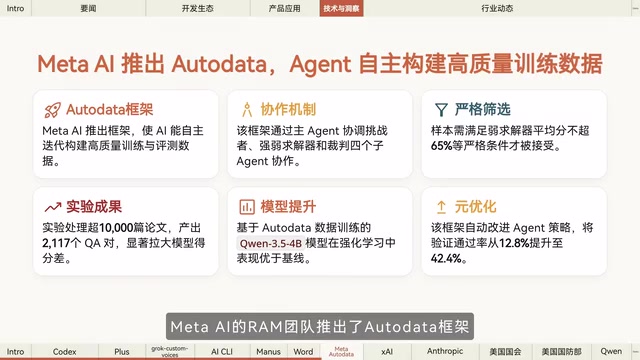
Meta AI released the AutoData framework, which uses one primary agent coordinating four sub-agents to rigorously filter Q&A pairs, allowing AI agents to autonomously iterate and generate high-quality training data like data scientists.
Meta is essentially using AI to solve AI's biggest bottleneck: the scarcity of high-quality data. This is a bootstrapping solution — using existing AI to produce training data for the next generation of AI. Elegant as it is, the risks are obvious: if the filtering agents themselves carry biases or blind spots, these flaws will be systematically amplified and baked into downstream models. Once the data flywheel starts spinning, the cost of correction far exceeds starting over. Meta is betting this flywheel spins faster than competitors' — as for whether the direction is right, they'll figure that out after they're already running.
Musk Admits in Court That xAI Used Distillation to Train Grok: Most Ironic Testimony of the Year
In a California federal court hearing, Elon Musk testified and admitted that xAI partially used distillation techniques — learning knowledge from OpenAI models — when training Grok. Musk argued that "this is a common practice among AI companies."
This is probably the most ironic court testimony of 2026. One of Musk's core arguments when suing OpenAI was that its technology wasn't open enough and was captured by commercial interests — and then he turned around and distilled from OpenAI's models. The defense "this is standard industry practice" is a classic — when you accuse others of doing it, it's a crime; when you do it yourself, it's just how the industry works.
The deeper impact: this essentially acknowledges an open secret in the AI industry — virtually all latecomers are, in some sense, "standing on OpenAI's shoulders." The knowledge boundaries between models are far blurrier than the legal boundaries between companies.
Anthropic's Valuation Pushes Toward $900 Billion, But the White House Wants to Hit the Brakes
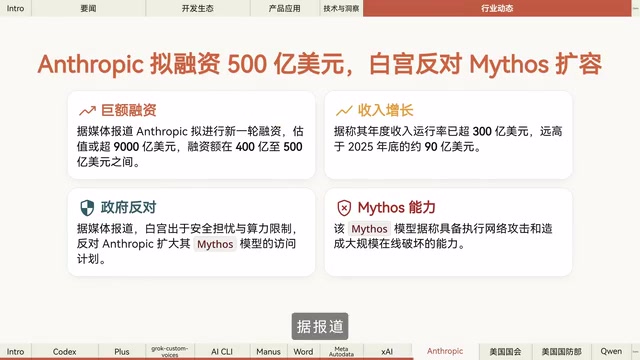
Anthropic is conducting a new private funding round totaling $40-50 billion, with a valuation expected to exceed $900 billion — potentially surpassing OpenAI as the world's highest-valued AI startup. Simultaneously, the White House has explicitly opposed expanding access to Anthropic's AI model Mythos, citing safety concerns and compute limitations.
This creates a bizarre paradox: investors are flooding in because they believe in Anthropic's technical prowess, while the government wants to restrict it precisely because that prowess is too strong. Anthropic is walking a tightrope — the higher the valuation and the stronger the capabilities, the tighter the regulatory shackles. Whether it can find a balance between "powerful enough to justify the valuation" and "not dangerous enough to be restricted" will define the regulatory paradigm for the entire AI industry.
U.S. Advances AI Age Verification Bill: AI Companions Say "No" to Minors
The U.S. Senate Judiciary Committee unanimously voted to advance a user age verification and responsible conversation bill, with the House simultaneously introducing companion legislation. The bills require AI companies to implement age verification, prohibit providing AI companions to minors, and mandate periodic disclosure of non-human identity to users.
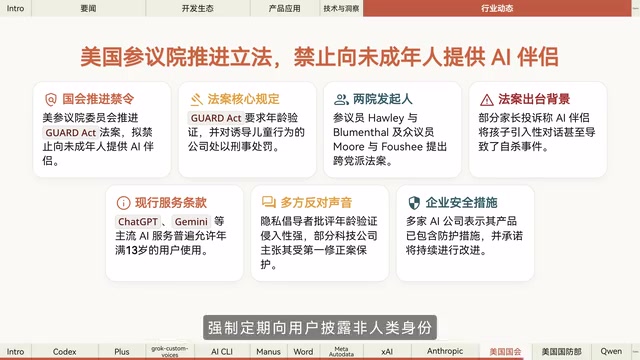
These two provisions target the most hidden ethical minefield in current AI products. The impact of AI companions on adolescent mental health is no longer a theoretical issue — it's a social experiment already underway. The Judiciary Committee's unanimous vote shows this has transcended partisan divides to become a consensus issue.
But the execution challenges are enormous: age verification has never been truly solved in the internet era, and it will only be harder in the AI era. The deeper question: when adults are also developing deep emotional dependencies on AI, is protecting only minors just drawing a line that's destined to blur?
U.S. Department of Defense Signs Classified Network Deployment Agreements with 7 AI Companies
The U.S. Department of Defense signed agreements with seven companies — SpaceX, OpenAI, Google, NVIDIA, Reflection, Microsoft, and AWS — allowing AI technology and models to be deployed on IL6 and IL7 high-security classified networks for lawful operational purposes.
IL6 and IL7 — these are among the U.S. military's highest security-level information systems. The list of seven signatory companies is itself a membership roster of the "AI-military-industrial complex": SpaceX handles space, AWS and Microsoft handle the cloud, NVIDIA handles compute, OpenAI and Google handle models. This isn't simple technology procurement — it's AI formally becoming core infrastructure of the U.S. defense system.
A telling detail: the relatively low-profile name Reflection appearing on this list suggests the military's selection criteria aren't purely about brand recognition, but about matching specific capabilities. The Pandora's box of AI weaponization is no longer a question of "will it be opened" but "how wide is it already open."
Qwen and Fireworks AI Strategic Partnership: A New Path for Chinese Models Going Global
Qwen and Fireworks AI reached a strategic partnership. Users can directly access Qwen 3.6 Plus and other closed-source Chinese-language models on the Fireworks platform, achieving production-grade deployment at lower fine-tuning and inference costs.
This is a landmark event for Chinese AI models going overseas. Qwen reaches international developers through the Fireworks platform, bypassing the compliance, trust, and infrastructure challenges of direct international expansion. But "lower fine-tuning and inference costs" as a selling point is a double-edged sword — it attracts cost-sensitive customers, who tend to have the lowest loyalty. What Qwen truly needs to prove isn't that it's cheap, but that it's irreplaceable in specific scenarios. If Chinese models position themselves overseas only as "affordable alternatives," the ceiling will be very low.
From pet features to military deployment, from distillation scandals to trillion-dollar valuations — the AI industry in 2026 is simultaneously staging a warm-and-fuzzy user acquisition war and a cutthroat geopolitical chess match, with a group of legislators caught in the middle who still haven't figured out what the rules should be.
Related articles
 Tech Frontiers
A Rare Quiet Day in AI: Recursive Self-Improvement Stirs Beneath the Surface
A rare quiet day in AI sees multiple sources go silent simultaneously. Behind the calm, Recursive Self-Improvement (RSI) research continues. What this means for the industry.
 Tech Frontiers
Reve 2 vs. Ideogram 4: A Deep Dive into Layout Control in AI Image Generation
A deep comparison of Reve 2 and Ideogram 4's layout control capabilities, covering technical approaches, real-world use cases, and industry trends for designers and creators.
 Tech Frontiers
In the Weights: Check Your Influence Score in the AI World
In the Weights is an AI influence search engine that quantifies your presence in the AI world with a score. Explore how it evaluates practitioners and what it means for digital identity.