OpenAI Codex Masterclass Complete Breakdown: From Plugin Systems to Sub Agents, Everything You Need to Know About AI Coding Agents

A complete breakdown of OpenAI Codex's full capabilities from Plugins to Sub Agents and beyond.
This article provides a comprehensive analysis of the OpenAI Codex Masterclass, covering the platform's evolution into a full software engineering Agent. It details the Plugin system, Automations, Sub Agents for parallel task execution, AI-powered Code Review, and experimental features like Garden Approvals and Hooks, along with live demos showing games built in an hour and 57-file syncs in 2 minutes.
OpenAI Codex Masterclass Complete Breakdown: From Plugin Systems to Sub Agents, Everything You Need to Know About AI Coding Agents
When an AI can not only write code but also reply to your emails, review PRs, and build games, you start wondering if your desk is about to be replaced by a sandbox. This article is based on the OpenAI Codex Masterclass delivered by OpenAI's London team, presented by Vaibhav Srivastav and Katia Gil Guzman, who tore Codex apart from its underlying architecture all the way to its cutting-edge experimental features. If you're using Codex or planning to get started, this one's worth bookmarking.
What Exactly Is Codex? It's More Than a Code Completion Tool
OpenAI Codex is a full-fledged software engineering Agent. Note: not code completion, not a chatbot—an Agent. It can write code, run commands, execute tests, explore entire codebases, and even connect to third-party tools like Figma, Linear, and Notion.
Architecturally, Codex is built on models like GPT 5.3 Codex and GPT 5.4, wrapped in a unified Agent Harness that manages tool execution, environment setup, and security policies. In plain English: they put the AI in a safety cage so it can do work without nuking your servers.
The interaction methods are equally diverse—Codex App, IDE extensions, CLI, Slack, GitHub—wherever you are, it's there. This isn't a coding assistant; it's basically a full-stack intern who doesn't ask for a salary, doesn't slack off, and doesn't spam emoji in Slack.
Model Evolution: Version Numbers Update Faster Than Phone Cases
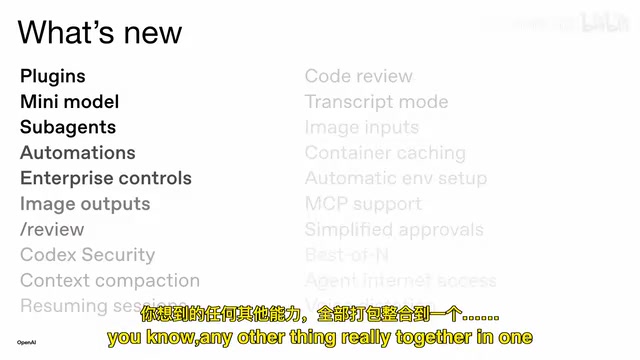
Codex's model iteration roadmap has been aggressive:
- GPT 5.2 → GPT 5.2 Codex → GPT 5.3 Codex → GPT 5.3 Codex Spark (with Cerebras) → GPT 5.4
- Also released GPT 5.4 Mini and GPT 5.4 Nano, for short tasks and Sub Agents respectively
Performance improvements are substantial:
- Introduction of WebSockets delivering approximately 1.75x token processing speed improvement
- Fast Mode doubles that again
So the old speed was intentionally slow?
User data tells the story even better: Codex has surpassed 3 million weekly active users, growing over 3x since January this year. That growth curve would make any SaaS founder weep. Then again, when your product can write code for people, it'd be weird if user growth wasn't explosive.
Codex App: The Perfect Colleague You've Always Dreamed Of
Core capabilities of the Codex App include:
- Cross-project work and parallel multi-feature development within the same project
- Native Git Work Tree support—finally no more jumping between ten branches; only programmers understand the pain of context switching
- Automations (similar to cron jobs)—essentially giving AI an alarm clock: when the time comes, get to work
- Native Windows support, including a native Windows sandbox (claimed to be an industry first)—Windows users are finally no longer second-class citizens
Recently released features in chronological order include: Plugins, Mini Models, Code Review, Security, and more. Each one deserves its own deep dive.
Plugins System: LEGO Bricks Meet Enterprise Middleware
Codex's Plugins system bundles three things into reusable workflows:
| Component | Purpose | Example |
|---|---|---|
| Skills | Reusable instruction packages | Auto-created to avoid repetitive operations |
| Apps | Connect third-party services | Notion, Linear, Google Drive |
| MCP Servers | External tool extensions | Expose external system capabilities to Codex |
The best part is that Skills can be auto-created by Codex—AI writing its own instruction manual. What level of self-management is this? You can use officially provided plugins or create custom ones. It feels like Codex is quietly turning itself into the super-portal for all SaaS products.
Automations: The Personal Assistant You Always Wanted But Could Never Afford
Automations was one of the most exciting features covered in the masterclass. Check out these real use cases:
- Slack auto-categorization: Every morning at 9 AM, automatically checks Slack messages and categorizes them by urgency
- Gmail automation: Filters emails that need replies, assesses time-sensitivity and legitimacy—finally someone to filter out those "Congratulations, you've won five million dollars" emails
- Conversational creation supported: Just tell Codex what automation you want, and it handles the configuration
- You can set run frequency, associate projects, and connect various Apps and Plugins
Presenter Katia said this feature saves her several hours every day. I believe it, because just dealing with unread Slack messages is already a full-time job.
Live Demos: 57 Files Synced in 2 Minutes, A Game Built From Scratch in 1 Hour
Two demos during the masterclass absolutely electrified the room.
Google Drive Data Sync
Using the Google Drive plugin, Codex read 57 YAML event files from a codebase and automatically updated them into a Google Sheets spreadsheet. Total time: 2 minutes. Doing this manually would take me about 2 hours plus 3 cups of coffee.
Platform Jumping Game Development
This one was truly mind-blowing. Using the Games Studio plugin (which includes Image Gen and Playwright Interactive skills), with just a single prompt—"make a brick platform jumping game":
- Image Gen automatically generates game sprites and visual assets
- Playwright Interactive serves as a headless browser letting Codex visually debug
- A complete game built from scratch in about 1 hour
This isn't assisted coding anymore—this is AI launching its own startup. Indie game developers watching this probably had mixed feelings.
Code Review: Everyone Is Equal Before AI
Codex Code Review is considered one of the best code review tools in the industry. Core capabilities include:
- Automatically reviews every PR on GitHub, tagging issues by P0/P1/P2 priority
- Reviews don't just look at the diff—they analyze the entire repository context to identify second-order effects
- Can be triggered via the
/reviewcommand in CLI or App
A key detail: 100% of PRs at OpenAI (including Greg's) are reviewed by Codex Code Review by default. What does this mean? It means everyone is equal before AI—no matter whose code it is, it has to pass the machine's inspection. After all, AI won't rush through an approval just because it's almost quitting time.
The most impressive move? They also released a Claude Code plugin—letting competitors' users use their review service. That's some serious business-level magnanimity.
Sub Agents: One Person Doing the Work of a Whole Team
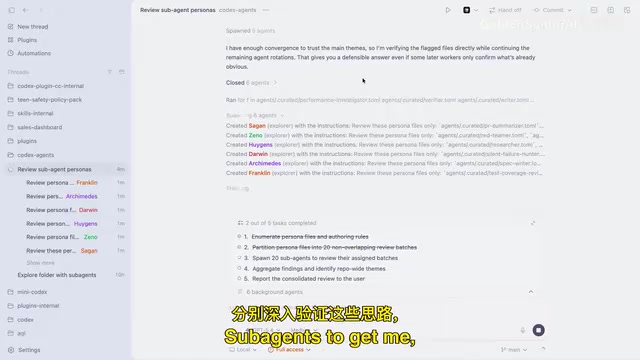
The Sub Agents system is one of Codex's most powerful capabilities. It can decompose main tasks into parallelizable independent subtasks and assign them to multiple Agents for simultaneous execution.
In the demo, 20 Sub Agents reviewed 45 Agent persona files in parallel, with the system automatically enabling Plan Mode to decompose into 5 subtasks.
Three default Sub Agent personalities are provided—basically RPG class specializations:
| Personality Type | Role | Use Case |
|---|---|---|
| Default | General-purpose | Routine tasks |
| Worker | Execution-oriented | Well-defined implementation tasks |
| Explorer | Exploration-oriented | Research, analysis, solution exploration |
Each Sub Agent can also be customized with its own model, reasoning intensity, sandbox mode (read-write/read-only), MCP access configuration (e.g., Sentry, Linear), and Skills. The configuration freedom rivals building a custom PC.
Even more impressive: you can have Codex analyze historical sessions and automatically recommend creating Sub Agents. AI is learning to replicate itself—this plot development is getting a bit cyberpunk.
Practical use cases include: cybersecurity vulnerability analysis, feature brainstorming, test execution, and more.
Cutting-Edge Experimental Features: Garden Approvals & Hooks
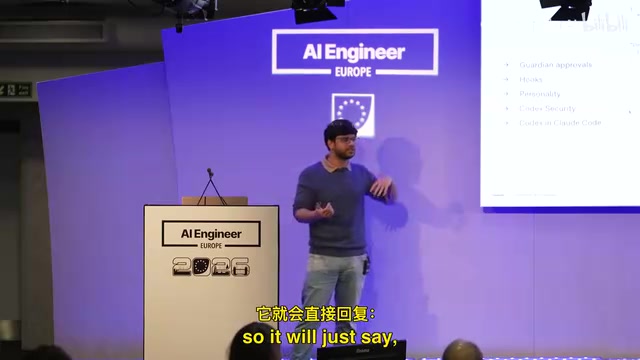
Garden Approvals: Using AI to Supervise AI
The YOLO mode name is refreshingly honest—it really is "You Only Live Once," because giving AI full permissions might mean your server only lives once too.
Garden Approvals offers an elegant solution: when Codex needs to perform privileged operations (deleting directories, starting servers, exposing files), it automatically spins up a Sub Agent to verify the operation's safety. In most cases, no human intervention is needed, effectively reducing approval fatigue.
Essentially, it's the AI world's answer to "who watches the watchmen?"—the answer being: another watchman. Nested-doll security architecture, but it actually works.
Hooks System
Three types of Hooks are supported, implemented via hooks.json configuration files and Python scripts:
- Start Hook: Automatically pulls latest code from GitHub at session start
- Per Tool Use Hook: Logs every tool usage for research and documentation
- Stop Hook: When a long task ends, automatically tells Codex to continue to the next round
Combined, these three Hooks basically create a "perpetual motion machine" mode for AI. The Stop Hook makes Codex automatically start the next round after task completion—isn't that just a humanoid version of a while True loop? In terms of AI workload, this is beyond 996—it's straight-up 24/7.
Other Features Worth Noting
- Personality customization: Set a friendly or pragmatic personality—finally, you can choose whether AI gently tells you your code has bugs, or just slaps you with the truth
- Codex Security: Scans and fixes GitHub project vulnerabilities commit by commit, letting security teams finally get some sleep
- Cloud Agent support: Switch from local to cloud execution, supporting Best-of-N parallel runs—let multiple AIs race and pick the best result. Simple, crude, but effective
- Session data is stored in the
.codex/.sessionsfolder and can be scanned and analyzed by Codex for optimization
Currently, cloud tasks don't support Sub Agents or local Skills execution (for security reasons), but they're already on the roadmap. Seems like OpenAI also knows what it would look like to let a swarm of AIs run free in the cloud.
Final Thoughts
Codex isn't just helping you write code anymore—it's helping you run a company. And the only thing you need to do is make sure you still remember your password.
From Plugins to Automations, from Sub Agents to Garden Approvals, OpenAI Codex is evolving from a coding tool into a comprehensive software engineering operating system. Three million weekly active users is just the beginning. When all these cutting-edge features stabilize and ship, the way software development works will be fundamentally redefined.
This article is based on the OpenAI Codex Masterclass video content, presented by Vaibhav Srivastav and Katia Gil Guzman.
Related articles
Deep Dive into AI Agent Skill Design: …
Deep Dive into AI Agent Skill Design: Engineering Practices from Anthropic and Perplexity
A deep dive into Skill design philosophy from Anthropic's Claude Code team and Perplexity's Agent team, covering the Tax Test, Gotchas Flywheel, progressive disclosure, and Eval-First practices for building high-quality AI Agent skill systems.
Deep Dive into OpenAI's Official GPT-5…
Deep Dive into OpenAI's Official GPT-5.6 Prompting Guide: The Shift from Manual to Automatic
A deep dive into OpenAI's official GPT-5.6 Sol prompting guide: conciseness-first, outcome-oriented design, autonomy boundaries, tool routing, and reasoning intensity tuning.
 Deep Dives
Deep Dive into How OpenClaw (Open-Source Crayfish) AI Agent Works
Deep analysis of OpenClaw AI Agent internals: System Prompt, tool calling, SubAgents, Skill system, memory, and Context Engineering explained.