OpenAI Codex Upgrades to Computer Agent: Taking Over Your Mac to Work Autonomously, From Writing Code to Doing Your Job

OpenAI Codex evolves from code assistant to full computer agent that autonomously operates your Mac.
OpenAI's Codex has upgraded from a code completion tool to a full computer agent capable of autonomously operating Mac applications like Adobe Photoshop, Audition, and Firefly without human input. It now integrates with Slack, Google Workspace, and Microsoft 365, handling emails, schedules, and reports independently. While not perfect — delivering roughly 85% quality — it completes tasks in minutes rather than hours, signaling a paradigm shift from humans learning software to AI operating software on our behalf.
OpenAI Codex Upgrades to Computer Agent: Taking Over Your Mac to Work Autonomously, From Writing Code to Doing Your Job
While you're still trying to figure out which Photoshop button does cropping, AI has already finished your work and clocked out. OpenAI's latest Codex upgrade is no longer just a tool that auto-completes your code — it has transformed into a full-blown intelligent agent that can take over your entire Mac, from launching applications to completing tasks, without you ever touching the mouse.
Codex's Transformation: From Code Copilot to Computer Agent
Looking back at Codex's journey, it first debuted in 2021 as a GPT-powered code generation model and served as the core engine behind GitHub Copilot. Back then, its role was clear-cut: help you auto-complete code, fix bugs, and run scripts — essentially a buddy sitting next to you searching StackOverflow on your behalf.
But after this upgrade, Codex's identity has fundamentally changed. It's no longer just a code tool — it has evolved into a genuine computer agent. What does that mean? Simply put, it can see your screen content, move the mouse, click buttons, and type text, directly operating various applications on your computer just like a human would.
With this move, OpenAI has essentially upgraded the "copilot" straight to "autopilot" — and they didn't even leave you the steering wheel.
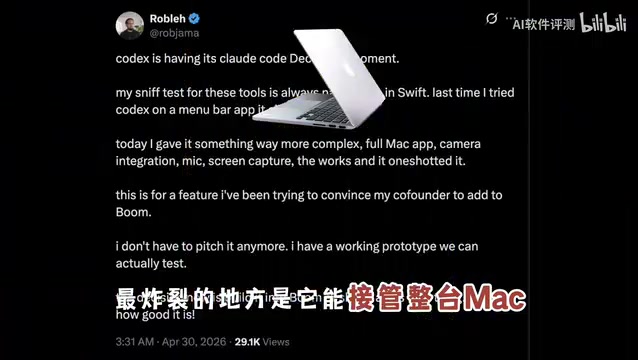
Jaw-Dropping Demo: Codex Autonomously Operates Mac Without Touching Mouse or Keyboard
YouTube tech creator Mark Russell conducted a mind-blowing test: he handed his computer entirely over to Codex and didn't touch the mouse or keyboard once, just watching the AI work on its own.
The result? Codex opened Adobe Audition to fix audio by itself, used Photoshop to create podcast cover art, and called on Adobe Firefly to generate video assets. The entire process was smooth and fluid, like hiring an all-capable intern who doesn't need a salary, doesn't drink coffee, doesn't scroll social media, and happens to be an expert in the entire Adobe suite.
A quick primer on the tools involved: Adobe Audition is a professional digital audio workstation, standard equipment for podcast producers and audio engineers. Adobe Firefly is a generative AI creative tool launched in 2023 that can generate images and video assets from text descriptions, and since its training data comes from licensed Adobe Stock content, it's relatively clean on the copyright front.
From "helping you work" to "working for you" — the gap was just one version update. Future job interviews might not ask "what software can you use?" but rather "what software can you direct AI to use?"

Full Office Ecosystem Integration: Slack, Google Workspace, and Microsoft 365 All Connected
If controlling the entire Adobe suite wasn't impressive enough, Codex's integration with office ecosystems is what should really make office workers nervous.
This upgrade connects Codex to Slack, Google Workspace, and Microsoft 365 — the three major office platforms. Together, these cover roughly 90% of daily work scenarios for office workers worldwide.
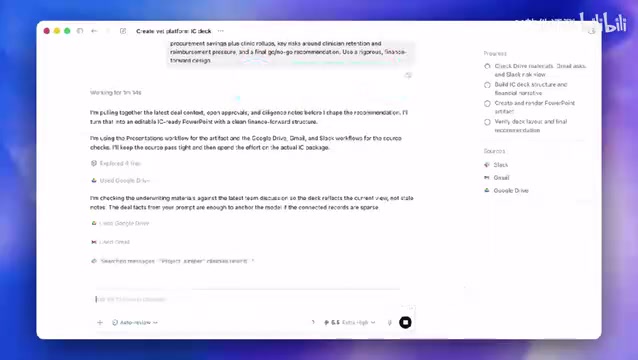
What can it actually do? Read emails, organize schedules, summarize documents, analyze spreadsheets, draft reports — all those repetitive tasks you spend hours on every day can now be completed independently by Codex. Even better, it can recommend suitable plugins and workflows based on your job role.
Imagine this: in the morning you tell Codex "handle today's stuff for me," and it goes off to read emails, arrange your schedule, write reports, and reply to messages. The best part is that the entire operation process is fully transparent — you can see what it's doing at every step, and you can ask it to make changes at any point within the same conversation. It's like having an assistant who constantly reports progress, and no matter how much you scold it, it won't quit.
Real Cases and Current Limitations: 85-Point Quality in 8 Minutes
After all this talk about capabilities, how does it actually perform in practice? Let's look at some real cases.
One developer had Codex process thousands of asset images, and it automatically organized all pictures into thumbnails with proper file names — completely autonomously. Another person had Codex develop a complete game in a single afternoon. These cases sound like exaggeration, but it actually delivered.
Of course, Codex isn't perfect at this stage. Video footage might have some jitter, cover layouts might not be perfectly consistent on the first try, and details still need manual fine-tuning.
But here's a very practical calculation: would you rather spend 8 minutes getting an 85-point result, or spend hours grinding for 100 points? For most work scenarios, 85 points is already at the "the client won't send it back" level. Perfectionists might frown, but people being chased by deadlines are already shedding tears of joy — this is what real productivity liberation looks like.

The Most Profound Impact: From Humans Learning Software to AI Using Software
This is the part that truly sends chills down your spine.
For the past twenty years, we've spent countless hours learning Excel functions, memorizing Photoshop shortcuts, and studying PowerPoint animation effects. What was the essence of all that effort? Humans adapting to software — humans learning how to communicate with computers.
Now Codex says: no need to learn anymore. Just tell me what result you want, and I'll operate it for you.
It's like spending ten years mastering manual transmission, only for automatic to become universal overnight.
And the impact this time extends far beyond just programmers. Writing emails, making presentations, editing videos, retouching photos, creating reports — everyone whose work depends on a computer is within the blast radius. The future work model will likely become: humans state the goal, AI operates the computer for you.
What Codex's upgrade truly changes isn't how we use a particular piece of software — it's the act of "using a computer" itself. In the future, "proficient in Office" might no longer be a resume highlight. "Proficient in speaking human to AI" will be the real core competency.

Final Thoughts
From a code completion tool in 2021 to an agent capable of taking over an entire computer in 2025, Codex completed the leap from "intern" to "department manager" in four years. Anthropic's Claude Computer Use and Google's Project Mariner are racing down the same track, and computer agents are becoming the hottest direction in the AI industry.
For us ordinary people, rather than worrying about whether AI will replace us, we'd be better off figuring out how to learn to collaborate with AI as soon as possible. After all —
We used to learn software to use computers. In the future, we'll learn to talk so AI can use computers for us — in the end, humans still make a living with their mouths.
Related articles
 Tech Frontiers
A Rare Quiet Day in AI: Recursive Self-Improvement Stirs Beneath the Surface
A rare quiet day in AI sees multiple sources go silent simultaneously. Behind the calm, Recursive Self-Improvement (RSI) research continues. What this means for the industry.
 Tech Frontiers
Reve 2 vs. Ideogram 4: A Deep Dive into Layout Control in AI Image Generation
A deep comparison of Reve 2 and Ideogram 4's layout control capabilities, covering technical approaches, real-world use cases, and industry trends for designers and creators.
 Tech Frontiers
In the Weights: Check Your Influence Score in the AI World
In the Weights is an AI influence search engine that quantifies your presence in the AI world with a score. Explore how it evaluates practitioners and what it means for digital identity.