OpenAI Connectors Failures: Why Do Third-Party Integrations Keep Breaking?

OpenAI reports elevated Connectors error rates, exposing the structural fragility and insufficient disclosure of AI platforms' third-party integration layer.
At 03:50 UTC on October 22, OpenAI's status page reported elevated error rates in Connectors and said it was investigating, but did not disclose the specific affected connectors or the root cause. The article notes that Connectors' request path spans the inference layer, connector gateway, OAuth authorization layer, and third-party APIs, where any rate limiting, timeout, or token expiration appears as user-side errors. In agent-style workflows, such errors are amplified by retries, adding token costs and result deviations. It also notes insufficient disclosure granularity on OpenAI's status page and recommends degradation strategies, application-side error monitoring, and OAuth token rotation.
Incident Recap: A Sudden Spike in Connectors Error Rates
According to the official OpenAI status page (03:50 UTC, October 22), the platform is investigating elevated error rates affecting Connectors. The status page update reads: "We are investigating elevated errors affecting connectors. We will provide an update as soon as possible."
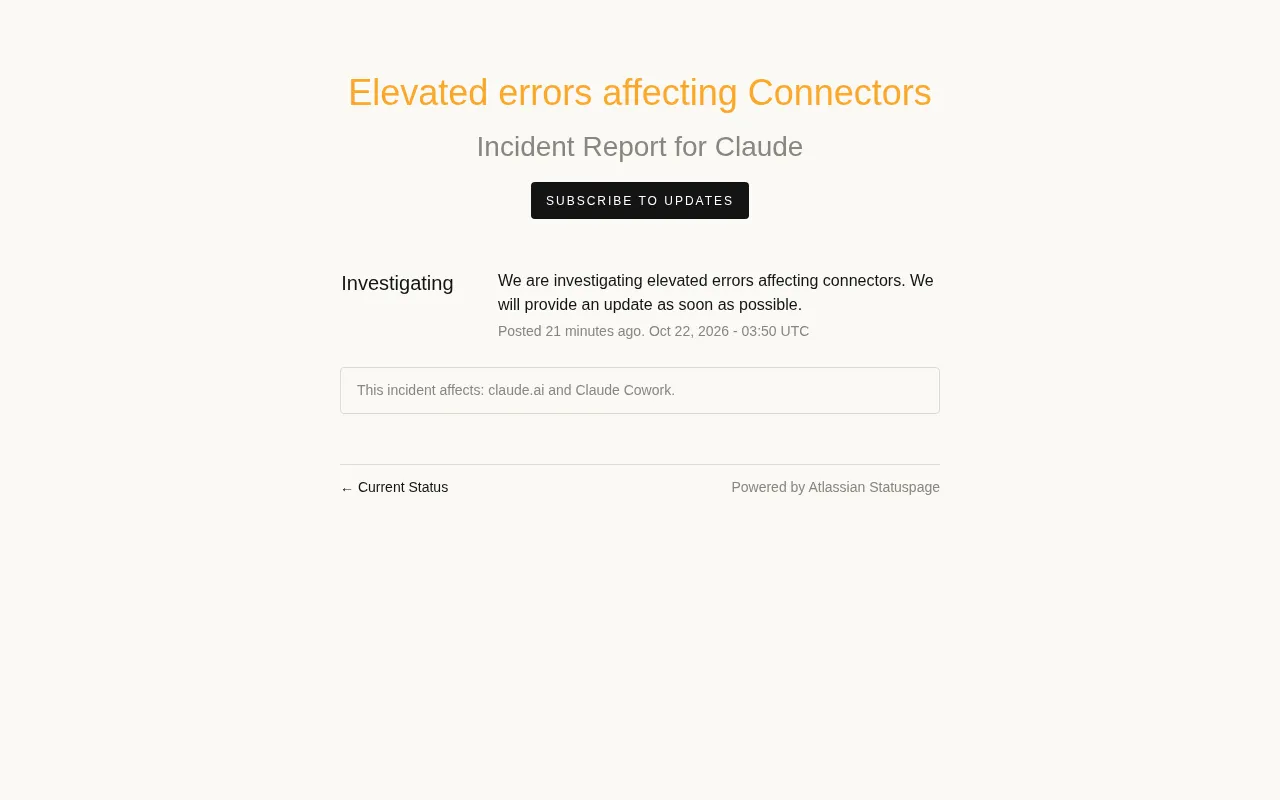
This brief announcement confirms a recurring phenomenon: Connectors, which serve as the bridge in the OpenAI ecosystem to third-party applications (such as Google Drive, Slack, GitHub, and others), have stability problems that are far from isolated. Judging from the status page's wording "elevated errors," this is not a complete outage but a significant rise in the failure rate of some requests—a type of failure that is often more insidious for teams relying on automated workflows.
What Exactly Do Connectors Connect?
Connectors are the integration framework OpenAI provides for products like ChatGPT, allowing models to access external data sources and tools. Enterprise users use it to connect internal document repositories, code repositories, and project management tools to the chat interface, enabling "reading and operating business data directly in the chat."
The complexity of this architecture determines its fragility: a single request must traverse OpenAI's inference layer, the connector gateway, the OAuth authorization layer, and the third-party service's API. Any rate limiting, timeout, or token expiration in any of these links will manifest on the user side as "the connector is unavailable." The fact that the status page only generically labels it "connectors" precisely indicates that fault localization requires cross-system investigation.
The OAuth 2.0 authorization framework is key background for understanding the fragility of Connectors. OAuth is an open-standard authorization protocol that allows third-party applications to obtain limited access to a user's resources without exposing the user's password. In the Connectors scenario, when an enterprise user connects Google Drive, Slack, or GitHub to ChatGPT, what actually happens is the OAuth "authorization code" flow: OpenAI, as the client, requests authorization from the third-party service, which returns an access token and a refresh token. Access tokens usually have a short lifespan (tens of minutes to several hours), and once expired, the refresh token must be used to obtain a new token. Once the refresh mechanism fails, the token is manually revoked by the user, or the third-party service changes its scope requirements, the connector will immediately report an error. This is also why the article lists "OAuth authorization rotation" as a common cause of failure—many seemingly server-side problems are rooted in token lifecycle management.
SLA (Service Level Agreement) is also worth explaining. An SLA is a service provider's formal commitment to metrics such as availability and response time; for example, "99.9% monthly availability" means about 43 minutes of downtime allowed per month. Connectors themselves do not directly promise an end-to-end SLA; instead, they inherit the SLAs of the third-party services they depend on. When a third-party API itself falls below its committed level or adjusts its rate limit policy, OpenAI can only adapt passively. This explains a structural fact: the theoretical upper limit of connector availability equals the product of the availability of all dependencies in the chain—the more dependencies, the lower the overall reliability.
The Stability Dilemma of Third-Party Integrations
Single Points of Risk in the Dependency Chain
Connectors' stability is inherently constrained by third-party API SLAs. When Google Drive or Slack adjusts its rate limiting policy, OpenAI's adaptation layer must be updated accordingly. This rise in error rates occurred in the early morning UTC hours and may be related to third-party service maintenance windows or regional network fluctuations—but the official root cause has not yet been disclosed.
The Amplifying Effect of Error Propagation
In agent-style workflows, connector errors are amplified. For example, in a process that automatically organizes meeting notes, if the connector reading the calendar intermittently fails, the model may repeatedly retry and consume extra tokens, so that users perceive not only unavailable functionality but also abnormal costs. Such composite failures appear on the status page as only a single line of "elevated errors," with clearly insufficient information granularity.
The key difference between agent-style workflows and ordinary conversations lies in their autonomy and multi-step execution. In agent mode, once a model is given a goal, it autonomously plans steps, calls tools, observes results, and decides the next step, forming a "think—act—observe" loop. This means a single task may trigger dozens of tool calls. When a connector intermittently fails, the agent usually does not silently give up but calls again according to preset retry logic—each retry is a new model inference, consuming tokens and introducing latency. More troublesome is that failure information may be misinterpreted by the model as "data does not exist" rather than "request failed," leading it to continue based on incomplete information and produce erroneous conclusions. Therefore, connector stability in agent scenarios is not only about availability but is also directly tied to cost control and correctness of results—which is the fundamental reason enterprises need application-side independent monitoring of failure rates rather than relying solely on the official status page.
Repetition of Historical Patterns
OpenAI's status page has seen multiple Connectors-related incidents in the past, with highly similar patterns: first "Investigating," then updated to "Identified" or "Resolved" several hours later, without publishing the list of specific affected connectors. For enterprise operations teams, this ambiguity means they cannot quickly determine whether their own workflows are within the affected scope and can only wait passively.
Practical Impact on Developers and Enterprises
Teams building internal tools on Connectors should incorporate such incidents into their architecture design considerations:
- Degradation strategy: Configure backup data sources or caching layers for critical connectors to avoid single points of failure directly blocking business processes.
- Error monitoring: Record connector call failure rates on the application side and cross-check them against the official status page rather than relying entirely on official notifications.
- Authorization rotation: OAuth token expiration is a common cause of connector errors; regular rotation and monitoring of token health can reduce non-server-side failures.
For individual users, when encountering connector errors, first check the authorization status of the third-party service and the official status page before deciding whether to rebuild the connection—blindly deleting and reconnecting may trigger additional authorization flow issues.
Conclusion: The Need for Transparency Beyond the Status Page
This incident itself provides limited information, but the structural problems it exposes deserve attention: when AI platforms extend their capability boundaries into third-party ecosystems, the costs of fault attribution and communication rise accordingly. A single line of "elevated errors" is enough for ordinary users but far from enough for enterprise operations. The reliability of Connectors ultimately depends on whether OpenAI can provide more fine-grained fault disclosure beyond the status page, and whether developers are willing to design sufficient redundancy for the integration layer.
One-line Summary
OpenAI reports elevated Connectors error rates, exposing the structural fragility and insufficient disclosure of AI platforms' third-party integration layer.
Paragraph Summary
At 03:50 UTC on October 22, OpenAI's status page reported elevated error rates in Connectors and said it was investigating, but did not disclose the specific affected connectors or the root cause. The article notes that Connectors, as an integration framework connecting third-party applications such as Google Drive, Slack, and GitHub, have a request path spanning the inference layer, connector gateway, OAuth authorization layer, and third-party APIs; rate limiting, timeouts, or token expiration in any link will manifest as user-side errors. In agent-style workflows, such errors are amplified by retry mechanisms, bringing extra token costs and result deviations. The article also points out that OpenAI's status page has historically provided insufficient disclosure granularity, making it difficult for enterprise operations to determine the scope of impact, and recommends that teams configure degradation strategies, application-side error monitoring, and OAuth token rotation.
Related articles

AgentCore in Practice: Connecting Custom Tools and MCP Servers to Agents
DebuggerCafe tutorial shows how to connect custom tools and MCP servers to Amazon Bedrock AgentCore agents, covering tool contract design, MCP reuse, and production concerns.

816B Parameters Scores Only 39? The Real Cost-Effectiveness of the Open-Source LLM Parameter Race
Meta's 816B Muse Spark Open scores just 39 on Artificial Analysis, while 180B Qwen3.8-Flash-Next scores 40. This article analyzes 11 open-weight models' parameters vs. scores, exploring the real impact of activated parameters, quantized size, and deployment cost.

Aerial Manipulators: The Next Step for Drones from 'Seeing' to 'Changing'
Starting from a Reddit discussion, this article analyzes the technical challenges, potential applications, and deployment bottlenecks of aerial manipulators, exploring the key challenges for drones moving from environmental perception to physical manipulation.