OpenAI Dev Day Full Breakdown: DOT Assistant, UltraFast, and GPT 6.1 Sol Take the Stage

OpenAI Dev Day unveiled DOT assistant, UltraFast inference, GPT 6.1 Sol, and Codex cloud hosting.
OpenAI Dev Day delivered a dense wave of announcements. Personal assistant DOT offers always-on proactive help via cloud agents connected to Gmail and calendars, embedded in Slack and Teams. On the inference side, Cerebras-powered UltraFast makes GPT-6 Astra roughly 8x faster with a $500/month Pro plan, while GPT 6.1 Sol delivers near-flagship performance at roughly one-fifth the price — evidence that both OpenAI and Anthropic have mastered post-training distillation. Developer updates include cloud-native Codex, a security scanner, voice CLI, and a Decisions API. Plugins returned with token portability, and ChatGPT Space offers a native Notion-like collaborative workspace.
OpenAI's Dev Day dropped a rapid-fire series of major announcements — from a personal AI assistant to an ultra-high-speed inference model to a new model that's cheaper yet nearly matches flagship performance. Based on a firsthand account from a YouTube creator who attended in person, this article breaks down the most noteworthy highlights from the event and the industry trends they signal.
DOT: Your Always-On Personal AI Assistant
The most talked-about announcement was undoubtedly DOT — OpenAI's new entry into the personal assistant space, going head-to-head with the likes of Grokbot, Muse, and Instinct. The creator noted that this entire generation of products draws its inspiration from OpenClawAd, which essentially set the tone for the whole category.
DOT's core philosophy is "always on": it works for you 24/7 with a strong emphasis on proactivity. Rather than a passive tool where you open ChatGPT, type a prompt, and wait for a response, DOT anticipates your needs and handles things before you even realize you need them. It's also highly accessible — beyond ChatGPT, it integrates with Slack and Teams, showing up wherever you need it.
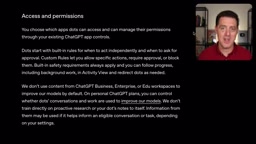
One interesting observation: this generation of personal assistants seems to be converging on the same design language — some kind of soft geometric shape with a pair of eyes. Grokbot and DOT look strikingly similar, much like how nearly every product started mimicking ChatGPT's interface after it launched.
Under the hood, DOT is built on a cluster of cloud-hosted agents with their own runtime environment. Connect your Gmail, Google Docs, calendar, and other personal accounts, and it can access and act on them on your behalf. The creator believes these "simplified" products could shift public perception of AI — unlike Codex or ChatGPT, there's no learning curve. It feels more like talking to a genuinely capable assistant, which could convert far more people into everyday AI users.
The Architectural Trade-off
That said, the creator was candid about not fully agreeing with DOT's implementation approach. DOT essentially "lives inside" ChatGPT, directly controlling your ChatGPT and Codex threads — a notably different approach from Muse or Grokbot. He would have preferred DOT as a standalone app. The reason it's built this way is understandable: to give it computer use capabilities, code execution, and an independent runtime, OpenAI built it on top of Codex and ChatGPT.
One billing detail worth noting: conversations with DOT itself don't count against your ChatGPT usage, but once DOT starts controlling your ChatGPT or Codex threads, that activity does count toward consumption.
A quick note on terminology: In AI contexts, an "agent" refers to a program that can autonomously plan, call tools, and execute multi-step tasks — as opposed to a single-turn language model call. DOT being built on cloud agents means it can run continuously, maintain state, call external APIs (like Gmail or your calendar), and advance tasks without supervision. "Computer use" is a key capability expansion for recent AI assistants, allowing models to directly control browsers, desktop apps, and terminals rather than just outputting text. DOT being "built on Codex and ChatGPT" lets it reuse existing computer use and code execution infrastructure — efficient from an engineering standpoint, but at the cost of the independence the creator criticized.
UltraFast and GPT 6.1 Sol: Two Routes — Speed vs. Value
UltraFast was one of the creator's most personally exciting announcements. It's essentially GPT-6 Astra powered by Cerebras chips, running roughly 8x faster than on NVIDIA GPUs — but at a steep price. It costs 6x more, and it burns through tokens at a ferocious rate. The creator mentioned that after getting early access, he spent $1,000 in just an hour and a half.

Alongside UltraFast, OpenAI introduced a new Pro 500 plan at $500/month. On the surface, this seems to contradict the narrative that "AI is getting cheaper." The creator offered a sharp explanation: the cost per token at equivalent intelligence levels is indeed falling continuously (what once cost tens of dollars per million tokens now costs just cents), but if you're chasing the absolute frontier — whether in speed or peak quality — you will inevitably pay more. In other words, intelligence itself is getting cheaper, but the premium for the cutting edge remains.
As for the actual value of Pro 500, the creator ran the numbers: it offers 25x the usage of Plus, while the existing $200 plan was quietly downgraded from 20x to 10x. That means you're paying more for diminishing incremental returns.
GPT 6.1 Sol: Perhaps the Most Impressive Announcement of the Day
If UltraFast is the "ultimate speed" play, GPT 6.1 Sol is the "ultimate value" play. It's cheap, fast, and efficient — and its performance nearly matches the absolute frontier.
The creator drew a direct parallel to Anthropic's strategy: Anthropic first released Opus 5.5 (the current consensus top model), then followed up with Sonnet 5.5 — nearly matching Opus in performance at half the price. OpenAI is now running the same playbook with GPT 6.1 Sol.
The pricing comparison is striking:
- GPT 6 Astra: $10/million input tokens, $50/million output tokens
- GPT 6.1 Sol: ~$2/million input tokens, ~$10/million output tokens, cached input as low as $0.10
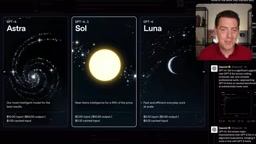
From the benchmarks the creator shared, on the leaderboard he considers most reflective of real developer experience, 6.1 Sol has matched or even slightly surpassed Astra — at a fraction of the price. On PDF-related benchmarks (GDP PDF), Sol similarly approaches Astra's performance. On OS World, which measures computer operation capability, Sol performs strongly at higher "thinking" settings, only falling slightly behind Astra at the very top.
This led the creator to a key insight: OpenAI and Anthropic have essentially solved "post-training" at nearly the same moment. They first train massive models like Fable and Astra, then distill them into smaller versions with almost no performance degradation — cheaper inference, faster responses, and a win for everyone.
On the technical side: Cerebras is an AI inference acceleration chip company whose flagship product, the Wafer-Scale Engine, turns an entire silicon wafer into a single processor with far greater on-chip memory bandwidth than traditional GPU clusters. This gives it a pronounced speed advantage in autoregressive language model inference — where the bottleneck is typically memory bandwidth rather than raw compute. NVIDIA GPUs are unmatched for parallel training, but in inference scenarios, specialized chips' memory bandwidth advantages can translate to several-fold or even tens-of-fold throughput gains. UltraFast's "8x faster" claim is a direct result of this architectural difference, at the cost of significantly higher per-unit compute expenses.
"Post-training" refers to the suite of processes — supervised fine-tuning (SFT), reinforcement learning from human feedback (RLHF), and newer RL-based reasoning optimization — applied after large-scale pretraining to make models more precise and better aligned with human intent. "Distillation" (knowledge distillation) involves training a smaller "student" model using the output distributions of a larger "teacher" model, allowing the student to approach the teacher's reasoning quality at a fraction of the parameter count. The creator's claim that "post-training is basically solved" means both OpenAI and Anthropic have mastered a mature pipeline: train a high-ceiling flagship model, then distill it into a smaller, cheaper-to-run version with minimal performance loss — GPT 6.1 Sol vs. GPT 6 Astra, and Sonnet 5.5 vs. Opus 5.5, are both textbook examples of this approach.
Codex Goes Native to the Cloud and Developer Toolchain Upgrades
There was no shortage of developer-focused updates either.
Codex Security Cloud is exactly what it sounds like — an AI service that continuously scans your code for vulnerabilities and security issues, providing non-stop alerts about potential risks.
More significantly, Codex is now natively cloud-hosted. The creator was unambiguous about his take: code should run in the cloud; it shouldn't require your local laptop to stay open. He also shared an amusing observation — once UltraFast mode is enabled, the actual inference speed is so extreme that the local machine becomes the bottleneck. Tool calls and terminal command execution lag become painfully obvious. UltraFast essentially exposed the fact that local compute was always the weak link.
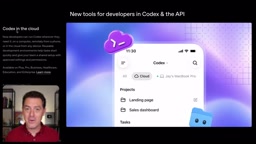
Other developer updates include:
- A brand-new CLI: with voice control support
- Redesigned Codex code review experience: an entirely new code review workflow
- Decisions API preview: a model purpose-built for rapid decision-making, based on the lightweight Luna model. The creator noted that while the concept targets the same space as Jev, Jev — being built from the ground up for decisions — may still hold a speed edge. Adapting an existing model like Sol for this purpose may not close that gap.
Plugins Return and ChatGPT Space
OpenAI also relaunched plugins. Two Dev Days ago, this feature was widely written off as "apps are dead," and the experience at the time genuinely wasn't great. This time around, apps can be natively embedded in the ChatGPT experience, with support for "Sign in with ChatGPT" for third-party services.
A notably generous design choice is token portability: if you already have a ChatGPT subscription, you can log into third-party apps without needing a separate subscription or purchasing additional tokens — your existing quota travels with you. The creator found this particularly clever, noting it "doesn't look like something Anthropic would do."
Rounding out the event was ChatGPT Space, which the creator called his most anticipated feature of the entire show. Think of it as a native Notion: you, your team, and various agents can all collaborate in the same workspace, with everything from presentations and spreadsheets to websites living inside this new shared environment.
Closing Thoughts
This Dev Day was extraordinarily information-dense, but the throughline was clear: DOT aims to bring AI to a much broader mainstream audience; UltraFast and GPT 6.1 Sol represent two distinct bets — absolute speed vs. maximum value; and Codex going cloud-native reshapes how developers work. Whether it's the pricing philosophy of "intelligence gets cheaper, but the frontier still commands a premium," or the technical read that "post-training is essentially solved," both are trends worth watching closely.
Note: This article is based on the firsthand account of a single YouTube creator. Product names, model versions, and pricing mentioned reflect what was described in the video — please refer to official OpenAI announcements for authoritative details.
Related articles

Should U.S. College Fraternities Be Banned? A Researcher's Incisive Observations
Why not just ban U.S. college fraternities? A researcher finds the key resistance comes from decision-makers' own fraternity identities and schools' "willful ignorance."

Microsoft Discovery: Accelerating Scientific Discovery with AI Agents
Microsoft's Discovery platform runs specialized AI agents to help researchers screen and prioritize the most promising compounds and experimental paths, reducing experiments and accelerating scientific discovery.

Cambridge Heavy Industries Secretly Develops Desktop-Scale Nuclear Fusion Device
Cambridge Heavy Industries is secretly developing a desktop-scale laser-driven nuclear fusion device, targeting the equipment supply market for fusion power plants. This article analyzes its miniaturization technology path, commercialization logic, and unique positioning in the fusion startup wave.