OpenAI Endorses robots.txt Signal: A Unified Way for Websites to Express AI Training Preferences

OpenAI will honor a shared robots.txt signal, standardizing how websites express AI training preferences.
OpenAI announced it will support a shared robots.txt signal to identify website operators' AI training preferences, creating a clearer, more scalable channel between content providers and model trainers. robots.txt, long the classic protocol for search crawlers, is now being extended to declare whether content may be used for AI training. Backed by multiple participating providers, the mechanism lets sites express preferences at low cost with a single declaration—no technical integration or site-by-site negotiation. However, the signal is a declaration rather than a mandatory block; its effectiveness depends on voluntary compliance, and its long-term impact remains to be seen.
OpenAI recently announced that it will support a shared robots.txt signal to identify website operators' preferences regarding AI training. The move is intended to establish a clearer, more scalable communication channel between content providers and model trainers.
The Core Change: robots.txt Becomes the Entry Point for Expressing AI Training Preferences
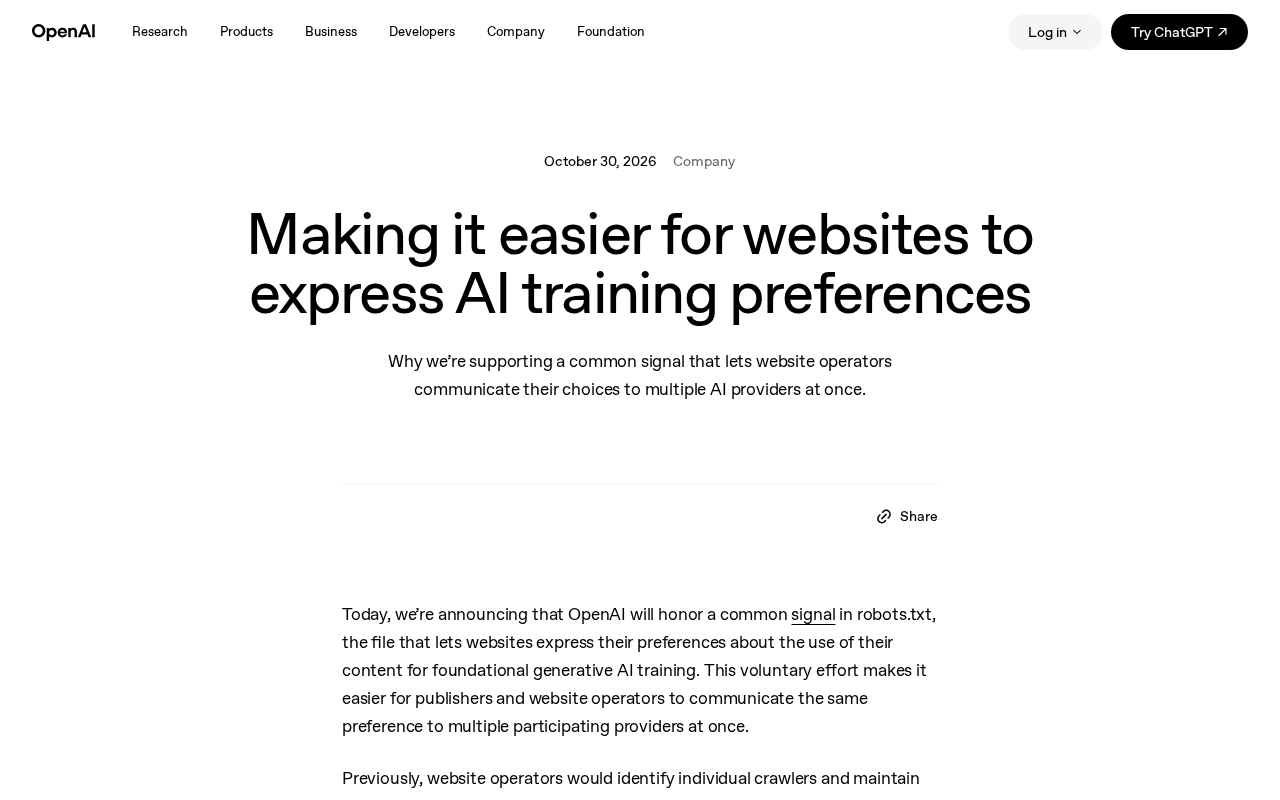
According to OpenAI, it will honor a shared robots.txt signal that helps website operators communicate their AI training preferences to providers participating in the mechanism. robots.txt has long been the classic protocol followed by search engine crawlers; now it is being given a new purpose—expressing whether content may be used for AI training.
The value of this approach lies in standardization. In the past, if a website wanted to refuse AI crawling, it often had to rely on platform-specific rules, individual negotiations, or technical blocking—costly and difficult to unify. A shared signal lets a website make a single declaration in robots.txt that any participating provider can read and honor.
OpenAI is not the only participant. Judging from the wording, this is a multi-party mechanism that emphasizes coordination among "participating providers." This means website operators' preference expressions may gain broader industry recognition, rather than being limited to a single company's crawler.
robots.txt is a plain-text file that emerged in 1994 alongside the Robots Exclusion Protocol. It is typically placed in a website's root directory so crawlers can read it before fetching content. It uses directives such as User-agent, Allow, and Disallow to declare which paths may or may not be crawled, but the protocol itself does not control whether a page is indexed or used—it is merely an industry self-regulation convention. Because the file can be publicly read by any HTTP client without encryption or authentication, it is naturally suited to serving as a shared policy entry point for multiple parties. However, traditional robots.txt syntax only describes "whether crawling is allowed" and does not express downstream uses such as "whether crawled content may be used for training"—precisely the part the shared AI training preference signal seeks to extend. Subsequent standardization efforts, including RFC 9309, also provide a compatible foundation for such extensions.
Industry Significance: Content Licensing Moves Toward Readable, Actionable Default Rules
The legality and transparency of AI training data sources have long been a point of contention. Websites want to retain control, while model developers need stable, predictable paths to data. The shared robots.txt signal attempts to find a low-friction balance between the two.
For content providers, the mechanism lowers the cost of expression: no technical integration is required—they can simply use the existing file. For AI developers, a unified signal reduces the burden of site-by-site negotiation and gives compliant crawling a clearer basis.
Of course, the robots.txt signal is essentially a "declaration" rather than a mandatory technical block. Its effectiveness depends on whether providers voluntarily comply. OpenAI has explicitly stated that it will respect the signal, but the mechanism's long-term impact will depend on how participating parties actually implement it and whether the industry reaches a broader consensus.
Before the shared robots.txt signal emerged, the more common alternatives in the industry were the "AI preferences" extension being advanced by the IETF—such as HTTP response header fields like Content-Usage—and opt-out mechanisms introduced by some platforms. Compared with these approaches, the robots.txt signal has the advantage of reusing an existing file location and read process, resulting in a low deployment barrier; its disadvantage is coarse granularity, making it hard to express permissions differentiated by purpose, time period, or model type. In addition, compliance with robots.txt is voluntary; without contractual or legal constraints, the declaration itself carries no enforcement power. As a result, such signals are usually used in combination with website terms of service, copyright notices, and data licensing agreements to form a more complete content governance framework.
Practical Impact on Website Operators
If you are responsible for website content strategy, this change is worth watching. Going forward, when formulating content usage policies, an AI training preference declaration in robots.txt may become a standard configuration—similar to today's sitemap or canonical tags.
Keep in mind that the specific syntax and fields of the signal should be based on official documentation to avoid incorrect interpretation caused by non-standard formatting. At the same time, a single signal may not cover all AI use cases, and websites may still need to combine terms of service, copyright notices, and other means to comprehensively manage content licensing.
Looking at the trend, the rules between content providers and AI trainers are moving from ambiguity toward clarity. OpenAI's statement is one step in that direction; the extent to which other participating providers follow suit will determine whether this shared signal can truly become an industry-wide common language.
On the technical implementation side, website operators need to confirm that the robots.txt encoding (usually UTF-8), directive order, and matching rules are correctly parsed by the target crawlers. Because different providers may vary in their support levels and parsing details for the same signal, it is advisable to verify after deployment through log analysis or official validation tools. If the website uses a CDN or reverse proxy, operators should also confirm that the robots.txt in the root directory is not overridden or rewritten by the caching layer. For operators with multiple domains and sub-sites, files should be maintained separately in each site's root directory to avoid the signal becoming ineffective due to inconsistent paths.
One-line Summary
OpenAI will honor a shared robots.txt signal, standardizing how websites express AI training preferences.
Paragraph Summary
OpenAI announced that it will support a shared robots.txt signal to identify website operators' preferences regarding AI training, establishing a clearer, more scalable communication channel between content providers and model trainers. robots.txt was originally the classic protocol followed by search engine crawlers; it is now being extended to declare whether content may be used for AI training. The mechanism is supported by multiple participating providers, and websites can express their preferences at low cost with a single declaration in their existing file—no technical integration or site-by-site negotiation required. However, the signal is essentially a declaration rather than a mandatory technical block; its effectiveness depends on whether providers voluntarily comply, and its long-term impact will depend on how participating parties actually implement it and whether industry consensus forms.
Related articles

Salesforce Acquires Rune for $375M: AI Logistics Tech Bolsters Defense Business
Salesforce reportedly acquires defense tech startup Rune for $375M. Rune's AI logistics tech will strengthen Salesforce's Missionforce defense platform, continuing its M&A spree.

Why Fair Use Benefits Everyone in the AI Era
Starting from a Hacker News discussion, this article analyzes the legal logic and controversies of the fair use principle in AI training and content creation, and its dual impact on creators and the tech ecosystem.

Mistral Large 4 Open-Sources a Trillion Parameters, Microsoft Offers Voluntary Severance to 60,000 Employees
Mistral Large 4 open-sources a trillion-parameter multimodal model with a coding agent score of 48; SanDisk earnings show AI inference reshaping NAND demand; Google Gemini adds in-app file editing, OpenAI raises Codex quotas, and Microsoft offers voluntary severance to 60,000 employees.