OpenAI GPT-6.2 Reportedly Cancelled, Google Gemini 4 Oxygen Leaked

OpenAI may cancel GPT-6.2 for GPT-6.5; Google opens free Gemini 4 API; Agent engineering accelerates.
This period's AI news centers on three threads. Leaks suggest OpenAI may cancel GPT-6.2 Astra for GPT-6.5, though unconfirmed; Google's Gemini 4 Oxygen checkpoint leaked, and the Hydrogen free API is open with million-token context, quota shared per project. NVIDIA open-sourced Personal AI Router to pool home compute; a Grok engineer's method turned Agent errors into code checks, merging 3,000 PRs in a month; GAIRNLP claims first recursive self-improvement at frontier-scale pretraining, while a Northwestern-Google paper auto-improves prompts and memory, lifting GLM5 from 64.2% to 75.7%. Claude Fable 5.2 Max topped Agent Arena, and Loveable had widespread database misconfigurations.
Today's AI Brief: Model Iteration and Ecosystem Shifts
According to aggregated leaks from the Bilibili AI morning news program, OpenAI's model roadmap may be undergoing a major adjustment, while Google is accelerating its Gemini 4 lineup. Meanwhile, there are noteworthy developments in the open-source community and hardware space. Here's a breakdown and analysis of the core information.
OpenAI: GPT-6.2 Astra May Be Cancelled in Favor of GPT-6.5
Multiple AI news accounts report that OpenAI may have cancelled development of GPT-6.2 Astra and is instead pushing forward with GPT-6.5. A circulating code screenshot appears to contain a migration configuration pointing "GPT-6 Astra" to "GPT-6.5 Astra." The reason for the cancellation remains speculative, and OpenAI has neither confirmed the plan nor announced a release date for a new model.
If true, this change suggests OpenAI is internally restructuring its model naming and iteration cadence. For developers and enterprise users, API stability and version migration costs are factors that need to be assessed in advance.
Meanwhile, OpenAI's Cyber team is soliciting feedback on Daybreak, covering the model, Codex plugin, access permission documentation, red team testing, and the defense factory. In the comments, users are urging new model releases, and some are asking about the progress of the $50 Pro plan—a question that received many likes, reflecting the community's keen interest in OpenAI's product cadence.
API Version Migration refers to the process by which a model provider gradually guides users from old model identifiers to new ones when releasing a new version. Common practices include: keeping the old version number in the API for a period with a deprecation date, mapping model IDs via configuration files or environment variables, and providing a compatibility layer that automatically routes old requests to the new version. For developers, the main costs of version migration include regression testing, prompt re-tuning, parsing failures caused by output format changes, and token billing differences. OpenAI has previously used a "snapshot version number" mechanism (e.g., gpt-4-0613) so users can lock in behaviorally stable models. If the migration configuration pointing "GPT-6 Astra" to "GPT-6.5 Astra" described in the article is accurate, it suggests OpenAI may be using alias mapping internally to smooth the transition—but such configurations also make it difficult for outsiders to determine whether the actual model has been swapped.
Google Gemini 4: Oxygen Leaked, Hydrogen Opens Free API
AI blogger Lumina reports that a new model checkpoint appearing on the Arena platform may be Google's next-generation Flash model, Gemini 4 Oxygen. The checkpoint was initially believed to be Gemini 4 Krypton. Lumina showed web page scenes reportedly generated by Oxygen and Hydrogen using the same prompts, with clear differences in visual detail and rendering; another user shared an interactive castle demo generated by Oxygen.
More practically, Google has opened the free API for Gemini 4 Hydrogen, aimed at everyday coding and Agent workflows, with support for million-token context. Users can create an API Key in Google AI Studio and then enter the model ID in a Gemini-compatible client. Free quota is calculated per project—multiple Keys under the same project share the quota—and rate limits can be viewed in AI Studio.

For individual developers and small teams, this free quota is a viable low-cost entry point for validating Agent workflows. Note, however, that free quota is shared per project; multiple Keys cannot bypass rate limits, so planning call frequency wisely remains key.
On subscriptions, Abenai subscriptions are about to integrate Hermes, with the message recommending Hydrogen. The JL Google AI Pro giveaway has ended, and official support confirms that users who activated before October 29 can continue using the remaining term. As for when the latest Gemini 4 will be available in Anti-Gravity, that remains unclear.
Model Checkpoint refers to a snapshot of model weights and optimizer state saved periodically during training, which can be used to resume training, roll back, or serve as a candidate release version. On public evaluation platforms like Arena, new checkpoints often appear anonymously or under code names for blind comparison by users, and the community uses these to infer upcoming model releases. Code names (such as Oxygen, Hydrogen, Krypton) are usually internal experimental names and do not have a fixed correspondence to final product names, so claims that "a checkpoint is a certain model" are inferences rather than confirmations. Free API quota calculated per project means the billing entity is the Google Cloud project rather than an individual key; multiple Keys generated under the same project share quota and rate limits—a common anti-abuse design among cloud providers.
NVIDIA Developments and Open-Source Hardware Routing
A report claims that Jensen Huang is discussing with allies a return to the NVIDIA CEO role, with an investigation still ongoing; the report also says tech executives are forming a war room to lobby NVIDIA's board and reportedly seeking White House support. Such claims currently lack official confirmation and should be treated with caution.
On the product side, NVIDIA has open-sourced Personal AI Router, which can connect Windows, Linux, and Mac computers on a home network to a unified AI inference entry point, automatically distributing requests to the machine that has the corresponding model installed and the lowest load. After downloading and installing, users can choose Aulama or LM Studio and then pair other computers using a 6-digit PIN.
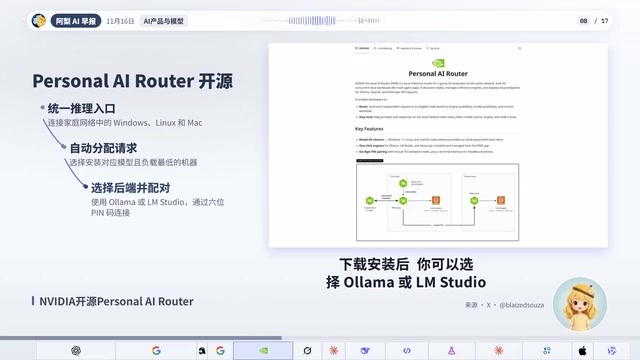
The value of this tool lies in consolidating scattered home computing power into a unified inference pool—suitable for users with multiple devices who want to run models locally. PIN pairing lowers the configuration barrier, but the actual experience still depends on model installation on each device and network latency.
Local Inference Router is a type of middleware that schedules AI requests within a LAN: it maintains an inventory of installed models and real-time load on each node, and upon receiving a request, forwards it according to a "model match + lowest load" strategy, thereby aggregating the scattered computing power of multiple ordinary computers into a logical inference service. Compared with cloud APIs, the advantages of local routing are that data never leaves the intranet and there is no per-call billing; the disadvantages are that it is limited by each device's VRAM and compute, so concurrency and first-token latency are inferior to data centers. PIN pairing is a common way to simplify the pairing process, usually combined with LAN discovery (mDNS) to avoid manually entering IPs. The actual throughput of such tools depends on the slowest node and network bandwidth, making them suitable for experiments by individuals or small teams rather than production-grade high-concurrency scenarios.
Agent Engineering in Practice: From Code Checks to Framework Self-Iteration
Grok engineer "Potato Sister" Lauren shared an Agent engineering methodology: convert each error the Agent sends into a code check rule, then have it self-verify through video screenshots and tests. With this approach, the team merged 3,000 PRs into production within a month, and the Agent could also merge code on its own.
Cloud Code project settings can now configure different models for the coordinator and the ready-made configuration separately, and the project feature recently added custom views, allowing users to create views and then assign project outcomes into them. These improvements point in the same direction: letting Agents take on more closed-loop work in real engineering processes, not just generating code snippets.
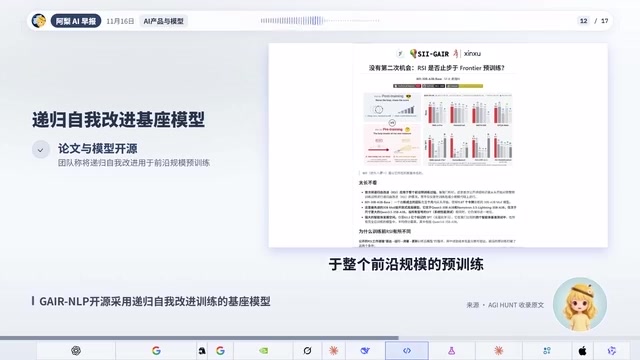
On the research side, GAIRNLP published a paper and open-sourced a model, claiming to be the first to apply recursive self-improvement to pretraining at entire frontier scale. The team broke the method into multiple small loops, each handling a different part of training. The paper claims that the open-source base model's training results surpass certain 30B-class MoE models; the model was trained from scratch on 11.8 trillion tokens over three months.
A paper from Northwestern University and Google proposes that AI agents can automatically improve framework components such as prompts, tools, and memory through trial runs, iterating even when new tasks have no standard answers. In experiments, GLM5's benchmark score rose from 64.2% to 75.7% without changing the model itself, and small models can also automatically iterate these framework components. If widely validated, such methods would reduce the one-way dependence on model scale.
Recursive Self-Improvement refers to a loop in which a system uses its own outputs to evaluate and modify its own components (prompts, tool-calling strategies, memory structures, or even training processes) and then applies the improved results to the next round of improvement. Applying it to "pretraining at entire frontier scale" means breaking the training process into independently evaluable sub-stages, with the model or automated processes adjusting data mixtures, curriculum scheduling, and so on. It is important to distinguish: the Northwestern University and Google work mentioned in the article improves "framework components" rather than model weights—this is agent framework self-iteration, which carries lower risk and better interpretability; whereas self-improvement that alters the pretraining process involves deeper issues such as the reliability of evaluation signals, reward hacking, and training instability, so the paper's conclusions still require independent replication.
Safety and Evaluation: Agent Leaderboards and Low-Code Platform Risks
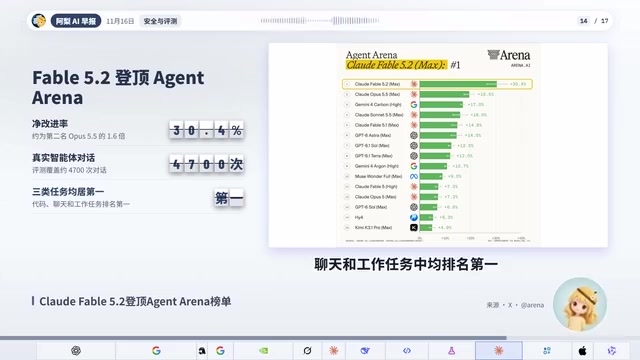
Anthropic's Claude Fable 5.2 Max topped the Agent Arena leaderboard with a progress improvement rate of 30.4%, about 1.6 times that of second-place Opes 5.5. The evaluation covered approximately 4,700 real agent conversations, with Fable 5.2 ranking first in coding, chat, and work tasks, rising from fifth to first compared with the previous generation. Average cost per task dropped from $7.7 to $7.3, and the API price was cut by 20%.
On the security front, German security firm Christie Field and Handelsblatt examined 159,041 projects on the Loveable platform and found serious security issues in a large number of apps; some apps had improperly configured database interfaces, allowing access to private chat records, passport details, and other information without logging in. Loveable focuses on building apps with zero technical barrier, but its terms of service place responsibility for the app and data processing on the customer. This is a reminder: the convenience of low-code platforms and security responsibility are two different things, and you still need to audit before going live.
Chips and Hardware: T-Head Files and Apple Glasses
According to Bloomberg, Siri's AI integration will be central to Apple's smart glasses plan; the report also says Apple now seems to place more emphasis on AI, but the smart glasses will not launch soon.
Alibaba's chip design unit T-Head has confidentially filed a listing application with the Hong Kong Stock Exchange, advancing the spin-off listing of its data center processor business. Analysts believe confidential filing usually means the parent company wants the chip business to be independently valued by the market based on its own financial data; others believe 2027 may become a key development period for the domestic semiconductor industry.
Other Updates: DeepSeek Conversation Deadline Adjustment
DeepSeekAd is gradually adjusting the inactivity deadline for long conversations from 72 hours to 7 days, and is still tuning it. Long conversations that are not continued beyond the deadline cannot be resumed, but records are not deleted—users can still export records or continue through a new conversation. Some users have found that by changing the title and force-quitting the app before reopening it, some old conversations can be reactivated.
Overall, this period's developments center on three main threads: model roadmap adjustments, free API openings, and Agent engineering implementation. Leak-based information should still be treated with official releases as the standard, but free quotas and open-source tools provide developers with usable experimental space right now.
One-line Summary
OpenAI may cancel GPT-6.2 in favor of GPT-6.5; Google opens free Gemini 4 API; Agent engineering accelerates.
Paragraph Summary
This period's AI developments center on three main threads. On model roadmaps, multiple leaks suggest OpenAI may cancel GPT-6.2 Astra in favor of GPT-6.5, though this is unconfirmed; Google's Gemini 4 series has leaked an Oxygen checkpoint, and the free API for Hydrogen is now open, supporting million-token context for coding and Agent workflows, with free quota shared per project. On engineering and ecosystem, NVIDIA open-sourced Personal AI Router to consolidate home multi-device compute; a Grok engineer shared a method for turning Agent errors into code check rules, merging 3,000 PRs in a month; GAIRNLP claims to be the first to apply recursive self-improvement to frontier-scale pretraining, while a Northwestern University and Google paper lets agents automatically improve prompts and memory, raising GLM5's benchmark score from 64.2% to 75.7%. On the security side, Claude Fable 5.2 Max topped Agent Arena, while nearly 160,000 projects on the Loveable platform were found to have numerous database misconfiguration issues.
Related articles

Why Microsoft CEO Nadella Still Backs Nvidia After Jensen Huang's Departure
Microsoft CEO Nadella publicly expresses confidence in Nvidia interim CEO Colette Kress. This article analyzes Nvidia's power transition after Jensen Huang's departure, Microsoft's compute dependency, and the trust logic of the AI supply chain.

Nadella: Critical Infrastructure Is 'Unpatchable' as AI Cybersecurity Arms Race Escalates
Microsoft CEO Nadella addresses AI cyberattack fears, saying much critical infrastructure is unpatchable, downplaying the Outlook outage, and analyzing AI's dual role in cybersecurity.

Musk Backs Jensen Huang: Firing Him Is Like Cutting Jordan
Musk says Jensen Huang is loyal to the U.S. and likens firing him to cutting Michael Jordan—highlighting politicization anxieties in the AI chip industry and defending talent value.