OpenAI GPT-Live Voice Model: How Full-Duplex Interaction Reshapes Human-AI Conversation

OpenAI's GPT-Live voice models bring full-duplex interaction and task delegation for natural, powerful AI conversation.
OpenAI's new GPT-Live voice model family introduces full-duplex interaction that lets AI listen and speak simultaneously and be interrupted naturally. A delegation mechanism routes complex tasks to GPT-5.5, boosting GPQA scores from 45% to 80%. With real-time translation, image analysis, and temporal awareness, voice is becoming the core interface for human-AI interaction.
GPT-Live: A True Revolution in Voice Interaction
OpenAI has officially unveiled a brand-new family of conversational voice models called GPT-Live, which includes two versions: the flagship GPT-Live 1 and the more lightweight GPT-Live 1 Mini, which serves as the default for free users. Compared to the previous Advanced Voice Mode, this update is by no means a minor patch—it fundamentally redefines the way humans interact with AI through voice at the architectural level.
The most significant breakthrough lies in Full Duplex interaction. Full duplex is a classic concept in telecommunications, referring to a system where both parties can send and receive signals simultaneously—a traditional telephone is a full-duplex system, while a walkie-talkie is a typical example of half-duplex, where transmission can only occur in one direction at a time. Bringing this concept into AI voice interaction requires solving complex technical challenges such as real-time endpoint detection, echo cancellation, and interruption handling. Endpoint detection (VAD, Voice Activity Detection) must determine at the millisecond level whether a user is still speaking or has simply paused to think—traditional approaches rely on signal features such as energy thresholds and zero-crossing rates, while AI scenarios also require judgment based on semantic context. Echo cancellation technology traces back to adaptive filter research at Bell Labs in the 1960s, and modern neural network approaches (such as RNNoise) have pushed it to new heights. Interruption handling involves the turn-taking mechanism in dialogue management, a challenge that sits at the deep intersection of sociolinguistics and computer science. Early voice assistants like Siri and Google Assistant all used half-duplex mode, requiring users to wait for a prompt tone before speaking. While these challenges have decades of signal processing accumulation in traditional telecommunications, porting them to AI voice systems introduces entirely new contextual complexities.
Unlike the traditional three-stage "ASR → NLU → TTS" pipeline, GPT-Live employs an end-to-end voice model that directly processes audio waveform input and outputs audio waveforms, without any intermediate text conversion. The traditional pipeline separates speech recognition, natural language understanding, and speech synthesis into three independent systems connected in series, each introducing latency and information loss, typically accumulating 1–3 seconds of delay. Pioneers of end-to-end architecture include Google's AudioLM (2022) and Meta's Voicebox (2023), which demonstrated that audio could serve as an independent generative modeling target. Building on this foundation and inspired by research such as Google's AudioPaLM and Meta's SeamlessM4T, GPT-Live conducts end-to-end training directly in the audio representation space, fully preserving the paralinguistic information that is inevitably lost during traditional text conversion. Notably, according to Mehrabian's rule, about 38% of the emotional information in human speech is conveyed through prosodic features such as pitch, speech rate, and volume—information that is almost entirely lost during text transcription. End-to-end models can encode these features directly into the semantic understanding process, achieving true "understanding of speech" rather than mere "text recognition." It is precisely this fundamental architectural innovation that makes true full duplex possible: GPT-Live 1 can simultaneously receive voice input and continuously generate voice output, inserting natural responses like "yeah" and "got it" before you've finished speaking, and better handling pauses, interruptions, and overlapping dialogue. As a result, the entire conversational experience feels much closer to natural communication between real people, rather than a mechanical question-and-answer exchange.
Delegation Mechanism: Enabling Voice Models to Handle Deep Tasks
One of GPT-Live's most impressive features is the delegation mechanism it introduces. When a user makes a complex request requiring deep processing, GPT-Live 1 handles the fast, natural instant response, while GPT-5.5 running in the background simultaneously executes the "heavy lifting" such as search and reasoning. The results from both are then merged and returned to the user.
The design inspiration for this architecture comes from the dual-system theory proposed by Nobel laureate in Economics Daniel Kahneman in his book Thinking, Fast and Slow—System 1 handles fast, intuitive responses, while System 2 handles slow, deep logical reasoning. Applying this framework to AI system design is not entirely new—well before GPT-Live, Anthropic's "Draft-then-Refine" method and Google's Speculative Decoding technique both embodied the idea of fast-slow system collaboration. Speculative decoding uses a small model to rapidly generate candidate token sequences, which are then batch-verified by a large model, boosting inference speed by 2–3x; DeepMind's AlphaCode 2 and OpenAI's own o-series models have also demonstrated the concept of "fast generation + slow verification." GPT-Live's innovation lies in extending this idea to real-time voice interaction scenarios, and unlike speculative decoding's approach of "accelerating the same task," its essence is routing subtasks of different natures to the models best suited for them—an engineering practice of task decomposition and async orchestration: GPT-Live 1 plays the "System 1" role, maintaining the immediate fluency of conversation, while GPT-5.5 plays the "System 2" role, executing computationally intensive tasks such as search, multi-step reasoning, and tool use in the background. This hybrid reasoning architecture of "routing + orchestration" represents an early commercial practice of AI systems evolving from monolithic models toward the multi-agent collaboration paradigm. Its key engineering challenges lie in judging the timing of task dispatch, synchronizing context between the two models, and ensuring semantic coherence when merging results.
The ingenuity of this architectural design lies in the fact that the voice model doesn't have to interrupt the flow of conversation to handle complex tasks—it can talk with you while dispatching a more powerful reasoning model in the background to complete tasks. This effectively breaks down the barrier between "natural interaction" and "frontier intelligence"—you get both a smooth voice experience and the capabilities of an advanced reasoning model.
For everyday users, this change is significant. In the past, when using the standard version of ChatGPT, people often avoided asking difficult questions by voice because the voice model wasn't "smart enough." Now, with a voice version that can link up with a high-reasoning model, many complex tasks that previously had to be completed by typing can now be done hands-free, greatly unlocking productivity.
Benchmarks: The Leap from "Toy" to "GPT-5 Level"
The data speaks for itself. Across multiple authoritative benchmarks, GPT-Live demonstrates an astonishing leap in capability:
- GPQA (Graduate-Level Science Q&A): GPQA (Graduate-Level Google-Proof Q&A) was designed by researchers at New York University in 2023, and its core design philosophy reflects the academic community's deep reflection on the problem of AI benchmark contamination. All 1,198 questions in GPQA have been validated by domain experts, and the designers required that "even a PhD student outside the field would need more than 30 minutes to answer." The four-choice distractors are plausible-looking wrong answers designed by experts in the same field—rendering retrieval-based "cheating" strategies almost useless and forcing cross-domain reasoning and knowledge integration, aiming to genuinely test deep understanding rather than information retrieval. The previous Advanced Voice Mode scored only 45%, barely above random guessing (about 25% for four choices); GPT-Live Mini and Live Medium reached 70% and 80% respectively, entering the range of human domain experts (human experts average about 65%), essentially reaching the level of a "GPT-5 class" voice model.
- BrowseComp (Agent Search): BrowseComp represents a new direction in "capability-oriented benchmarks"—it tests not static knowledge but dynamic information integration ability. It is a benchmark designed internally by OpenAI, specifically evaluating a model's ability in multi-step web information retrieval and integration, requiring the model to plan multi-round search strategies, assess information credibility, and synthesize output—similar to the workflow of a human researcher who plans search paths, verifies information, and synthesizes answers. This aligns closely with the industry's focus on the practical value of AI Agents, and foreshadows that future AI evaluation systems will increasingly emphasize task completion rather than the amount of knowledge memorized. The old voice mode scored less than 1%; GPT-Live Mini reached 30% even on the free version, while the high-reasoning version broke through 60%–75%. This leap directly reflects the qualitative change brought by the delegation mechanism, which grants the voice model the ability to call external tools—what improves is not speech recognition itself, but the task execution and information integration capabilities behind the voice model.
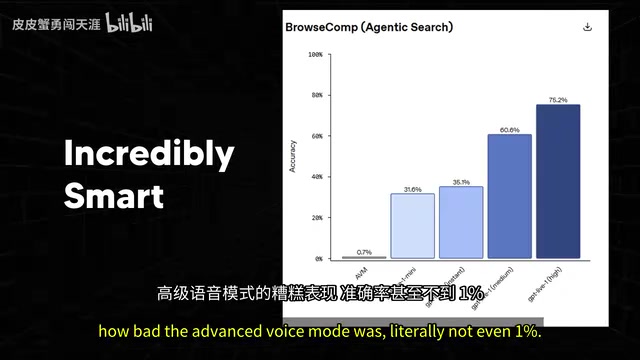
From nearly zero to over 60%, this leaping progress is a change that every user can genuinely perceive.
The Real Test of Full-Duplex Capability: The Voice Telecom Benchmark
Beyond knowledge and reasoning capabilities, OpenAI also tested the model's performance in real phone call scenarios—this is the Voice Telecom benchmark. The test simulates all kinds of chaotic situations: the other party has an accent, there's background noise, the line drops, the user and the bot talk over each other—these are precisely the true litmus test of full-duplex capability (listening and speaking simultaneously).
Results show that GPT-Live 1 Mini scored about 40%, nearly double the old Advanced Voice Mode; the Medium and High versions reached nearly four times the old version. Currently on the market, no other AI company has achieved such a breakthrough in both voice realism and knowledge capability simultaneously.
Multimodality and Practical Scenarios: Far More Than Just "Chatting"
GPT-Live's capabilities extend far beyond conversation itself. OpenAI has showcased its rich applications in real-world scenarios through multiple demonstrations.
Real-Time Commentary Combining Images and Voice
Users can have the model analyze images while in voice mode. In one demo, before meeting his girlfriend's parents, a user asked GPT-Live 1 to act as a "strict judge" and critique his outfit. The model not only gave candid feedback ("I really like the vibe, but for meeting the parents it might come across as a bit flashy"), but also provided specific improvement suggestions—"keep the cut, but switch to a more understated color or pattern"—demonstrating nuanced visual understanding and practical advice capabilities.

Embedded Mini Apps and Browser
GPT-Live 1 doesn't just "respond"—it can also proactively pull up a mini browser and small apps to complete tasks for you. In one demo, a user asked about the weather in Mexico City this week, the team's game schedule, and good places to watch the match. The model not only answered verbally but also visually presented the relevant information on screen. This experience of "AI actually doing things for you and showing the results" will be an excellent onboarding guide for free users.
Real-Time Translation: Sci-Fi-Like Multilingual Conversation
One of the most stunning demos is real-time voice translation. A user asked the model to translate whatever languages it heard into English in real time—French, Cantonese, Spanish, and various other languages were smoothly and instantly translated, and the model could seamlessly switch between translation and normal conversation, even summarizing everyone's favorite foods at the end. The advantages of the end-to-end architecture are especially prominent here—because there's no intermediate text conversion layer, the model can directly perceive the tone and rhythm of the source language, making the translation closer to the original speaker's emotional expression in tone, compensating for the long-standing shortcoming of traditional machine translation systems being "semantically accurate but emotionally distorted." The underlying logic of this advantage is that human tonal features (such as rising intonation indicating a question or falling intonation indicating certainty) have cross-cultural universality across different languages. End-to-end models can directly leverage these prosodic cues, whereas traditional translation systems have already discarded them during textualization.

As the OpenAI team put it, because the model can "think in real time," it can even begin responding before the user has finished speaking—and this is precisely the secret to making interaction feel natural.

Temporal Awareness: Making Conversation Closer to Real Communication
Another easily overlooked yet extremely critical capability is temporal awareness. Traditional large language models are essentially "stateless"—this stems from the autoregressive inference mechanism of the Transformer architecture: its positional encoding only represents relative positions within a sequence, completely decoupled from the real-world clock; each forward pass is an independent computation on the input sequence, and the model has no built-in clock or persistent memory. Researchers have tried various approaches to compensate for this flaw: Time-aware Transformers introduce timestamp embeddings into the attention mechanism; external tool calling allows the model to request the system clock. But under these traditional approaches, the model itself is "blind" to the passage of time and can only continue responding after an external system returns results.
Because GPT-Live runs continuously in a streaming manner, the pace of its token generation itself aligns with the real timeline. This represents a qualitative change from "simulating temporal awareness through language" to "genuinely perceiving the passage of time"—the model can perceive the duration of silences between utterances, the rhythm of speech, and the beat of conversation, and can therefore truly understand the passage of time in conversation, rather than relying on external tools to simulate this perception. In the coffee brewing demo, a user asked the model to time a 30-second bloom for a "light-roast V60 pour-over." The model not only set a timer and counted down in real time but also reminded the user of the next step at the end, and gave instant advice when the user asked "what if I run out of water?" This continuous grasp of time not only makes it perform exceptionally well in practical scenarios such as countdowns and reminders, but also lays the foundation for future "long-term companion AI assistants"—an AI that can truly perceive the passage of time is the only kind that can accurately understand what temporal relationships like "yesterday," "in a bit," and "just now" actually mean in conversation.
Conclusion: Voice Is Becoming the Core Interface for Human-Computer Interaction
The release of GPT-Live marks the transformation of voice from an auxiliary feature into the core interface for human-computer interaction. The naturalness brought by full-duplex interaction, the deep capabilities enabled by the delegation mechanism, and the practicality delivered by multimodality and temporal awareness together constitute a truly meaningful experience upgrade.
As the OpenAI team said, voice interaction can only become truly usable when the model has complete context, can be interrupted and interrupt you, and can understand and execute your instructions. GPT-Live lets us feel for the first time—conversing with AI can be as natural as conversing with a real person.
Key Takeaways
Related articles
PGP-Clinical-TimeKAN: A Detailed Guide to the Multivariate Physiological Indicator Joint Prediction Framework
An in-depth analysis of the PGP-Clinical-TimeKAN framework for joint probabilistic prediction of multivariate physiological indicators, covering trajectory-first paradigm, KAN message passing, MIMIC-IV validation, and ablation studies.
CriticGen: A New Framework That Transforms AI Evaluation into Actionable Improvement Feedback
CriticGen proposes a generation-aware evaluation framework that transforms AI assessment from passive scoring to an active optimization loop, achieving 73.17% answer improvement and 93.28% non-degradation rate.
Vercel AI SDK workflow-harness Update Analysis
Deep analysis of Vercel AI SDK workflow-harness 1.0.107 update: architecture design, engineering practices, and developer value for building reliable AI apps.