OpenAI Launches Agents API: A Deep Dive into Managed Agent Infrastructure

OpenAI's Agents API provides managed infrastructure for AI agents, covering orchestration, context, and multi-agent coordination.
OpenAI's Agents API opens the Codex execution framework as a managed service, taking over the most tedious aspects of agent development: orchestration, session management, and context handling. It connects external tools via MCP, injects operational runbooks as skills, and lets developers choose their own sandbox environments for flexibility and compliance. Key technical features include programmatic tool calling to pre-filter data and save tokens, multi-agent orchestration for parallelizing large tasks, and context compaction to keep long-running sessions coherent. OpenAI positions it as a runtime framework that evolves continuously with new models, marking a shift from hand-assembled infrastructure to a managed platform era for agent development.
Deploying a long-running AI agent to production has never been easy. Even with a powerful model in hand, developers still face the tedious work of connecting tools, tracking progress, managing context, and maintaining and securing the underlying infrastructure. OpenAI's newly released Agents API is designed to take exactly that infrastructure burden off developers' plates.
What Problem Does the Agents API Actually Solve?
At its core, the Agents API brings the Codex harness — Codex's execution framework — into your application as a managed service. In other words, orchestration, sessions, and context management, which developers previously had to build themselves, are now handled by OpenAI, freeing teams to focus on actual business logic.
The positioning is clear: this isn't another model — it's a runtime framework built around models. For any team trying to move agents from demo to real production, the most time-consuming part is rarely tuning the model. It's stitching together the surrounding orchestration, state management, tool calls, and security isolation, then maintaining all of it long-term. The Agents API aims to eliminate that cost entirely.

Understanding Its Capabilities Through a Real-World Scenario
OpenAI used a highly relatable example in their demo: building an agent to help investigate production incidents.
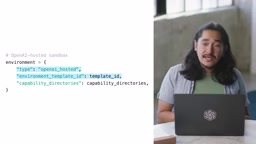
Such an agent needs access to observability data, recent code changes, and the team's operational runbooks for handling outages. In the Agents API, these capabilities are connected via MCP (Model Context Protocol), while the team's runbooks are made available to the agent as skills.
Notably, control over the execution environment remains in the developer's hands. You decide what kind of sandbox the agent runs in and which tools it can access — the sandbox can be OpenAI's own, a third-party provider's, or your own infrastructure. This flexibility is especially important for enterprises with compliance and security requirements.
MCP (Model Context Protocol) is a standard protocol proposed and open-sourced by Anthropic in late 2024, designed to unify how AI models connect to external tools and data sources. Think of it as the USB-C of AI integrations: before MCP, every agent framework required custom integration code for each individual tool. With MCP, any tool that implements the standard MCP Server interface can be called directly by any MCP-compatible model or framework. OpenAI's adoption of MCP in the Agents API means developers can reuse an existing ecosystem of MCP tools — such as connectors for databases, code repositories, and monitoring platforms — without rewriting integrations for the OpenAI ecosystem. This is also a rare signal of protocol convergence across competing AI vendors at the tool-connectivity layer.
Key Technical Features
Programmatic Tool Calling: The Key to Saving Tokens
In scenarios like incident investigation, log volumes often far exceed a model's context window capacity. The Agents API provides programmatic tool calling: the agent can process and filter logs directly in code, feeding only the information that's truly needed into the context.
The logic behind this is straightforward cost optimization — rather than passing massive volumes of raw data back and forth between models and burning through tokens unnecessarily, the agent pre-filters at the code layer, reserving that precious context budget for critical information.
Multi-Agent Orchestration: Breaking Down Large Tasks
For the most complex tasks, independent work can be distributed through multi-agent orchestration. In an incident investigation scenario, one sub-agent can check recent code changes while another examines telemetry data, with the primary agent then synthesizing the findings into a unified conclusion.
This division of labor essentially mirrors how a collaborative human team operates, and is a common pattern for keeping agents efficient and focused when tackling complex problems.
Context Compaction: Keeping Long Sessions Running
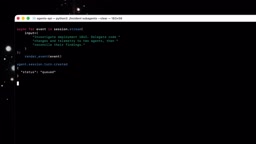
Even for a single agent session, long-running context windows can continue to function effectively through compaction. The mechanism provides the model with a summary of all previously completed work, allowing the agent to continue progressing without losing the critical thread of the investigation.
For long-running tasks that may last hours or more, this mechanism is fundamental to maintaining coherence.
The context window is one of the most fundamental limitations of current large language models: a model can only "see" a finite number of tokens during a single inference pass, and anything beyond that is truncated or lost. For agent tasks that run continuously for hours, this limitation is particularly fatal — early tool call results, intermediate reasoning, and key findings can all be lost to window overflow, causing the agent to repeat work or drift off course. Compaction is essentially an automated "meeting minutes" system: before the context is exhausted, the system distills completed work into a structured summary that replaces the original detailed records, freeing up space to continue. This closely mirrors the cognitive strategy humans use for long-term projects — you don't need to remember every raw detail, just enough of a summary to reconstruct the decision-making thread.
Output: Deliverable Results
When the investigation is complete, the findings are delivered as a report for the on-call team to review — including likely root causes, supporting evidence, and recommended next steps, all packaged into a shareable document.

This reflects the Agents API's pragmatic orientation: it's not just about getting an agent to "run" — it's about ensuring the agent's final output can genuinely integrate into existing team workflows.
An Execution Framework That Will Keep Evolving
The core message conveyed throughout the demo is this: with the Agents API, developers can build and drive a complete workflow without having to build or maintain any agent infrastructure themselves.
An even more important promise lies beneath the surface — this harness will continue to improve as new models and capabilities emerge. OpenAI positions it as "an ever-evolving execution framework behind a single API." This means that once developers are integrated, they benefit continuously from model iterations without having to repeatedly rebuild their own underlying architecture.
For the industry at large, this signals a shift in agent development from the "hand-assembling infrastructure" era toward the "managed platform" era. Whoever can provide the most stable, lowest-maintenance runtime that evolves alongside models will likely become the default choice for developers building agent applications.
Related articles
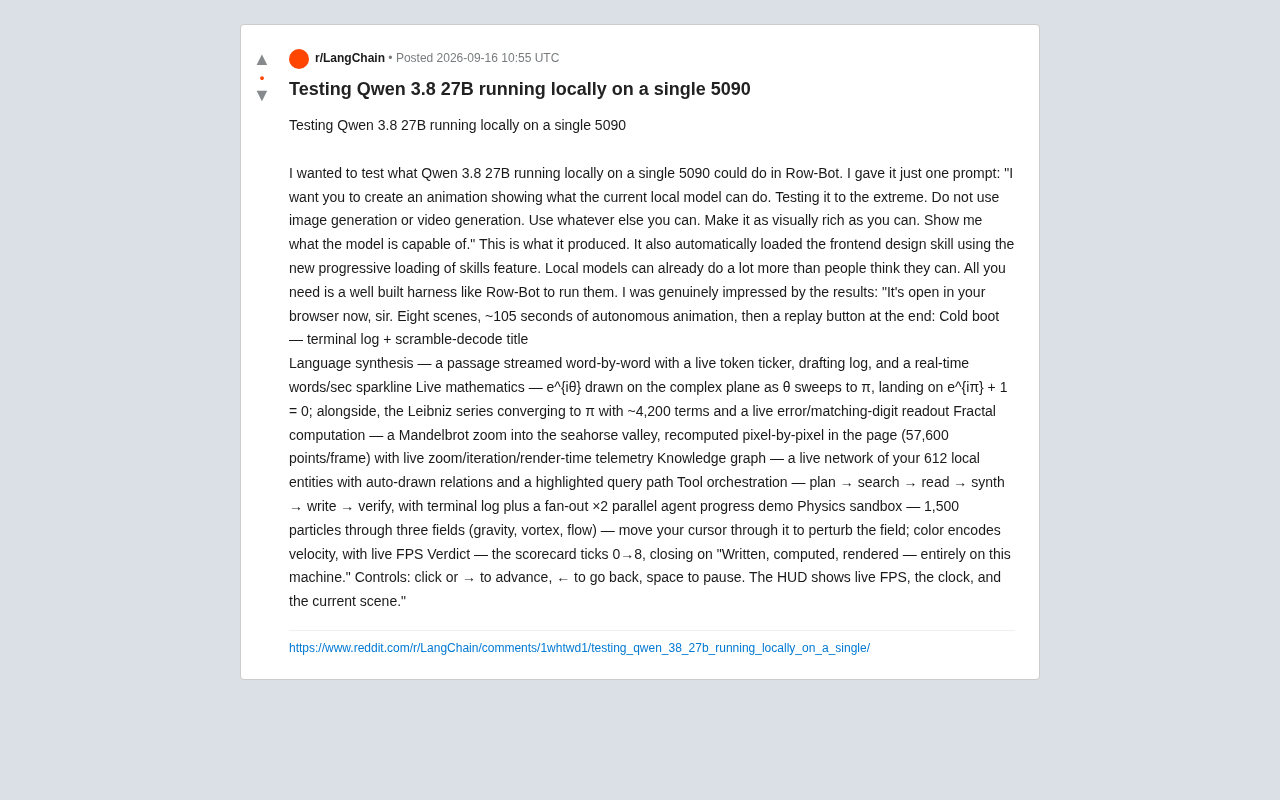
Running Qwen3 27B Locally on a Single RTX 5090: What Can It Actually Do?
A developer runs Qwen3 27B locally on a single RTX 5090 via the Row-Bot Agent framework, generating an 8-scene, 105-second interactive animation from one prompt — including real-time math, fractals, and physics.

AI Hybrid Workflow in Practice: Auto-Generating 3D Creatures with Astra + Blender + MiniMax
A Reddit creator tests an Astra+Blender+MiniMax hybrid AI workflow for 3D creature animation — from concept to rigging to retargeting. Here's what works and what doesn't.
Apple Reference Image: A New Paradigm for Verifiable Photography
Apple's Reference Image proposal uses on-device cryptographic signing to establish verifiable baselines for real photos, tackling AI-generated image authenticity at the hardware level.