OpenAI Launches ChatGPT for Teens, Adds College Application Planning Tool

OpenAI launches ChatGPT for Teens with default safeguards and College Planner for college applications.
OpenAI treats teens as a standalone product line with ChatGPT for Teens, which auto-enables protections for under-18 accounts using a "system identification, on by default" approach. It also previews College Planner for U.S. four-year college applicants, integrating requirements, deadlines, and financial aid steps into one interface. OpenAI emphasizes support for counselors and teen feedback, aiming to embed into the broader college preparation ecosystem.
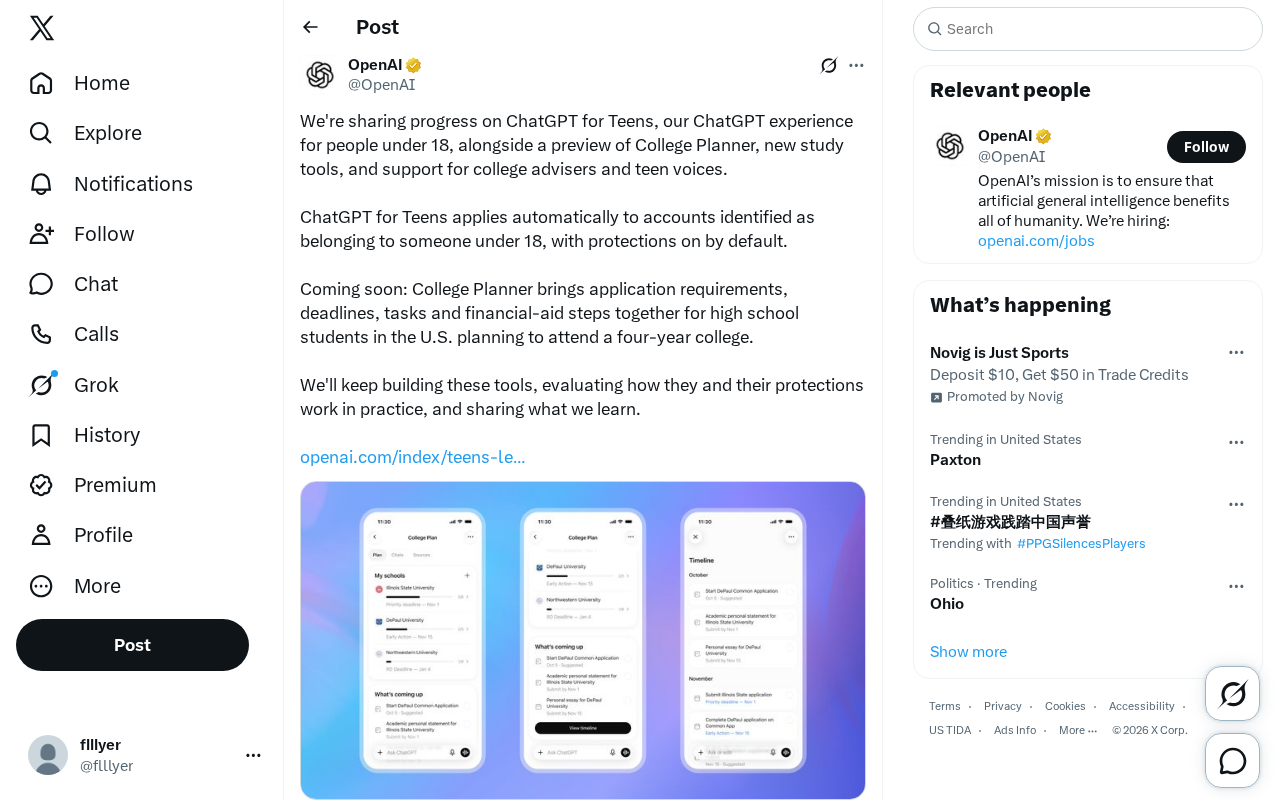
OpenAI is treating teen users as a standalone product line. According to an announcement on its official X account, ChatGPT for Teens has moved from concept to actual deployment—any account identified by the system as belonging to someone under 18 will automatically have this experience applied, with safeguards enabled by default.
ChatGPT for Teens: Protection by Default, Not an Optional Switch
Unlike many platforms that tuck teen safety settings away in inconspicuous corners, ChatGPT for Teens is built on the core principle of "automatic identification, enabled by default." As long as an account is determined to belong to a minor, the protection mechanisms take effect—no manual configuration required from the user.
This design approach is worth noting. Over the past few years, regulatory pressure and public discussion around AI's impact on minors have continued to intensify. OpenAI has chosen to respond proactively at the product level rather than waiting for external compliance requirements to take hold. The company says it will continuously evaluate how these tools and their safeguards perform in real-world use and publicly share what it learns.
From a product strategy perspective, this is a move that balances compliance with user growth. Teens genuinely need AI tools—from homework help to study planning—and rather than pushing users to work around the system, it makes more sense to offer an official version with guardrails.
The Design Logic Behind "Enabled by Default"
In product design and behavioral economics, the "default option" is considered one of the most powerful design levers. Extensive research shows that the vast majority of users never actively change default settings, so making safety protections the default is in practice far more restrictive than "providing a toggle that's off by default."
For products aimed at minors, this logic is also closely tied to the issue of "age verification." Platforms typically infer age through birth dates entered at registration, payment information, or behavioral characteristics—but all of these methods carry the risk of misjudgment. OpenAI's approach of "system identification triggers automatic application" means the judgment call rests with the platform rather than the user, lowering the barrier for teens to actively circumvent protections.
This also brings controversy: adult users misidentified as minors may face additional restrictions, while teens who misreport their age could evade protections. This kind of tension is a common challenge for AI products targeting minors.
College Planner: Turning College Applications into a Manageable Task Flow
Another key feature announced is College Planner, aimed at U.S. high school students planning to attend four-year universities. It consolidates application requirements, deadlines, to-do tasks, and financial aid steps into a single interface.
College applications are inherently a multi-threaded project: standardized test timelines, recommendation letters, essays, different deadlines for each school, the FAFSA form... information is scattered across dozens of websites and emails. College Planner aims to address the anxiety and execution failures caused by this fragmentation of information.
This feature is currently in preview. Based on the description, it's not a simple calendar tool but an assistant with process management capabilities—breaking down the complex application process into trackable steps. For first-generation college student families or students with limited access to school counselors, the value of such tools is especially significant.
FAFSA and First-Generation College Students
FAFSA (Free Application for Federal Student Aid) is the entry point for federal financial aid applications provided by the U.S. federal government. Virtually all students needing financial assistance must fill it out. Its forms are complex and require extensive documentation (family tax information, asset verification, etc.), and it has long been regarded as one of the most error-prone and delay-prone parts of the application process.
"First-generation college student" refers to a student whose parents have not obtained a four-year college degree. This group often lacks family experience to guide them through the application process, and their understanding of deadlines, essay requirements, and financial aid mechanisms is significantly less than that of families with college backgrounds. Research consistently shows that information asymmetry is one of the key reasons for their lower enrollment and completion rates. Therefore, tools that structure and visualize the application process typically provide more practical help to these students than to those from well-resourced families.
College Counselors and Youth Voices: An Ecosystem, Not a Point Product
OpenAI also mentioned support for college counselors and the importance it places on teen feedback. This indicates its goal is not just to build a tool for students but to embed itself in the entire college preparation support system.
School counselors often serve hundreds of students, making personalized guidance nearly impossible from a staffing perspective. If AI can handle the foundational work of information integration and progress tracking, counselors' time can be freed up for areas requiring more human judgment—such as essay brainstorming, school selection strategy, and emotional support.
OpenAI emphasized it will "share what it learns," an open stance that is relatively rare in the teen product space. Products involving minors typically have closed iteration processes, so OpenAI's choice to share progress publicly may also be an attempt to set the tone for industry discussion.
Where Are the Boundaries of AI in Education?
The launch of ChatGPT for Teens and College Planner pushes a more fundamental question to the forefront: what role should AI play in educational settings?
The tools themselves are neutral. College Planner can help students avoid missing deadlines, but it could also lead some students to over-rely on checklists and neglect the process of actively researching schools. Safeguards can filter inappropriate content, but they cannot replace the judgment of parents and teachers.
OpenAI's stance is "continuous evaluation, continuous sharing." For students and parents considering incorporating AI into their learning process, this at least provides a transparent, verifiable option. How it actually performs going forward depends on whether the safeguards are truly effective and whether College Planner can deliver on its promise to simplify complex processes.
One-line Summary
OpenAI launches ChatGPT for Teens and college application assistant College Planner, embedding default protections into the college preparation support ecosystem.
Paragraph Summary
OpenAI treats teen users as a standalone product line, launching ChatGPT for Teens and College Planner. The former automatically enables safeguards for accounts belonging to users under 18, adopting a "system identification, enabled by default" design rather than an optional toggle; the latter targets U.S. four-year college applicants, integrating application requirements, deadlines, to-do tasks, and financial aid steps into a unified interface. OpenAI also announced support for college counselors and prioritizes teen feedback, attempting to embed itself in the entire college preparation support system rather than building a standalone tool. The company emphasizes it will continuously evaluate how safeguards and tools actually perform and publicly share what it learns. This move is both a compliance response to regulatory and public concerns and a product strategy that balances user growth, while also pushing the more fundamental question of "what role should AI play in education" to the forefront.
Related articles

Why Does the Tesla Roadster Need to Fly? A Deep Dive into Musk's Wild Demo
Tesla's Roadster launch showed wall-climbing, upside-down driving, and flying stunts—but The Vergecast notes the demo car may lack a battery, the Rocket version is invite-only and not street-legal, and the website terms don't guarantee delivery. After nine years of delays, why does this car still need to exist?

AI Is Not a Replacement: Human-AI Collaboration Through the Lens of Factory Root Cause Analysis
Starting from factory root cause analysis, this article explains how AI accelerates evidence chain construction rather than replacing human experts, exploring the pragmatic implementation logic and business value of 'AI supporting people rather than replacing them.'

AI Agent Decision Auditing: Building an Evidence Chain in Regulated Workflows
Starting from a Reddit discussion, this article analyzes three core issues in AI agent decision auditing within regulated workflows: what fields audit records should contain, how to handle feedback latency for erroneous decisions, and how to continuously calibrate LLM judge consistency with human judgment.