OpenAI Launches ChatGPT Wallet: Can You Trust AI to Spend Your Money?

OpenAI partners with three major card networks to launch ChatGPT Wallet, letting AI agents pay — trust is the biggest barrier.
On November 13, OpenAI launched ChatGPT Wallet with Visa, Mastercard, and American Express, initially for US Pro subscribers aged 18+, with payment capabilities gradually rolled out through a persistent AI agent. Card details go into a dedicated secure form rather than the chat window; before payment, users review merchant, item, price, and terms, confirm via biometrics, and the payment network generates a token replacing the real card number. OpenAI says real card numbers aren't shared with merchants or the agent, and published integration guidelines to help merchants identify legitimate AI shopping requests. Debate centers on why payments still need multiple confirmations when AI is so capable, and on privacy risks from concentrating chat, shopping, and payment data on one platform. The real barrier to AI payments, the article argues, isn't technology but whether users will hand over wallet control.
OpenAI is moving its AI assistant from "talking" to "doing" — paying for things on your behalf. On November 13, OpenAI announced the launch of ChatGPT Wallet, teaming up with Visa, Mastercard, and American Express. It's initially available to US ChatGPT Pro subscribers aged 18 and older, with capabilities rolled out gradually through its persistent AI agent. As soon as the news broke, discussion quickly shifted from "how cool is this feature" to a more practical question: are you willing to hand control of your wallet to an AI?
How ChatGPT Wallet Works: Secure Form + Biometrics + Payment Tokens
From the user flow, OpenAI has put considerable effort into security design. Users first add a bank card to the wallet, entering the card number, expiration date, and security code into a dedicated secure form rather than typing them into the chat window — a critical detail that keeps sensitive information out of the conversation context.

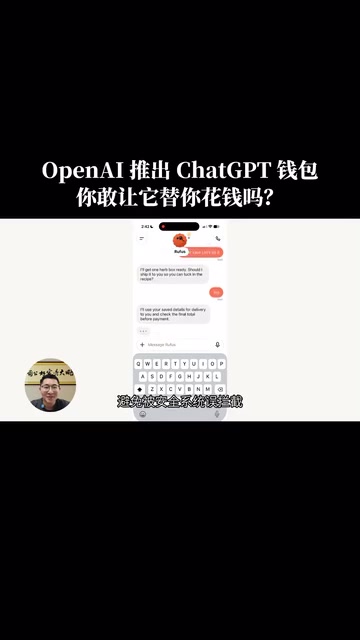
When it's time to actually pay, the process is broken into multiple confirmation steps: first reviewing the merchant, item, total price, card used, and any delivery or auto-renewal terms shown on the page, followed by a biometric confirmation. Once approved, the payment network generates a payment token that replaces the real card number, security code, and expiration date. According to the official statement, the real card number is never shared with the merchant or the agent.
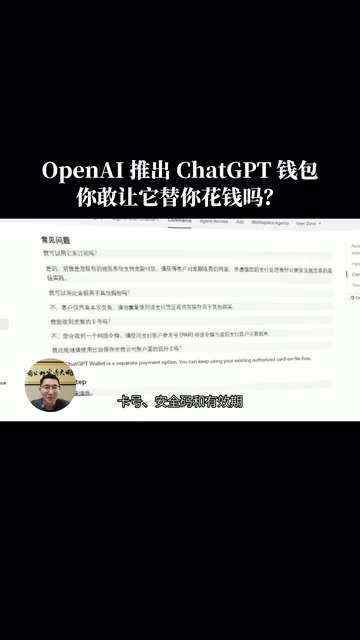
The essence of this mechanism is packaging "AI-initiated payment" as a tokenized transaction authorized by the user. The AI agent receives a token instead of a real card number, and the merchant sees a token too, theoretically reducing the risk of card information leaks. To help merchants recognize and accept AI-initiated payments, OpenAI has also published integration guidelines to help websites distinguish legitimate AI shopping requests and avoid being incorrectly blocked by fraud detection systems.
Payment tokenization refers to replacing sensitive information such as bank card numbers, expiration dates, and CVVs with a randomly generated substitute value (a token); during a transaction, the payment network maps the token back to the real card number to complete the charge. Tokens are typically bound to a specific merchant, device, or transaction scenario, making them difficult to reuse elsewhere even if leaked — and therefore safer than transmitting real card numbers directly. The standard is set by EMVCo, and the technology is already widely used in mobile payments like Apple Pay and Google Pay. What's different about ChatGPT Wallet is that the token is requested by an AI agent after user authorization, replacing the traditional "user clicks the pay button" step.
Persistent AI agent refers to an AI program that runs continuously in the background and can proactively execute multi-step tasks, unlike the turn-by-turn chat mode. Within the scope of user authorization, it can browse pages, compare information, and initiate actions. OpenAI chose to "gradually" open up agent payment capabilities because the more autonomous the agent, the larger the attack surface for prompt injection and privilege escalation. Limiting payment capability to a single transaction confirmed by the user each time, combined with biometrics, is essentially a "human-in-the-loop" constraint on the agent's action boundaries — which also explains why the current flow doesn't look like "one-click payment."
Why Users Hesitate: If AI Is So Powerful, Why All the Hurdles for Payments?
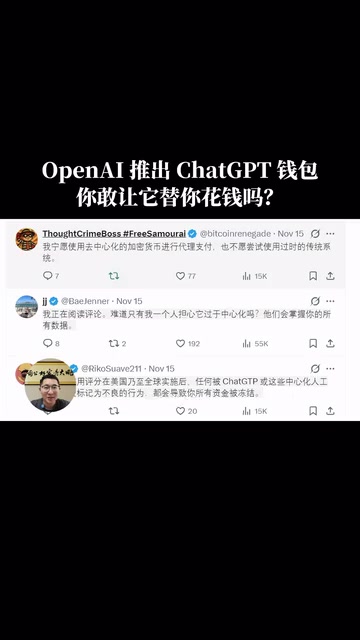
After the feature launch, comments were sharply divided. Some users' skepticism had a hint of "tough love": if AI is this advanced, why does payment still require upfront confirmation and rely on traditional financial systems like banks? In their view, since AI can make decisions for people, the friction at the payment step seems unnecessary.
Others' concerns were more practical: if chatting, shopping, and paying all go through the same AI assistant, will AI companies accumulate more and more personal information? When conversation records, spending preferences, and payment behavior converge on a single platform, the privacy risks of data concentration cannot be ignored.
These two voices actually point to the same contradiction: users want AI to be smart enough to handle everything, yet want it to be "dumb" enough when money is involved — stopping at every step to wait for their approval. OpenAI's current design clearly takes the latter stance — biometrics and multi-layer confirmation aren't a technological step backward, but deliberate human control points.
The Real Barrier to AI Payments: Not Technology, but Trust Boundaries
From an industry perspective, payment tokenization itself isn't new technology — the credit card industry has used it widely for years. What's novel about ChatGPT Wallet is placing an "AI agent" in the transaction chain: the AI initiates shopping requests, reviews terms, and triggers payment. What needs to be solved behind this is the identity verification problem — how do merchants confirm that a request genuinely comes from a user-authorized AI rather than a malicious script? OpenAI's integration guidelines exist precisely for this purpose.
But no matter how refined the technical solution, the trust problem is unavoidable. Many people are already comfortable letting AI search, write, and schedule for them; letting it touch their bank card directly raises the psychological barrier significantly. As one comment in the original discussion put it: as AI develops, it can do more and more for us, but there's one thing many people may still not be willing to hand over — control of their own wallet.
Whether ChatGPT Wallet can gain traction depends on two things: first, whether the tokenization and biometrics mechanism is reliable enough in real-world scenarios, and how liability for erroneous or fraudulent payments is defined; second, whether OpenAI can convince users that handing payments to AI doesn't mean giving up control. At least judging from the rollout pace — initially only for US Pro subscribers, gradually opened through the persistent agent — OpenAI itself knows this step needs to be taken slowly.
For ordinary users, the more realistic stance in the short term may be to wait and see: watch how it performs in real transactions before deciding whether to add your card. After all, AI can write your emails and look up information, but when it comes to things like wallet passwords, keeping them in your own hands a little longer isn't a bad idea.
Agentic Commerce is a hot direction in the payments industry in 2025, referring to AI agents completing search, price comparison, ordering, and payment on behalf of consumers. Beyond OpenAI, Google's AP2 protocol and Visa's Intelligent Commerce are all attempting to define standards for "AI agent identity verification" and "user intent credentials." The core challenge is how merchants and payment networks verify that a request genuinely comes from an agent explicitly authorized by the user, rather than a forged script. A common approach is for the agent to carry a verifiable signature or intent token, which the merchant's fraud detection system uses to approve the transaction. This ecosystem is still in its early stages with no unified standards — which is the practical reason OpenAI published integration guidelines.
One-line Summary
OpenAI teams up with three major card networks to launch ChatGPT Wallet, letting AI agents make payments — trust is the biggest barrier.
Paragraph Summary
On November 13, OpenAI launched ChatGPT Wallet in partnership with Visa, Mastercard, and American Express, initially available to US Pro subscribers aged 18 and older, with payment capabilities gradually provided through a persistent AI agent. In the flow, card information is entered into a dedicated secure form rather than the chat window; before payment, users review the merchant, item, total price, and terms, confirm via biometrics, and the payment network then generates a token replacing the real card number. OpenAI says real card numbers are not shared with merchants or the agent, and has published integration guidelines to help merchants identify legitimate AI shopping requests. User debate centers on two points: why payments still require multiple confirmations when AI is already smart enough, and the privacy risks of concentrating chat, shopping, and payment data on a single platform. The article argues that the real barrier to AI payments isn't technology, but whether users are willing to hand over control of their wallets.
Related articles

Inside Honey Trap Training: Emotional Dissociation and Anchoring Techniques
How are spies trained for honey trap missions? A trainee reveals emotional dissociation, perfume and keyword anchoring, and target photo binding—psychological techniques that condition reflexes for intelligence work.

Frontier AI Risk Management: Full-Pipeline Practices from Training to Deployment
OpenAI outlines a frontier AI risk management framework: from training-stage model alignment to deployment-stage sandboxing and blocking safeguards, plus post-deployment monitoring—a layered risk control system across the model lifecycle.
DaisyRose-27B: 1,200-Task RL Boosts Qwen3.8 from 5.6% to 12% on Terminal-Bench 4.1
DaisyRose-27B uses RL training on 1,200 tasks to boost Qwen3.8's Terminal-Bench 4.1 score from 5.6% to 12%, showing lightweight RL can more than double terminal task performance.