OpenAI May Be Entering Cost Control Mode: From Expansion to Thrift

A Hacker News discussion hints OpenAI may shift toward cost control, reflecting the AI industry's move from scale first to efficiency first.
Based on a Hacker News thread titled "OpenAI may be in cost control mode," the article analyzes that OpenAI may be shifting from aggressive expansion to cost control. Since the original post has only a title and few comments, lacking concrete data or official statements, the author treats it as an industry sentiment signal rather than a definitive conclusion. It notes that the rigid costs of large model companies in compute, power, and talent are the main drivers, and that this shift is a common industry adjustment from scale first to efficiency first. Cost control is more likely structural resource optimization than business contraction, with potential effects on API pricing, free quotas, and developers' cost models, ultimately to be verified through public moves in pricing, hiring, and cloud partnerships.
From Aggressive Expansion to Cost Control: A Turning Point for OpenAI
According to a discussion on Hacker News (original thread titled "OpenAI may be in cost control mode," with 27 points and 10 comments), OpenAI may be entering a cost control mode. Though brief, this claim points to a noteworthy industry signal: when an AI company known for aggressive expansion begins to emphasize costs, it often means its operational focus is shifting.
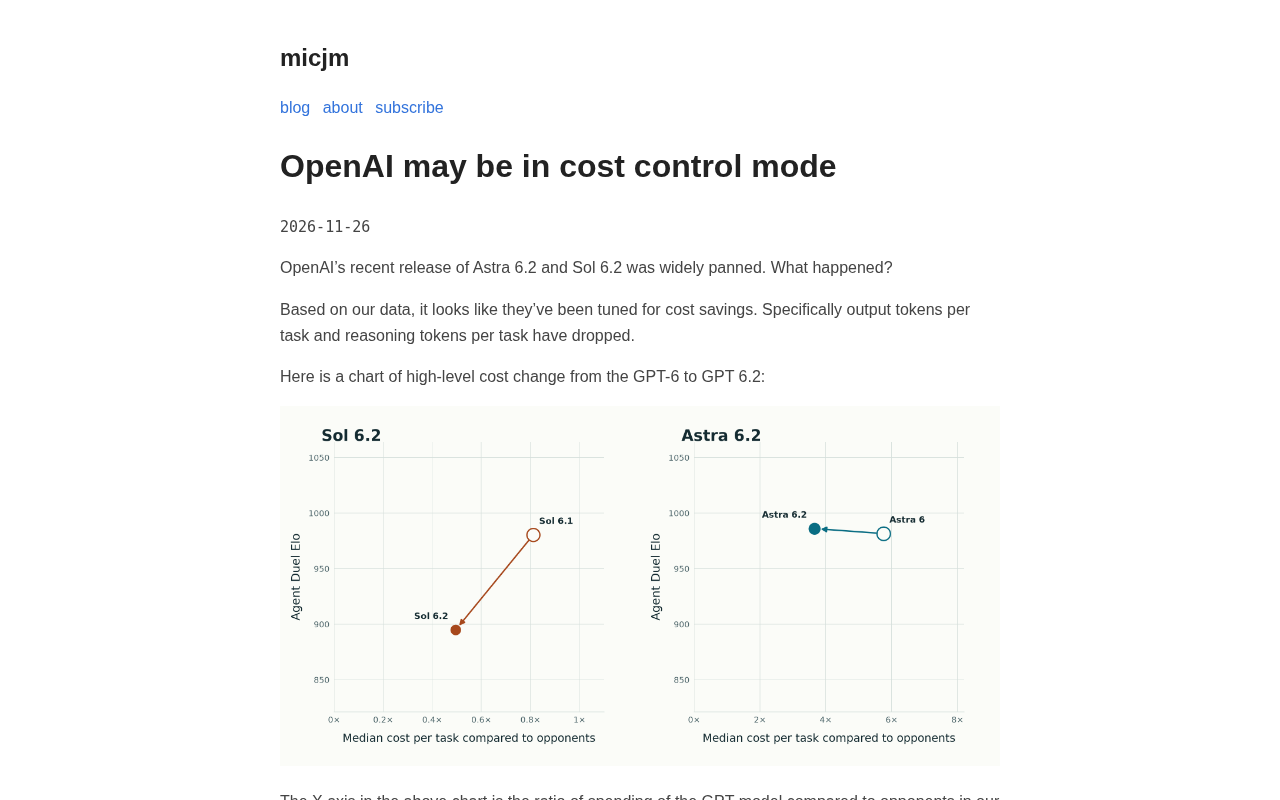
The thread didn't generate much discussion, but the title itself constitutes a judgment—OpenAI's operating strategy may be shifting from "racing ahead at any cost" to "pinching pennies to get by." For those who have long observed the AI industry, this shift isn't surprising, but the timing is worth pondering.
Why "Cost Control" Has Become a Keyword
The Structural Cost Pressure on Large Model Companies
The cost structure of training and running large models makes this a business that is hard to run asset-light. Compute procurement, data center construction, electricity consumption, and the salaries of top research talent are all ongoing and rigid expenditures. Even as revenue grows, the expansion on the spending side often outpaces it. When a company is said to be entering cost control mode, it usually means management believes the revenue curve can't catch up to the cost curve for now, and internal belt-tightening is needed to buy time.
The Hacker News discussion doesn't elaborate on specifics, but judging from industry common sense, cost control could manifest in several directions: reducing resource allocation to non-core projects, optimizing inference costs, slowing certain hiring, and seeking more favorable terms on cloud resource procurement.
Costs for large models typically fall into two parts: training costs and inference costs. Training costs are a one-time large investment involving thousands of GPUs running in parallel for extended periods, with a single training run costing tens of millions of dollars; inference costs are the ongoing overhead incurred each time a model responds to a user request after launch, growing linearly with call volume. What both types of cost share is a heavy dependence on compute, which in turn is constrained by GPU supply, data center capacity, and power quotas. For this reason, even as large model companies grow revenue, their marginal costs decline far more slowly than those of traditional software companies—this is the fundamental reason their cost structure is hard to make "asset-light."
The Industry-Wide Shift from "Scale First" to "Efficiency First"
OpenAI is not the first AI company to undergo this kind of turn. The industry as a whole has generally followed the logic of "get big first, then get good," using funding to support scale and scale to gain data and market share. But as the capital environment becomes more rational and investors' patience with return cycles wanes, efficiency gets put back on the table. If OpenAI really is entering cost control mode, it reflects this industry-wide rhythm adjustment rather than the operational troubles of a single company.
The core logic of the "scale first" strategy is network effects and the learning curve: more users bring more data, more data feeds back into model capability, and improved capability attracts more users. This flywheel holds when capital is abundant, but it assumes funding can continuously cover losses. When interest rates rise and venture capital becomes more cautious, the flywheel loses fuel, and companies are forced to turn to unit economics—whether the cost corresponding to each dollar of revenue is reasonable. Efficiency first doesn't mean abandoning growth; it means requiring growth to have an explainable path to returns. This is also the backdrop for the frequent parallel phenomena of "cost reduction" and "price increases" in the AI industry in recent years.
Disagreements and Consensus in the Discussion
The Limited Information in the Community Discussion
It must be stated honestly that the original information in this Hacker News thread is very limited—only a title and a few comments (10), with no disclosure of specific cost data, internal memos, or official statements. Therefore, there are currently no verifiable details about exactly where OpenAI is controlling costs or how aggressively. The analysis in this article is based more on the direction indicated by the title, combined with industry background, rather than confirmation of specific facts.
Cost Control Is Not the Same as Contraction
One point that is easily misread: cost control is often equated with "the end of the burn-money model" or "business contraction." In reality, cost control is more likely a structural optimization—shifting resources from low-return experimental projects to core product lines, or reducing unit inference costs through technical means. For a company like OpenAI, controlling costs and continuing to expand are not contradictory; the key is the direction of resource reallocation.
Common methods of structural optimization include: deploying models in tiers by task complexity, using smaller models to handle simple requests to reduce inference costs; reducing unit compute consumption through techniques such as batching, caching, and quantization; and concentrating R&D resources on product lines with proven willingness to pay. Financially, these practices show up as lower costs, but operationally they may coincide with accelerated iteration of core products. Therefore, judging whether a company is really contracting requires looking not only at cost figures but also at the release cadence and user growth metrics of its core products.
Potential Impact on the Industry and Developers
If OpenAI really is tightening costs, the most direct impact may show up in API pricing strategy and adjustments to free quotas. The developer community is especially sensitive to this, because the cost models of many products are built on OpenAI's pricing. If pricing becomes more conservative, startups relying on its API will need to recalculate their gross margins.
Another angle to observe is the competitive landscape. When leading companies begin to focus on costs, it often means the industry is moving from an "arms race" phase into a "commercial validation" phase. This may not be a bad thing for the AI ecosystem as a whole—a sustainable business model supports long-term innovation better than a short-term parameter race.
Conclusion
The discussion "OpenAI may be in cost control mode" doesn't provide much certain information, but it captures a real shift in industry sentiment. In the absence of official data, the rational attitude is to treat it as an observation window rather than a conclusion. What's worth watching next are OpenAI's public moves on product pricing, hiring pace, and cloud resource partnerships—these are the key signals that will verify whether cost control is actually happening.
One-line Summary
A Hacker News discussion suggests OpenAI may shift toward cost control, reflecting the AI industry's move from scale first to efficiency first.
Paragraph Summary
Based on a Hacker News discussion titled "OpenAI may be in cost control mode," this article analyzes that OpenAI may be shifting from aggressive expansion to cost control. Since the original thread contains only a title and a few comments, with no specific data or official statements, the author treats it as a signal of industry sentiment rather than a definitive conclusion. The article points out that the rigid costs of large model companies in compute, power, and talent are the main drivers of cost control, and that this shift is a common adjustment as the AI industry moves from scale first to efficiency first. Cost control is more likely a structural optimization of resources than business contraction, and its potential impact shows up in API pricing, free quota adjustments, and the cost models of developers relying on OpenAI; ultimately, it needs to be verified through public moves such as pricing, hiring, and cloud partnerships.
Related articles

Nothing CMF Buds 2A Drops to $17.89 on Black Friday: A New Low for ANC Earbuds
Nothing CMF Buds 2A wireless earbuds Black Friday deal: just $17.89 on Amazon, about $11 off retail and a record low. ANC earbuds at an entry-level price.

When AI Creation Gets Accused of "Spitting": Hacker News Heats Up Over the Glaude Controversy
A Hacker News post, "Spitting in the Face of Glaude," sparks debate on AI creation transparency and attribution ethics. This analysis examines the blurred creator identity behind the controversy and offers practical advice for AI content production.

Akai Embraces Custom Firmware: MPC Sample 1.4 Lets Users AI-Program Their Sampler
Akai embraces the modding community with MPC Sample 1.4 firmware, supporting vibe-coded custom firmware and effects. We analyze the impact of this open strategy on music hardware and AI-assisted programming.