OpenAI Merges Codex and ChatGPT: Deep Dive into Three New Models + Agent Workflows

OpenAI merges Codex and ChatGPT, launches SOUL/TERRA/LUNA models, and doubles down on an Agent Native future.
OpenAI has merged Codex and ChatGPT into a unified platform and released three new GPT-5.6 models — SOUL, TERRA, and LUNA. This article breaks down the models' distinct roles, key Agent workflow techniques (Computer Use, loop optimization, multi-threading), the Sites vibe coding upgrade, and OpenAI's broader strategic bet on becoming an AI operating system.
Article
OpenAI recently made a notable product decision: merging Codex and ChatGPT into a unified application, releasing three new models, and upgrading Sites into a full-featured coding platform. This is more than a product consolidation — it represents OpenAI's strategic bet on an "Agent Native" future.
"Agent Native" refers to a core paradigm shift that has emerged in AI product design over the past two years. Traditional software is built with a "tool-native" mindset — users initiate every action, and software passively responds. "Agent Native" means the system is architected from the ground up assuming that AI Agents are the primary executors: interfaces, APIs, and permission models are all designed around "letting AI autonomously complete multi-step tasks" rather than merely "answering a single question." This shift mirrors the transition from "desktop-native" to "mobile-native" during the mobile internet era — not just porting PC web pages to phones, but fundamentally rethinking how native capabilities reshape product logic.
This article is based on an in-depth conversation between Bilibili creator Riley Brown and developer Ross Mike, offering a comprehensive breakdown of what this update means for developers and non-technical users alike — covering model capabilities, hands-on workflows, and product strategy.
Three New Models: SOUL, TERRA, and LUNA's Distinct Positioning
OpenAI released three GPT-5.6 series models at once: SOUL, TERRA, and LUNA. TERRA and LUNA are primarily aimed at everyday tasks for general users — as estimated by the conversation participants, roughly 70% of tasks don't require a massive model, and these two lightweight models are more than capable.
The one worth serious attention from developers and automation enthusiasts is SOUL. It represents OpenAI's current peak in autonomous task handling. Compared to GPT-5.5, SOUL shows meaningful improvements in both token efficiency and tool-calling capability.
Token Efficiency: The Underrated Core Competency
Ross Mike raised a point that's often overlooked: evaluating a model shouldn't focus solely on intelligence benchmarks — you also need to look at "token efficiency" and "number of tool calls."
Understanding these two concepts requires a bit of technical context. A token is the basic unit a large language model uses to process text — roughly equivalent to 0.75 English words. "Token efficiency" measures how many tokens a model consumes to complete a task of equivalent quality, directly affecting API costs and response speed. "Tool use" (also called function calling) refers to the model recognizing when it needs to invoke an external function — such as a search engine, code executor, or database — generating a structured call instruction, and integrating the results into the final response. In autonomous tasks, too many tool calls lead to "context pollution": each call's returned results occupy precious context window space, and once accumulated beyond a threshold, the model starts to "get lost" and struggles to track the relationship between the task goal and current state.
As an example, he noted that Gemini, while excellent on intelligence benchmarks, tends to spiral out of control on autonomous tasks — invoking 15 to 20 different tools and eventually confusing itself. GPT-5.5's strength, by contrast, lies in high token efficiency and effective tool use, and 5.6 pushes this even further. Additionally, 5.6 is more "proactive" than 5.5 — older models would repeatedly ask "should I continue to the next step?" mid-task, while 5.6 can execute all the way through once it has the full plan and then report back in one go.

That said, both participants acknowledged that 5.6 "isn't quite a paradigm-shifting product" — it's more of an iterative update, with the real revolution expected when GPT-6 arrives. Anthropic's Fable series currently remains in a class of its own for pure intelligence and extremely challenging tasks. But given cost — 5.6 is priced the same as 5.5 yet more capable — its price-to-performance ratio is highly competitive.
Codex Agent Workflows in Practice: Four Core Techniques
The most practically valuable part of the conversation was Ross Mike sharing several core workflows — revealing how to get the most out of the new Codex's Agent capabilities.
Technique 1: Computer Use — A Severely Underrated Automation Powerhouse
The first feature Ross Mike strongly recommends is "Computer Use." He even purchased a dedicated mini PC specifically for remote access so models can operate it.
"Computer Use" refers to a class of technology that lets AI models directly perceive and operate graphical user interfaces (GUIs) — essentially giving the model "eyes and hands." It typically works across two layers: a visual perception layer (the model understands the current interface state via screenshots or screen recordings) and an action execution layer (the model outputs mouse coordinates, keyboard instructions, and other action sequences, executed by underlying drivers). Anthropic was first to expose this capability via API in October 2024; OpenAI followed and integrated it into the Codex workflow. The key difference lies in the execution environment: Anthropic's solution takes over the user's local desktop by default — showing a brownish gradient overlay that prevents the user from simultaneously using their computer — while Codex's Computer Use runs silently in a cloud-based sandbox in the background, leaving the user completely undisturbed. This delivers a clear experience advantage in multi-task parallel scenarios.
The most typical use case is automated testing: after building a feature, you hand it off to an agent to perform end-to-end testing via Computer Use — automatically launching a browser, simulating form submissions and other UI interactions, discovering edge cases, and running repeated validations. This effectively hands the QA testing role of a traditional software team over to an agent.
Technique 2: Loop Workflows — An Optimization Method That Works in Any Domain
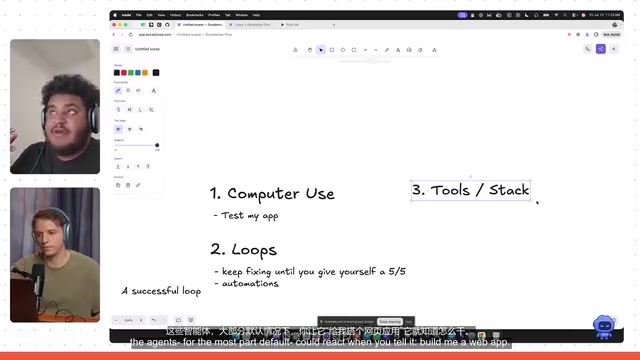
The "Loop" is the central methodology repeatedly emphasized throughout the conversation, built on three elements:
- Clear prompts: explicitly tell the agent what you want
- A feedback mechanism: give the agent a way to evaluate its own output
- A defined success criterion: provide a quantifiable threshold for judging "whether the bar has been met"
In a development context, you can have the SOUL model review the code it just wrote and score it from 1 to 5, then tell it to "keep revising until it gives itself a 5." Ross Mike notes that agents scoring their own code tend to be quite strict.

This loop approach applies equally to marketing. Riley Brown shared his method: scrape the 20 ads that competitors have run the longest (implying high conversion rates) as high-quality reference samples, have AI generate copy and then score it against each reference one by one, looping through optimization until the bar is met. The same logic applies to YouTube thumbnail design, video script creation, and similar tasks — the key is using high-quality examples as the AI's "scoring rubric."
Technique 3: Leverage the Tool Ecosystem — Build Apps Like LEGO
Ross Mike points out that a "building-block economy" has formed around agents — agents no longer need to build from scratch, but can assemble ready-made modules like LEGO bricks.
For example, when asking Codex to build a Replit clone, the agent automatically chose Convex for the database, Vercel's AI SDK to generate in-app code, and Daytona as the sandbox. He particularly praises Vercel's Eve framework because it organizes architecture using file names and folder structures (Agents, Skills, Tools, Sandbox, etc.), making it easy for agents to access and modify — a prime example of a tool "designed for agent use."
Technique 4: Multi-threaded Parallelism — Keep Agents Working at Peak Performance
Using multiple independent threads is a key technique for improving agent efficiency, with two key benefits: first, it lets you split independent features and process them in parallel; second — and more critically — each new thread starts with a fresh context.
Understanding this requires some knowledge of how the "context window" works: it represents the total amount of information a model can "remember" during a single inference pass, measured in tokens, typically ranging from 120,000 to 200,000 tokens. As conversation turns accumulate, the window gradually fills up with message history, tool call results, and intermediate outputs, causing the model's "attention" to earlier instructions to become diluted — an effect researchers call the "Lost in the Middle" phenomenon. The multi-threading strategy is essentially trading a "context reset" for "sustained high-quality output," similar to the "stateless service" design philosophy in software engineering: no dependency on historical state, each request processed independently, making the overall system more stable and predictable.
An agent that has already consumed 120,000 tokens of context performs far worse than one freshly started. Ross Mike once launched 10 threads simultaneously to test 10 different features, then went to spend time with his family and let the tools finish the work on their own.
Sites Upgrade: Codex Becomes a Full Vibe Coding Platform
This update makes the Sites feature fully available to all users. After clicking "Create a Website," users can generate a website hosted on the internet and shareable with others in one click — an experience similar to Replit or Lovable. Previously limited to Team plan users, it's now open to everyone.
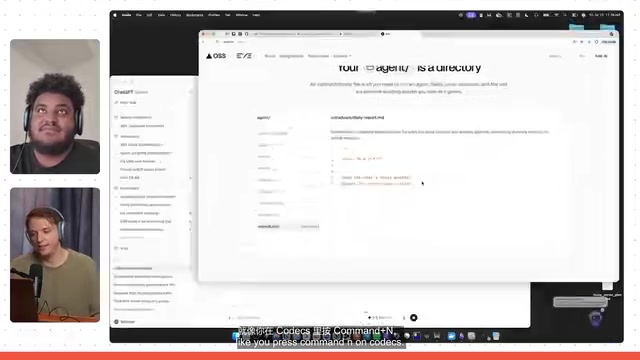
Even more conveniently, there's no need to switch to a dedicated Sites tab — just press Command N repeatedly in Codex to open a new conversation, type "Sites," and you can start building immediately, with the option to host on OpenAI's platform or Vercel. This effectively turns Codex into a complete "Vibe Coding" platform.
The term "vibe coding" was coined by OpenAI co-founder Andrej Karpathy in February 2025 and quickly became a popular phrase in the AI coding world. It means developers no longer precisely specify the implementation details of every line of code; instead, they describe in natural language "what kind of product they feel like building," and AI translates that vague intent into runnable code. Developers continuously provide feedback and accept or modify the AI's output — the whole process feels more like creative collaboration than traditional programming. The rise of tools like Replit, Lovable, and Cursor represents the commercial realization of this programming paradigm.
Additionally, the built-in browser now supports multiple tabs. Notably, OpenAI announced the discontinuation of its standalone browser project Atlas, redirecting resources toward enhancing Codex's built-in browser — further reinforcing its "Agent Native" strategic direction.
Why Merge ChatGPT and Codex? Reading the Strategic Intent
For professional developers, the "Work tab" — which generated a lot of Twitter buzz — has limited practical utility. The real strategic intent lies in user education.
OpenAI has nearly 1 billion users, but the majority treat ChatGPT as little more than "a place to ask text questions." Some users even believe Claude is the true AI action agent platform. This is both a brand perception problem and a user habit problem. The purpose of the merger is to gradually make the massive user base realize that ChatGPT can handle complex knowledge work, and to slowly build familiarity and trust with Agent capabilities.
Toward an AI Operating System: The Ultimate Form of the Super App
The conversation participants described the integrated Codex as a "super app" and "AI operating system." This industry logic has deep historical context: the "super app" concept originated in the Asian mobile internet context — WeChat and Alipay aggregated high-frequency scenarios like communication, payments, transportation, and shopping into a single entry point, forming a platform moat that's difficult to displace. The "super app" logic in the AI era is similar, but the implementation path is fundamentally different: traditional super apps relied on manually integrating third-party services, while an AI operating system achieves "intent-level integration" through Agent capabilities — users don't need to know which API was called or which app was opened underneath; they simply express their goal in natural language and the system autonomously orchestrates the completion. This mirrors Microsoft deeply embedding Copilot into Windows and Apple integrating Apple Intelligence into iOS: whoever controls the user's "intent entry point" controls the distribution rights of the next-generation computing platform.
The integrated Codex is evolving into an Agent-native operating system — when a user expresses a need, it directly opens pages in the built-in browser, pulls up small applications (like an AI-drafted email app), and the user can review and send or provide feedback to revise. Users can accomplish virtually everything just by "chatting with the AI." OpenAI's merger of ChatGPT and Codex is a pivotal move to capture this entry point.
Closing: The Real Opportunity Lies in Education and Imagination
At the end of the conversation, both creators talked about their next steps. Ross Mike has started revisiting dream projects he "used to think were beyond him," while also working on improving skills AI still struggles with — design (color, typography, spacing) and written expression — because "being clear about what you want and communicating it accurately" is the key to getting great results.
Riley Brown believes the biggest opportunity right now isn't in the tools themselves, but in education: "Tools are iterating too fast — people simply can't keep up." Helping businesses deploy these tools and teaching them efficient workflows represents a massive market gap.
As one of the most resonant lines from the conversation put it: "Most products right now are basically just a Markdown file — don't spend your time building Markdown, spend it building things that are genuinely useful." With the most advanced models available, the real bottleneck is no longer technology — it's imagination.
Key Takeaways
Related articles

Alibaba Launches Happy Shrimp: AI-Powered One-Click Complete Song Generation
Alibaba launches Happy Shrimp, an AI music generation tool that creates complete songs with lyrics, melody, arrangement, and vocals from natural language descriptions. In-depth analysis of its core features, differentiation from competitors like Suno, and industry impact.
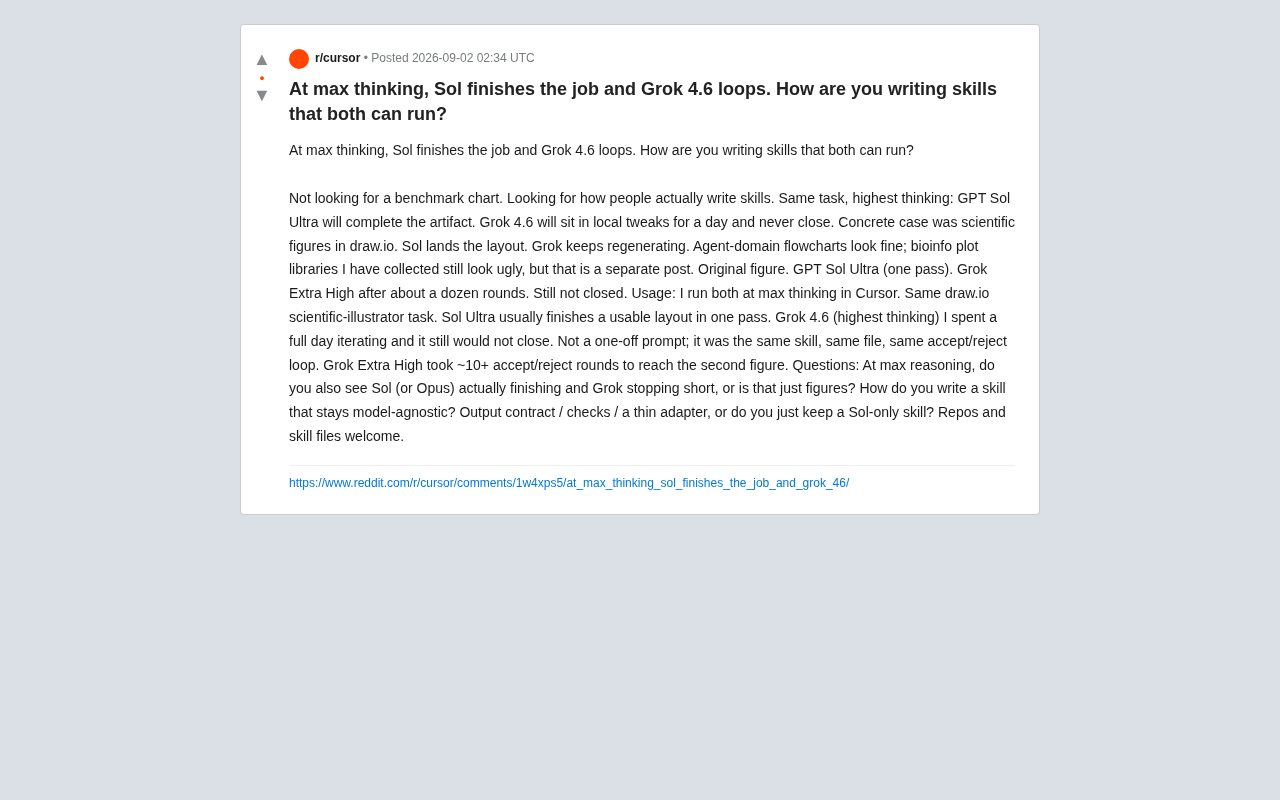
GPT Sol Ultra vs Grok 4.6: Real-World Task Completion Benchmark in Reasoning Mode
Developer benchmark reveals GPT Sol Ultra completes draw.io scientific diagrams in one iteration while Grok 4.6 fails to converge despite maximum reasoning mode, exposing that reasoning depth ≠ task delivery capability.
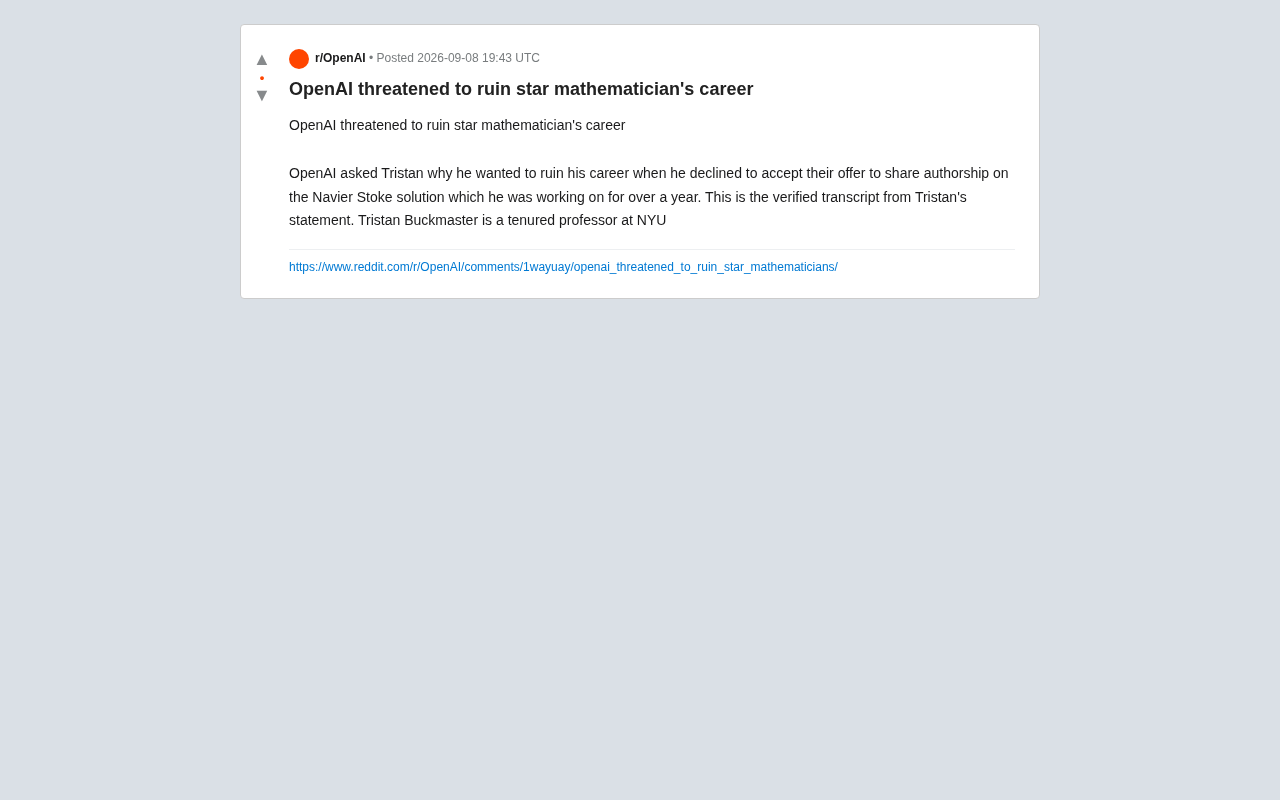
OpenAI Authorship Dispute: The Battle Over Academic Boundaries in the AI Era
OpenAI disputes authorship with mathematician Tristan Buckmaster over Navier-Stokes research, raising ethical questions about AI involvement in science.