OpenAI Partners with Oracle to Launch Community AI Education Program, Cultivating Talent for the Intelligent Era Starting from Local Schools

OpenAI partners with Oracle and Vantage to launch a community AI education program for all ages in the U.S.
OpenAI has partnered with Vantage Data Centers and Oracle to launch an AI education program in the Port Washington-Saukville community in Wisconsin, covering three key groups: students, teachers, and the existing workforce. The program aims to bring AI training to grassroots communities, address the labor market impact of AI-driven transformation, and create synergy with local AI infrastructure deployment to cultivate a localized talent ecosystem.
A New Educational Mandate for the Intelligent Era
As AI technology permeates every industry at an unprecedented pace, a critical question emerges: how do we ensure ordinary people aren't left behind by this technological revolution? OpenAI recently offered its answer — start with community education and bring AI training to local schools and grassroots communities.
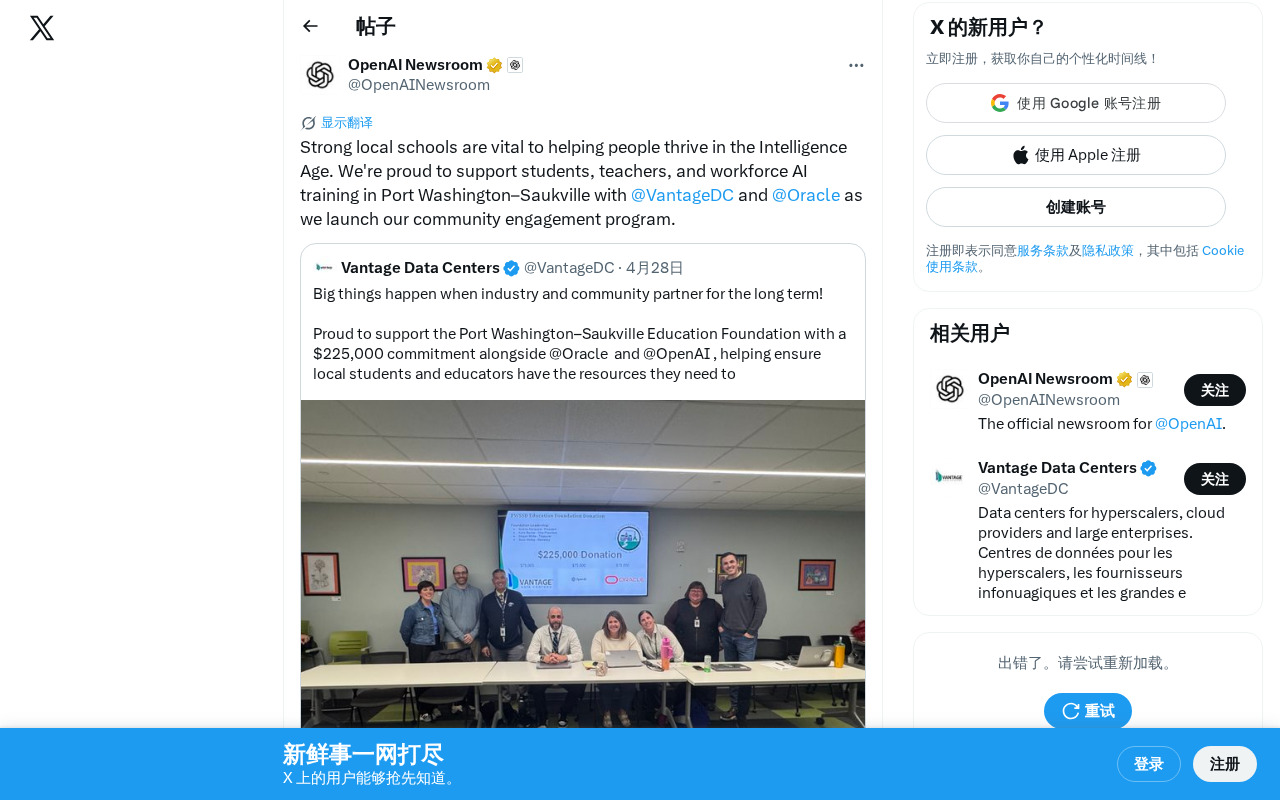
OpenAI announced a partnership with data center operator Vantage Data Centers and tech giant Oracle to launch a Community Engagement Program in the Port Washington-Saukville area of Wisconsin, providing AI training support for local students, teachers, and the workforce.
Why OpenAI Chose Local Schools as the Entry Point for AI Education
Education Is the Foundation for Navigating AI-Driven Transformation
In its announcement, OpenAI stated explicitly: "Strong local schools are essential for helping people thrive in the age of intelligence." This statement reflects a deeper logic — AI brings not just technological change, but a fundamental reshaping of the entire workforce structure.
The impact of AI on the labor market is well-documented. McKinsey Global Institute estimates that up to 375 million workers worldwide may need to switch occupational categories by 2030. The World Economic Forum's Future of Jobs Report notes that AI and automation will displace roughly 85 million jobs over the next five years while creating 97 million new ones — behind the net growth lies a profound restructuring of workforce skills. The unevenness of this "creative destruction" is particularly noteworthy: the beneficiaries tend to be concentrated among highly educated groups with existing digital skills and in tech hub cities, while blue-collar and mid-skill workers in smaller towns face greater displacement risk. Against this backdrop, if the education system fails to keep pace, the dividends of technology will belong to only a few, while the majority risk being marginalized. Making AI education universally accessible is no longer just a moral aspiration — it has become a practical necessity for maintaining social stability and economic inclusivity.
Choosing a small-to-midsize community like Port Washington-Saukville rather than a major city also sends a clear signal: AI education shouldn't be the exclusive domain of Silicon Valley and metropolitan areas — it needs to reach every community.
The Synergy Between AI Industry Deployment and Education
Here's a telling detail: the three parties in this collaboration — OpenAI, Vantage Data Centers, and Oracle — each represent different segments of the AI value chain, and understanding their positioning helps reveal the deeper logic behind this partnership.
Vantage Data Centers is a leading North American hyperscale data center operator, providing high-density computing infrastructure specifically designed for cloud computing and AI workloads — the physical facilities that AI model training and inference depend on. Oracle, through its Oracle Cloud Infrastructure (OCI), holds a significant position in enterprise AI deployment, having deepened its collaboration with NVIDIA in recent years to massively expand GPU clusters, making it an important cloud service partner for AI companies like OpenAI. The three-way collaboration in Wisconsin actually reflects the on-the-ground logic of the complete AI value chain — "computing infrastructure → cloud platform → model applications" — at the local level: data centers bring jobs and tax revenue, cloud platforms provide technical tools, and AI companies deliver knowledge and training content. Together, they form the embryo of a local AI ecosystem.
When AI infrastructure (such as data centers) is deployed in a region, whether the local area has an AI-literate workforce directly determines whether it can truly benefit from the AI industry. Advancing education and training in parallel with industrial deployment is a more forward-looking strategy, and it means this isn't merely a philanthropic gesture — it's likely an effort to cultivate a localized talent ecosystem for the long-term development of the AI industry.
Three Key Dimensions of the Community AI Education Program
Based on the information OpenAI has released, this Community Engagement Program covers three core groups:
Students: Exposing the next generation to AI technology from an early age, cultivating AI thinking and digital literacy, and laying the foundation for future learning and employment. It's worth distinguishing two related but different concepts here: Digital Literacy is a broader foundational capability framework encompassing information retrieval, cybersecurity awareness, and digital tool usage; AI Literacy, on the other hand, is a newer concept referring specifically to the comprehensive ability to understand how AI systems work, critically evaluate AI outputs, and use AI tools responsibly. Researchers Long & Magerko broke AI literacy down into 17 core competencies, including understanding the basic logic of machine learning and recognizing AI's limitations and biases. For K-12 students, the core of AI literacy education isn't about programming skills but about cultivating a mindset of "collaborating with AI" — a fundamental departure from traditional computer education and one of the biggest challenges in current curriculum design.
Teachers: Teachers are the key drivers of educational transformation. Providing AI training for teachers not only enhances their own technical capabilities but also enables AI education to be sustained in classrooms over the long term, creating a lasting mechanism.
Workforce: Offering AI skills training to working adults, helping them adapt to rapidly changing work environments and reducing the risk of unemployment due to technological displacement.
This "all ages, all roles" training design reflects deep, systematic thinking about AI education.
Industry Trend: Why Tech Giants Are Investing Heavily in AI Education
OpenAI's initiative is far from an isolated case. In recent years, Google, Microsoft, Amazon, and other tech giants have all ramped up their investments in AI education and skills training, though each company's strategic approach differs significantly. Google has invested over $100 million through its "Google.org" philanthropic arm in global AI skills training; Microsoft has pledged to provide AI skills training to 25 million people worldwide by 2025, using LinkedIn Learning as its primary delivery channel; Amazon's "AWS re/Start" and "AI Ready" programs focus on targeted training for cloud computing and AI engineers. By comparison, OpenAI's approach of going deep into a single community with coverage across all age groups represents a more "intensive cultivation" model.
Related articles
 Tech Frontiers
A Rare Quiet Day in AI: Recursive Self-Improvement Stirs Beneath the Surface
A rare quiet day in AI sees multiple sources go silent simultaneously. Behind the calm, Recursive Self-Improvement (RSI) research continues. What this means for the industry.
 Tech Frontiers
Reve 2 vs. Ideogram 4: A Deep Dive into Layout Control in AI Image Generation
A deep comparison of Reve 2 and Ideogram 4's layout control capabilities, covering technical approaches, real-world use cases, and industry trends for designers and creators.
 Tech Frontiers
In the Weights: Check Your Influence Score in the AI World
In the Weights is an AI influence search engine that quantifies your presence in the AI world with a score. Explore how it evaluates practitioners and what it means for digital identity.