OpenAI Prepaid Credits Vanish Without Records: An Analysis of API Billing Transparency Issues

OpenAI prepaid credits vanish without records, exposing AI API billing transparency gaps.
A developer reported that OpenAI marked their prepaid API credits as consumed but refused to provide any verifiable usage records. This incident highlights a broader industry problem: LLM API billing opacity. The article analyzes why token-based billing becomes a black box, examines community reactions, and offers developers practical strategies including independent logging, usage limits, and multi-provider diversification.
The Incident: Disappearing Prepaid Credits
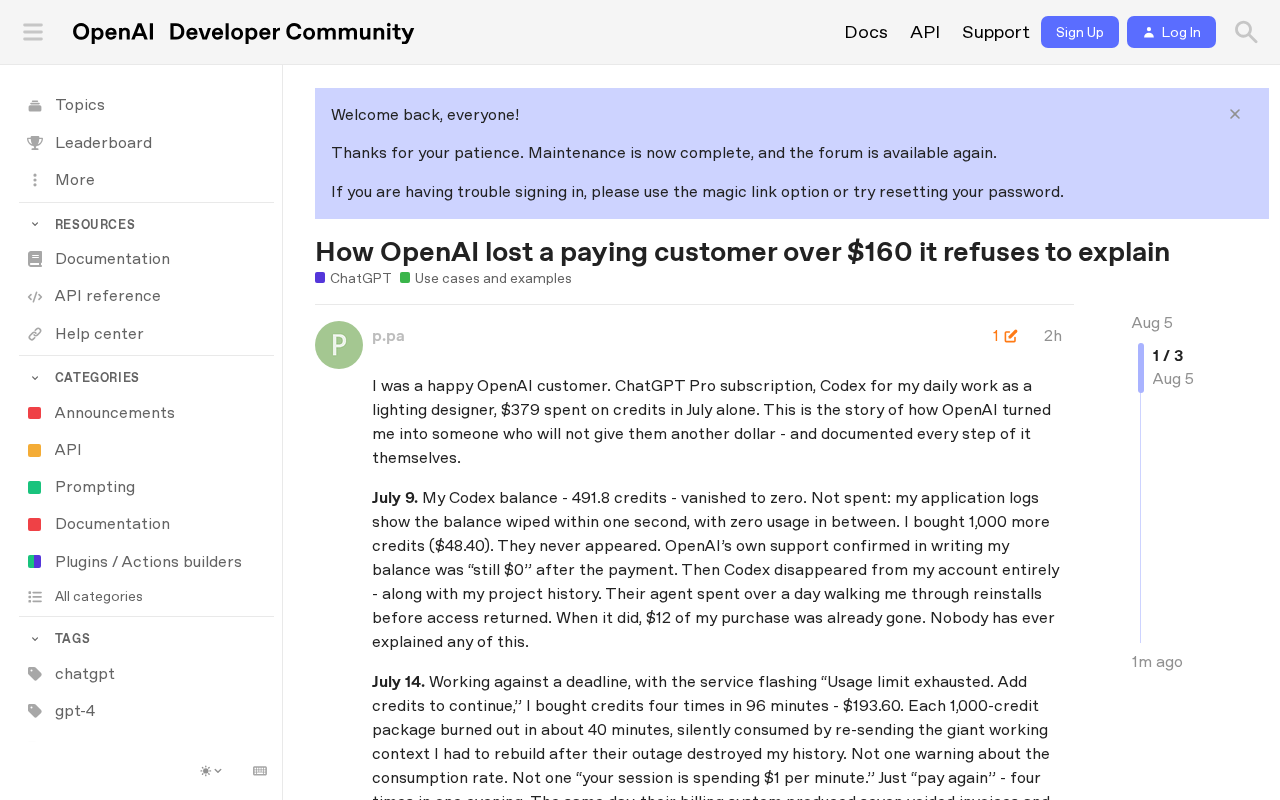
Recently, a developer posted on Hacker News about a frustrating experience with OpenAI: their prepaid API credits were marked as "consumed" by the system, but when they tried to view detailed usage records to trace where those credits actually went, OpenAI was unable (or refused) to provide any verifiable breakdown.
The post, titled "OpenAI says my prepaid credits were consumed, refuses to show any record," quickly garnered 36 upvotes and 11 comments, sparking widespread discussion in the developer community about API billing transparency. While this is just one user's case, it touches on a pain point common across AI API providers: the billing black box.
The Core Problem: Unverifiable API Billing
A Trust Crisis Under the Prepaid Model
For usage-based API services, prepaid credits should theoretically be a risk-reducing mechanism — users top up first, then consume, which in principle offers more control than auto-charging a credit card. However, when credits are deducted without any traceable record, that "control" becomes meaningless.
In the cloud computing industry, billing models generally fall into two categories: prepaid (Credits) and pay-as-you-go (post-paid). AWS Reserved Instances and GCP Committed Use Discounts are prepaid variants where users exchange upfront commitments for discounts. OpenAI's prepaid Credits system is more akin to mobile phone top-ups — charge first, use later, with the balance deducted in real time. The advantage of this model is predictable costs without surprise bills, but the downside is: if the provider's billing logic is opaque, users are at an informational disadvantage. By comparison, AWS CloudWatch and GCP Billing offer usage reports accurate down to individual API calls, supporting multi-dimensional filtering and export by resource, time period, and tags — an industry standard that current AI API billing systems have yet to fully match.
The user's core demand is actually quite simple: I paid money, and I have the right to know where it went. A complete invoice should include the timestamp of each request, the model called, the number of tokens consumed (input/output separately), and the corresponding charges. This is standard in traditional cloud services like AWS and GCP, where users can reconcile line by line.
Why LLM API Billing Easily Becomes a Black Box
LLM API billing logic is inherently more complex than traditional services:
-
Opaque token metering: Users find it difficult to precisely estimate how many tokens a request will generate, especially on the output side, which is entirely determined by the model. A token is the basic unit of text processing for LLMs, but it's neither equivalent to a character nor a word. For English text, one token corresponds to roughly 4 characters or 0.75 words; in Chinese text, a single character is typically encoded as 1-2 tokens. OpenAI's tiktoken tokenizer uses the BPE (Byte Pair Encoding) algorithm to split text into subword units. This means the same semantic expression in different wording may produce different token counts. More critically, input tokens and output tokens are usually priced at different rates (output is typically 2-4x the cost of input), and output length is entirely determined by the model's generation strategy. Users can only set an upper limit via the
max_tokensparameter but cannot precisely control actual output volume. -
Multiple models, multiple pricing tiers: GPT-4, GPT-4o, o1, and other models vary dramatically in price, making reconciliation extremely difficult when multiple models are used.
-
Hidden consumption: System prompts, function calls, context caching, and other mechanisms can generate additional token usage that ordinary users may not notice. There are multiple hard-to-detect sources of token consumption in LLM API calls. The system prompt (system message) is sent in full with every conversation request and billed accordingly — a 500-token system prompt across 100 conversation turns accumulates 50,000 input tokens. Function Calling / Tool Use injects the JSON Schema of function definitions into the context, with each function definition consuming roughly 50-200 tokens. Additionally, OpenAI's Prompt Caching feature introduced in 2024 offers a 50% discount on cache hits, but cache misses are billed at full price, and the cache creation and invalidation logic is not fully transparent to users. Structured Outputs with JSON Schema constraints also consume extra tokens. These hidden costs can accumulate to the point where actual bills far exceed what users estimate based on "visible text" alone.
When providers fail to offer granular billing breakdowns, these complexities become obstacles that prevent users from verifying their own usage.
Community Response: A Shared Anxiety Among Developers
Although the comment count was modest (11), posts like this make it to Hacker News because they strike a collective nerve. Billing disputes over API services are not uncommon in tech communities. Common user concerns include:
- Unexpected high bills: Code bugs, infinite loops, or missing rate limits can generate massive charges in a short period.
- Credit expiration or reset: Some providers' prepaid credits have expiration dates — use them or lose them.
- Lack of reconciliation tools: No ability to export detailed logs for cross-referencing against local call records.
What makes this incident unique is that the user's complaint isn't about "being charged too much," but about the "refusal to show any records whatsoever." Whether a provider can produce auditable records is fundamentally a litmus test of its transparency and accountability.
Lessons for Developers: How to Protect Your Interests
Build Independent API Call Logs
The most fundamental advice: don't rely entirely on the provider's billing dashboard. Log every API call at the application level, including:
- Request timestamp and request ID (OpenAI returns
x-request-idin response headers) - The model name used
- The
usagefield returned in the response (containing prompt_tokens, completion_tokens, total_tokens)
OpenAI returns an x-request-id field in the HTTP headers of every API response — a globally unique identifier used to locate a specific request's processing record in OpenAI's internal systems. When submitting a support ticket, providing the request ID helps the support team quickly look up billing details, processing time, and potential errors for that request. The best practice is to automatically capture and persistently store each call's request ID via middleware or decorators in your application code, forming a complete audit trail together with locally recorded token usage. It's worth noting that in streaming mode, the request ID also appears in the response headers of the first chunk, so your streaming processing logic must correctly extract this field.
With this independent log, you'll have the leverage to reconcile with the provider if a billing dispute ever arises.
Set Hard Usage Limits
The OpenAI platform provides usage limits settings, including monthly soft limits (which trigger email alerts) and hard limits (which stop service when reached). Properly configuring these limits can prevent credits from being rapidly depleted due to anomalous calls.
Diversify Risk Across Multiple Providers
For mission-critical production workloads, over-reliance on a single provider is itself a risk. Consider using a unified gateway layer (such as LiteLLM, OpenRouter, etc.) to connect multiple model providers — this enables both failover and additional billing record retention at the gateway level.
LiteLLM is an open-source unified API proxy layer that normalizes the different API formats of 100+ LLM providers (OpenAI, Anthropic, Google, Cohere, etc.) into an OpenAI-compatible interface. Developers only need to change the model name and API key to switch between providers without rewriting call code. OpenRouter is a commercial LLM routing service that provides a single entry point to access multiple models, with independent usage tracking and billing dashboards. The core value of these intermediary layers lies not only in failover and cost optimization, but also in the fact that, as independent third parties, they retain complete request/response logs that can serve as a "second set of books" for reconciliation with upstream providers. For enterprise users, deploying a self-hosted gateway also enables fine-grained access control, rate limiting, and cost allocation.
A Deeper Industry Reflection: Billing Auditability as Infrastructure
This individual case reflects a problem that must be solved as AI infrastructure matures: the credibility and auditability of billing.
As more enterprises build core business operations on LLM APIs, API consumption is likely to become a significant cost item. At that point, financial compliance and cost auditing will become essential requirements. If providers cannot offer usage breakdowns as clear and line-item verifiable as a utility bill, enterprise trust will be difficult to establish.
As AI applications scale, FinOps (Financial Operations, cloud financial management) principles are extending into the AI domain, giving rise to the emerging practice of "AI FinOps." According to a16z research, some enterprises' LLM API spending already accounts for 10-20% of their total cloud budgets. In response, the industry has developed various tools and methodologies: observability platforms like Helicone and Langfuse provide token-level cost tracking; prompt compression techniques (like LLMLingua) reduce costs by shortening input length; semantic caching reduces redundant calls by reusing historical responses for similar queries. Competitors like Anthropic and Google are also strengthening billing transparency — for example, Anthropic's Usage API supports usage breakdowns by organization member and project — and this competitive pressure is pushing the entire industry toward higher billing auditability standards.
It's worth noting that this article is based on a single user complaint, and OpenAI has not publicly responded to this specific case. The full picture remains to be seen as more information emerges. But regardless of the specific details, it serves as a wake-up call for the entire industry: while pursuing breakthroughs in model capabilities, transparent and trustworthy billing systems are equally indispensable infrastructure. For developers who depend on these services, maintaining independent records of your own usage will always be the most reliable form of self-protection.
Key Takeaways
Related articles

Amphibious Transforming Drone: Beyond 100x Power Savings, What Are the Real Needs?
Is the amphibious transforming drone just a gimmick? Starting from the 100x power difference of the M4 Morphobot, explore real application scenarios and thesis topic ideas, analyzing boundary conditions where pure drones and pure ground robots both fail.

Warhound Raises $200 Million: Genetically Engineered "War Dogs" Paired with Anduril Gear
Warhound raises $200M, backed by Ben Lamm and Palmer Luckey, to genetically engineer dogs for military and law enforcement use and equip them with Anduril gear. This article analyzes its technology direction, funding logic, and ethical controversy.

Claude API Comes to Google Cloud: IAM Integration and SDK Access Guide
Anthropic hosts the full Claude API on Google Cloud with IAM-controlled permissions and unified billing. This guide covers the Vertex AI and Anthropic-hosted entry points, IAM role configuration, and SDK access.