OpenAI Project Camellia: How AI Data Centers Are Tackling Electricity Costs, Water Usage, and Community Challenges

OpenAI's Project Camellia sets a new standard for responsible AI data center development with community-first commitments.
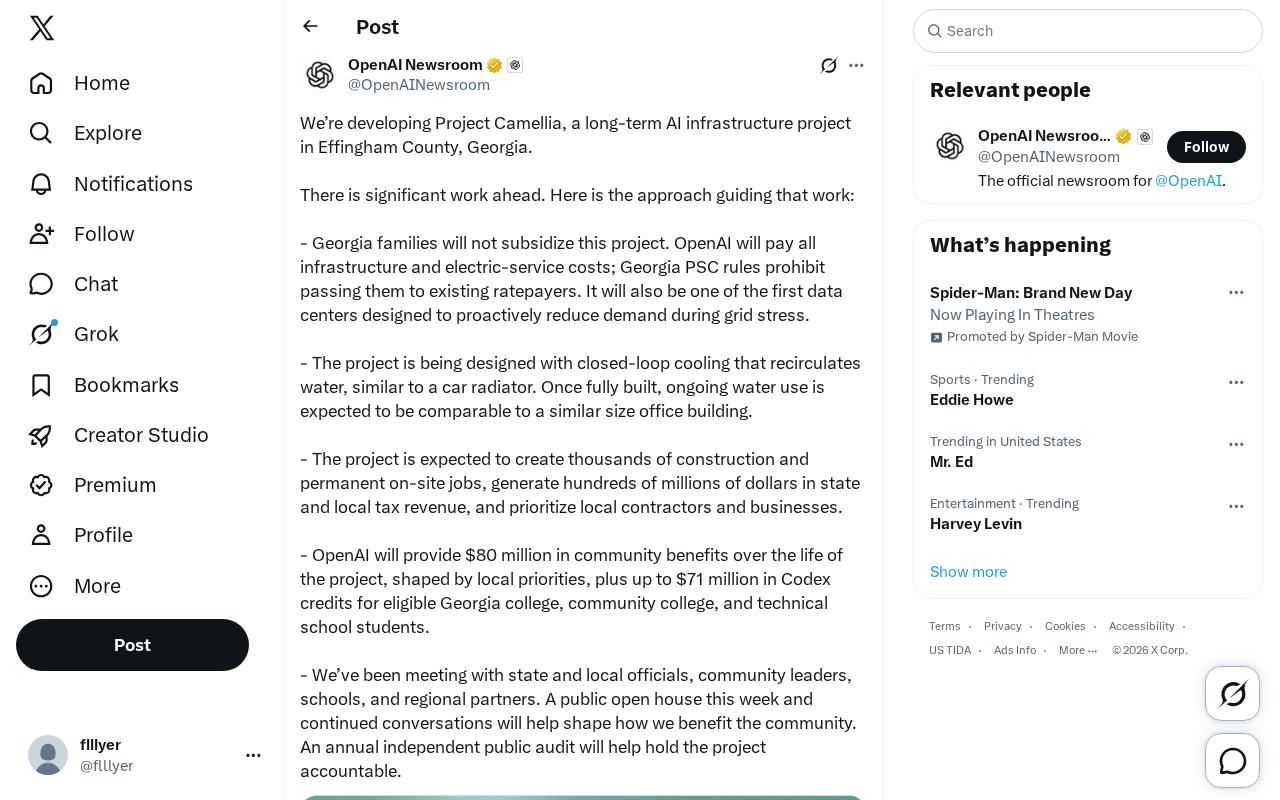
OpenAI announced Project Camellia, an AI data center in Georgia's Effingham County, addressing key public concerns about AI infrastructure. The project features closed-loop cooling to minimize water usage, grid-friendly demand response design, a commitment not to pass electricity costs to residents, $80M in community benefits, $71M in Codex education credits, and annual independent audits — establishing a new paradigm for earning social license in AI infrastructure development.
OpenAI Makes Its Move in Georgia: Project Camellia Emerges
OpenAI recently announced a long-term AI infrastructure project called Project Camellia, located in Effingham County, Georgia, USA. This marks another significant move on OpenAI's computing infrastructure map, following the "Stargate" initiative.
Stargate is a massive $500 billion AI infrastructure investment plan announced by OpenAI in early 2025 in partnership with SoftBank, Oracle, and others. It aims to build a large-scale data center network across the United States over the next four years, with the first project sited in Abilene, Texas. The plan has been called the "moon landing" of the AI era, with strategic goals that go beyond meeting OpenAI's own training and inference compute needs — it's also about ensuring U.S. leadership in AI infrastructure amid U.S.-China AI competition. Project Camellia can be seen as a specific implementation node under the broader Stargate strategy, but its independent branding and community commitment framework also show that OpenAI is crafting differentiated public relations strategies for different locations.
As the demands for large model training and inference grow exponentially, data centers have become core competitive assets for AI companies. Training current large language models (GPT-4, GPT-5 class) requires tens of thousands of high-end GPUs working in concert for months, with a single training run consuming tens of millions of kilowatt-hours of electricity. On the inference side — the process of serving user requests after model deployment — cumulative compute demands are equally staggering due to massive user bases and real-time response requirements. ChatGPT is estimated to have over 100 million daily active users, with each conversation potentially consuming more than 10 times the computational resources of a traditional Google search. This exponential hunger for compute is driving AI companies to expand data centers at unprecedented speeds.
However, the power consumption, water usage, and community impact of hyperscale data centers are increasingly becoming public concerns. OpenAI's announcement is less a simple project launch and more a carefully crafted "community responsibility pledge" — an attempt to proactively address criticism about the negative externalities of AI infrastructure while pushing forward with compute expansion.
Electricity Costs and Water Usage: Tackling Two Major Pain Points of AI Data Centers
Not Passing Electricity Costs to Local Residents
One of the most controversial issues surrounding data centers is whether their enormous power demands will drive up electricity prices for local residents. OpenAI explicitly committed in its announcement: Georgia families will not subsidize this project. All infrastructure and power service costs will be borne by OpenAI, and under Georgia Public Service Commission (PSC) regulations, these costs are prohibited from being passed on to existing electricity customers.
The Georgia Public Service Commission (PSC) is the state's independent agency responsible for regulating utilities including electricity, natural gas, and telecommunications, composed of elected commissioners. In recent years, as data centers have flooded into Georgia, the PSC has faced enormous pressure to balance economic development with protecting residential electricity rights. In 2024, Georgia Power, the state's largest utility, applied for a significant rate increase due to surging data center loads, triggering strong public backlash. The PSC subsequently enacted stricter cost-sharing rules requiring new large power customers to bear corresponding grid upgrade costs, prohibiting the socialization of these costs to ordinary residents. OpenAI's citation of PSC regulations in its announcement is a direct response to this policy context.
More notably, OpenAI stated that Camellia will be one of the first data centers designed to proactively reduce demand when the grid is under stress. This "grid-friendly" design means that when the regional grid faces peak loads or supply constraints, the data center can actively curtail its power consumption rather than becoming the straw that breaks the grid's back.
This flexible load or demand response mechanism holds significant importance in power systems. For data centers, achieving flexible load typically means: deferring non-urgent batch computing tasks (such as model training), reducing cooling system power during peak periods, or shifting portions of the load to data centers in other geographic locations. This mechanism is particularly important for grids with increasing shares of renewable energy, as the intermittent nature of wind and solar requires greater demand-side elasticity. However, for real-time inference services, load curtailment may mean degraded service quality, requiring data centers to architect load isolation between training tasks and inference services from the design stage. Regardless, this flexible load concept has demonstration significance for alleviating tensions between AI infrastructure and public power resources.
Closed-Loop Cooling: Reducing Water Usage to Office Building Levels
Water consumption is another major environmental controversy for data centers. Traditional evaporative cooling systems consume large amounts of freshwater, a particularly sensitive issue in water-scarce regions. Data center cooling methods fall into two main categories: open-loop evaporative cooling and closed-loop recirculating cooling. Open-loop systems (such as cooling towers) remove heat through water evaporation — highly efficient but enormously water-intensive — a 100MW-class data center might consume millions of liters of water per day.
OpenAI claims Camellia uses a closed-loop cooling design that dramatically reduces ongoing water consumption by recirculating cooling water — similar in principle to a car radiator. Closed-loop cooling systems keep coolant sealed within piping circuits, dissipating heat to the air through radiators or dry coolers without consuming the coolant itself. The technical challenge lies in lower heat dissipation efficiency in high-temperature environments, potentially requiring larger heat dissipation areas or auxiliary refrigeration equipment, with higher initial construction costs. However, with advances in liquid cooling technology (including direct liquid cooling and immersion cooling), closed-loop system efficiency has improved significantly.
The project's quantitative target is striking: once fully built, its daily water consumption is expected to be comparable to an office building of equivalent size. For a large AI data center, this is a remarkably aggressive commitment. If delivered, it would set a new industry benchmark for water resource utilization.
Economic Impact: Jobs, Tax Revenue, and Local-First Procurement
Camellia's economic benefits for the local area are another emphasis of OpenAI's messaging. According to the announcement, the project is expected to:
- Create thousands of construction-phase and long-term on-site jobs;
- Generate hundreds of millions of dollars in state and local tax revenue;
- Prioritize local contractors and businesses for construction participation.
This "jobs + tax revenue + local procurement" combination is a classic strategy for large infrastructure projects seeking local government and community support. For an area like Effingham County, the arrival of an AI data center means not only direct employment opportunities but also potential growth in surrounding supporting industries and services.
$80 Million in Community Benefits and $71 Million in Education Investment
OpenAI's community investment extends beyond employment and tax revenue. The announcement also outlined two substantial direct investments:
$80 Million Community Benefits Fund
Over the project's full lifecycle, OpenAI will provide $80 million in community benefits, with specific uses "shaped by local priorities." In other words, funding allocation will be determined by the community's actual needs rather than unilaterally dictated by the company. This "participatory" benefit design helps improve the targeting of funds and community buy-in.
Up to $71 Million in Codex Education Credits
More strategically significant, OpenAI committed to providing eligible Georgia university, community college, and technical school students with up to $71 million in Codex credits. OpenAI Codex was originally launched in 2021 as a code generation model and later evolved into the core engine behind GitHub Copilot. By 2025, Codex has developed into a more comprehensive AI software engineering agent platform capable of autonomously completing code writing, debugging, testing, and other development tasks. "Codex credits" are essentially usage allowances for OpenAI's platform, allowing students to use these AI development tools for free in their learning and project work.
This initiative kills two birds with one stone: it's both an educational investment giving back to the community and a way to seed the future AI talent pipeline. Getting young students to engage early with OpenAI's development tools helps expand the influence of its technology ecosystem over the long term. This strategy mirrors Microsoft's early provision of free Windows and Office to educational institutions, and Google's distribution of free Chromebooks to schools — penetrating the education market to cultivate user habits and lock in the future developer ecosystem. For computer science and engineering students, mastering AI-assisted programming tools has become an important competitive advantage in the job market.
Transparency and Accountability: Open Houses and Independent Audits
In terms of project execution, OpenAI emphasized transparency and public participation. The company stated it has held multiple rounds of discussions with state and local officials, community leaders, schools, and regional partners, and will host a public open house this week to co-shape the project's community benefits through ongoing dialogue.
More critically, OpenAI committed to annual independent public audits to ensure all commitments are fulfilled. Introducing a third-party independent audit mechanism is an important step in converting verbal promises into verifiable accountability, addressing widespread public concerns about tech giants "saying one thing and doing another."
AI Infrastructure Enters the Era of "Social License" Competition
The way Project Camellia was announced reflects a new phase in AI infrastructure development — technology and capital are no longer the only barriers to entry. "Social license" is becoming the critical variable determining whether a project can proceed smoothly.
Social License to Operate (SLO) is a concept originating from the mining industry, referring to broad recognition and acceptance by local communities and the public of a company's operational activities. Unlike legal permits, social license cannot be obtained through administrative approval — it must be earned through sustained trust-building, benefit-sharing, and transparent communication. In the data center industry, the importance of social license has risen sharply in recent years: Ireland temporarily suspended new data center approvals due to power supply constraints; Amsterdam, Netherlands implemented a data center construction ban; Loudoun County, Virginia (the world's highest density of data centers) also faced strong resident protests over noise and substation expansion. These cases demonstrate that even with sufficient funding and technical capability, projects lacking social license can still be indefinitely delayed or canceled.
OpenAI has addressed virtually every known pain point with this announcement: no cost pass-through on electricity, closed-loop cooling, grid-friendly design, local employment, community benefits, education investment, and independent audits. The comprehensiveness of this combination itself speaks to how seriously the industry now takes these issues.
Of course, a gap remains between promises and delivery. Whether technical targets like "water usage comparable to an office building" and "proactive load curtailment during grid stress" can truly be achieved still awaits verification through actual data once the project is built. Whether the independent audit mechanism has sufficient binding force also requires time to observe. But regardless, the "responsible infrastructure" paradigm represented by Project Camellia will very likely become standard practice for future large-scale AI data center projects.
Key Takeaways
Related articles

Gemini 3.7 Flash Spotted in Google Cloud Console — Launch Countdown Begins
Developers spot Gemini 3.7 Flash in Google Cloud Console, sparking discussion about its relationship to Pro and Google's model distillation strategy.

AI-Memory: Building a Cross-Tool Long-Term Memory System for Coding AIs
AI-Memory is a Rust-based open-source project providing long-term memory for Claude Code, Cursor, Aider and other Agent coding CLIs, enabling seamless handoff between vendors.

Bullet Enters the Stage: YC Newcomer Bets on a Faster Coding Agent
YC S26 startup Bullet launches a speed-focused coding Agent targeting developer latency pain points. Analysis of its differentiation, acceleration techniques, and market opportunity against Cursor and Claude Code.