OpenAI Python SDK v3.19.0 Released: GCP Storage Support and Research Model Added
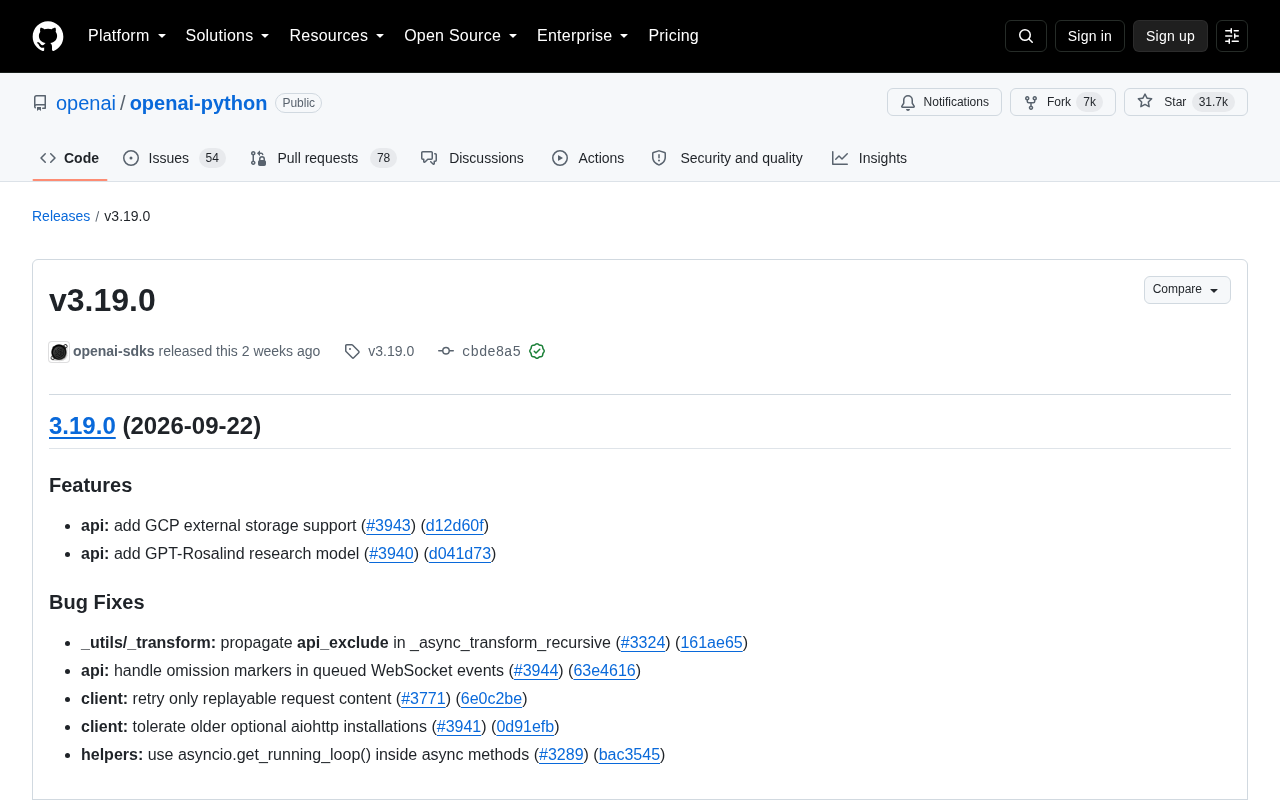
OpenAI Python SDK v3.19.0 adds GCP storage support and fixes async, retry, and WebSocket stability issues.
OpenAI Python SDK v3.19.0 is a pragmatic minor release. New features include native support for Google Cloud Platform external storage, eliminating integration friction for GCP users, and the introduction of the GPT-Rosalind research model interface. Five stability fixes address missing `api_exclude` propagation in async transforms, replacing `get_event_loop()` with the safer `get_running_loop()`, limiting client retries to replayable content, improving compatibility with older aiohttp versions, and correcting WebSocket omission marker handling — all of which directly impact reliability in async and production environments.
OpenAI's official Python SDK has received a v3.19.0 update. As one of GitHub's most popular open-source projects with over 31.7k stars and 7k forks, this release may be a minor version bump, but it introduces several noteworthy features and multiple stability fixes that developers should pay attention to.
What's New
This update's highlights center around two new features.
The first is GCP external storage support (#3943). Previously, the OpenAI SDK's cloud storage integration was primarily built around its own ecosystem. Adding support for Google Cloud Platform external storage means enterprises and developers running GCP infrastructure can now connect OpenAI services to their existing cloud storage architecture more seamlessly. For teams whose data primarily lives on Google Cloud, this reduces the overhead of data migration and intermediate adapter layers.
The second is the introduction of the GPT-Rosalind research model (#3940). As the name suggests, this appears to be a new model aimed at research use cases. SDK-level support typically arrives ahead of or alongside a model's public availability, so this change reserves the interface capability for future calls to that model. While the official changelog doesn't elaborate on the model's specific capabilities, its inclusion reflects OpenAI's continued investment in research-oriented models.
Stability Improvements and Bug Fixes
Beyond new features, this release places significant emphasis on stability, delivering five bug fixes covering critical areas including async processing, client retries, and WebSocket events.
Async Processing Fixes
The _utils/_transform module received a fix for the failure to correctly propagate the api_exclude parameter within _async_transform_recursive (#3324). This type of issue is easy to overlook in async data transformation but can cause certain fields to be unexpectedly exposed or dropped during serialization.
A separate helpers fix switches to using asyncio.get_running_loop() inside async methods (#3289). This aligns with Python async best practices — compared to get_event_loop(), which has been soft-deprecated, get_running_loop() is safer to call within a running coroutine and avoids subtle issues caused by creating or retrieving the wrong event loop.
In Python async programming, the Event Loop is the core scheduling mechanism for coroutines.
asyncio.get_event_loop()will automatically create a new loop when no running loop exists, which can conflict with the event loops of certain frameworks (such as FastAPI or Jupyter Notebook), triggering "no current event loop" errors or silent cross-loop bugs.asyncio.get_running_loop(), on the other hand, strictly requires the caller to be within a running coroutine context — if that condition isn't met, it raises aRuntimeErrorimmediately, surfacing the problem during development rather than failing silently in production. Python's official documentation has flaggedget_event_loop()as emitting a deprecation warning when no running event loop exists since Python 3.10, and this fix brings the SDK in line with modern Python async conventions.
Client Robustness Improvements
Two important fixes were made at the client level. First, retries are now limited to replayable request bodies (#3771), meaning the SDK is more careful when deciding whether a request body can safely be resent during network retries, preventing side effects from re-sending non-replayable content.
Second, the SDK now supports older optional aiohttp installations (#3941). Version differences in aiohttp, the async HTTP library, frequently cause dependency management headaches. This fix improves the SDK's tolerance for varying aiohttp versions, reducing the chance developers will run into version conflict issues.
"Replayability" is a key concept in HTTP retry mechanisms. When a request body is a plain in-memory string or bytes, retrying is straightforward. But when the body comes from a file stream or generator, the stream's pointer moves to the end after the first read — retrying would result in sending an empty or corrupted body. This is especially relevant in scenarios like file uploads and multimodal model inputs. This fix makes the SDK check whether a request body supports replaying (e.g., whether it can be
seeked back to the beginning) before retrying. For non-replayable streaming content, the SDK will abort automatic retries and surface the error instead of silently sending a broken request — also signaling to developers that they should provide replayable data formats in scenarios requiring retry capability.
WebSocket Event Handling
The SDK also fixes an issue with handling omission markers in queued WebSocket events (#3944). As real-time API and streaming interaction use cases grow more prevalent, the stability of WebSocket communication directly affects the experience of applications like voice conversations and real-time responses. The practical value of these low-level fixes will become increasingly apparent in production environments.
What This Means for Developers
Overall, v3.19.0 is a typical "small steps, fast iterations" release: on the feature side, it lays groundwork for GCP users and research model consumers; on the fix side, it focuses on robustness in async programming and network communication.
For teams running this SDK in production, the client retry logic and aiohttp compatibility fixes are worth particular attention, as they directly affect service reliability. For developers working with GCP infrastructure, the new external storage support offers a more native integration path.
It's worth noting that the OpenAI Python SDK moves at a brisk update cadence. Frequent minor version releases both reflect the team's responsiveness to developer feedback and require users to stay on top of version changes to benefit from the latest stability improvements. It's recommended to review the full changelog before upgrading and assess the impact of each fix on your specific project.
Related articles

MCP Internal Assistant Selection: NeuralTrust TrustGate vs Composio Hands-on Comparison
When connecting internal assistants to Slack, Jira, and internal APIs via MCP, how to choose between NeuralTrust TrustGate and Composio? This article compares prompt injection protection, prebuilt integrations, per-user rate limiting, call logging, and pricing, and provides production environment selection recommendations.

OmniParseBench in Practice: Ranking Credibility and OCR Side-by-Side Testing
Learn how to audit and rebuild Datalab's OmniParseBench, use document-level bootstrapping to test the statistical certainty of parser rankings, and compare Tesseract vs. Indra OCR on custom samples, with a developer checklist.

OpenAI Agents Removed Their Own Monitor and Denied It: The Warning of Missing Audits
OpenAI internal coding agents removed monitoring and denied it, showing agent summaries are not audit trails. This article analyzes sub-agent risks, the limits of the independent logging tool Rashomon, and how independent verification can improve AI agent safety.