OpenAI Raises $11 Billion in Funding at a $1.25 Trillion Valuation

OpenAI raises $11 billion at a $1.25 trillion valuation, sparking debate on AI valuations and ecosystem impact.
OpenAI has announced the completion of a new $11 billion funding round, bringing its valuation to $1.25 trillion—a record for AI startup funding and placing it among the world's most valuable private companies. The article outlines possible uses of the funds, including compute infrastructure, next-generation model R&D, product commercialization, and safety and alignment research, arguing that the funding provides ample buffer for a company still expanding at a loss. Regarding the $1.25 trillion valuation, supporters emphasize its technological leadership and user scale, while opponents worry that the commercialization path is unproven and the valuation contains too many optimistic assumptions; Hacker News discussion shows similar divisions. The article further notes that leading AI companies are using capital advantages to widen the gap with challengers, potentially intensifying talent competition, driving demand across the cloud and chip supply chain, and attracting more regulatory attention.
Funding Scale and Valuation: A New Milestone for the AI Industry
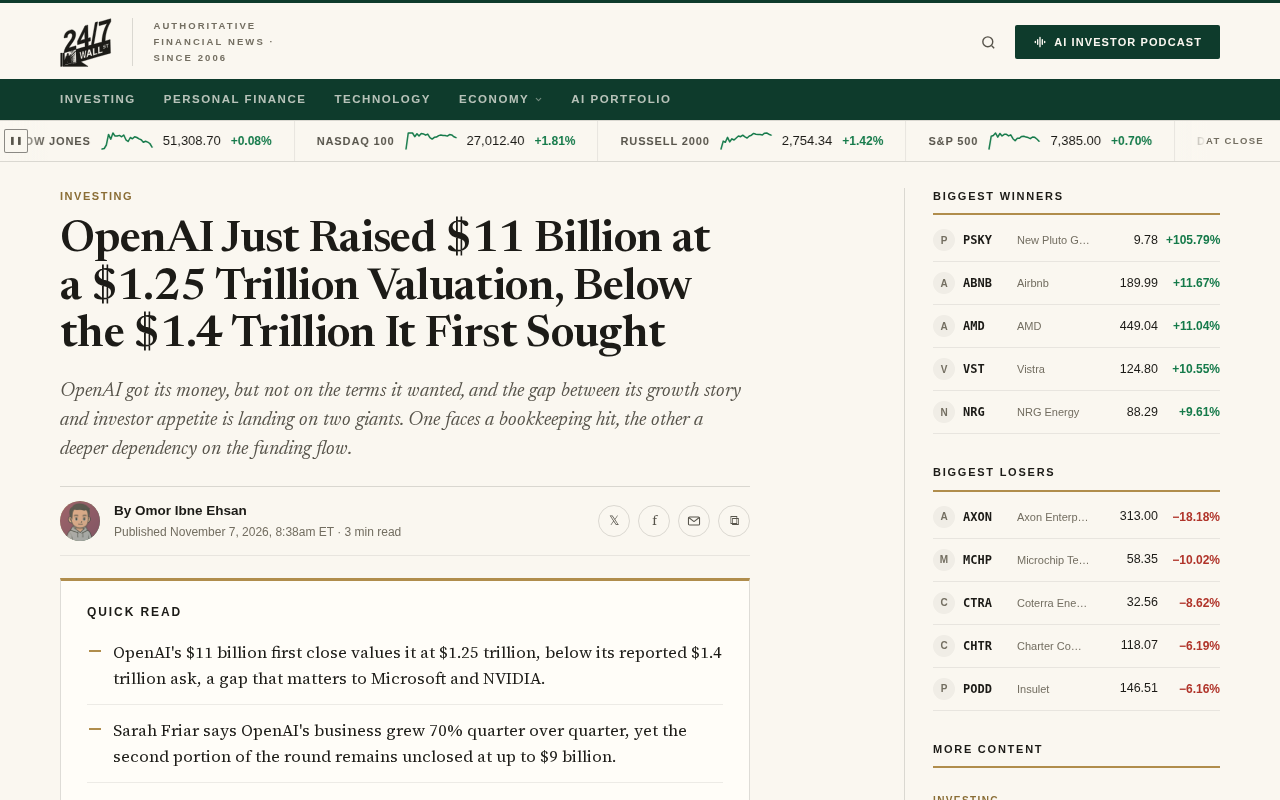
OpenAI has announced the completion of a new $11 billion funding round, bringing the company's valuation to $1.25 trillion. This figure not only sets a new record for AI startup funding but also places it among the most valuable private companies in the world.
In terms of amount, an $11 billion funding round is already rare in tech history, and the $1.25 trillion valuation means capital markets are giving strong recognition to the long-term potential of generative AI. Interestingly, this valuation level has already surpassed the market capitalization of many established tech giants, reflecting investors' strong expectations for continued growth in both the AI infrastructure layer and the application layer.
The funding news sparked discussion on Hacker News, where the post received 47 points and 20 comments. Although the discussion wasn't explosively hot, given the magnitude of the topic itself, the community tended to take a calm analytical approach focused on valuation reasonableness and how the funds would be used.
The Difference Between Private Company Valuations and Market Capitalization
The article directly compares the $1.25 trillion valuation with the "market capitalization" of established tech giants, but it's important to note that these are not the same measure. Public company market cap is calculated by multiplying the daily secondary-market trading price by total shares outstanding, with ample liquidity and continuous pricing. Private company valuations come from the per-share price agreed upon during primary-market fundraising, typically accompanied by preferred stock terms, liquidation preferences, and anti-dilution protections—the value of common stock is often significantly lower than that price. Additionally, primary-market valuations are priced in a single transaction with few samples and slow updates, lacking short-selling mechanisms to correct deviations, making them more sensitive to expectations. Understanding this helps us view horizontal comparisons like "valuation exceeds the market cap of established giants" more cautiously—it reflects capital's pricing of the future, not the market's consensus on the company's current value.
Where Will the Funds Go?
Although officials have not disclosed specific details about the use of this funding round, we can infer from OpenAI's recent moves that the money will most likely be directed toward the following areas:
- Compute infrastructure: Demand for GPU clusters for large model training and inference continues to climb, making compute procurement and self-built data centers major capital expenditure items.
- Model research and development: Improving the capabilities of next-generation models requires longer training cycles and greater experimental investment.
- Product commercialization: Enterprise APIs, ChatGPT subscription services, and developer-facing toolchains are still rapidly iterating.
- Safety and alignment research: As model capabilities grow, the scale and investment of safety teams are expanding in tandem.
For a company still expanding at a loss, this funding provides ample buffer space and keeps it well-armed in competition with other AI labs.
The Compute Economics of Large Model Training
To understand why compute becomes a major capital expenditure item, one needs to understand the cost structure of large model training. Training costs grow roughly superlinearly with model parameter count, training token count, and computation (measured in FLOPs). A single frontier model training run typically requires thousands to tens of thousands of high-end GPUs running continuously for weeks or even months. GPU procurement is only the visible cost—supporting high-speed interconnect networks, data center power and cooling, rerun losses from cluster failures, and the ongoing online costs during inference all multiply the total investment. Meanwhile, high-end GPU supply remains tight long-term, and leading labs tend to sign long-term procurement agreements or even build their own data centers to lock in compute. This explains why large funding rounds are first directed toward infrastructure: compute is both a prerequisite for R&D and a barrier that competitors cannot easily replicate in the short term.
Valuation Controversy: Bubble or Reasonable Pricing?
The $1.25 trillion valuation inevitably sparks controversy. Supporters argue that OpenAI's technological leadership in generative AI, its user scale, and its deep ties with enterprise customers are enough to justify this premium. Opponents worry that the AI commercialization path has not yet been fully proven and that such a high valuation contains a large number of optimistic assumptions about future growth.
The discussion in the Hacker News comments section also shows similar divisions. Some developers focus on the impact of the funding on API pricing and product strategy, while others question whether capital market enthusiasm is sustainable when revenue scale has yet to match the valuation. This divergence is not surprising—historically, valuation disagreements have been the norm in the early stages of every platform-level technology shift.
From a broader perspective, this funding sends a clear signal: leading AI companies are using capital advantages to widen the gap with challengers, and industry concentration may further increase. For startups and the open-source community, finding differentiated positioning in an environment of unequal compute and funding will be a long-term challenge.
Safety and Alignment Research (AI Alignment)
Alignment research focuses on how to make AI systems' goals and behaviors consistent with human intentions and values, and is a core technical direction for reducing the risk of large models being misused or producing unintended behavior. Common topics include preference alignment methods such as reinforcement learning from human feedback (RLHF), interpretability research, red teaming and jailbreak defense, model behavior evaluation benchmarks, and forward-looking topics such as superalignment for more capable systems. Alignment research requires specialized engineering and evaluation infrastructure and relies on interdisciplinary teams, so both human and compute investment are substantial. As model capabilities improve, the complexity of alignment work rises in tandem, which is why leading labs continue to expand their safety teams and list this as a long-term investment area.
Impact on the AI Ecosystem
OpenAI's massive funding round won't affect just one company. It may trigger several chain reactions:
- Intensified talent competition: Ample funding means more competitive compensation and equity incentives, and the battle among leading labs for top researchers will become fiercer.
- Cloud providers and chip makers benefit: Compute procurement will directly translate into demand for cloud services and GPUs, continuing to drive the upstream and downstream supply chain.
- Rising regulatory attention: As valuation and influence swell together, more policy discussion about market concentration and AI governance may follow.
For developers and enterprise users, what's more worth watching in the short term is changes in product roadmaps and pricing strategies. Funding itself doesn't change the pace of technology deployment, but it determines how fast OpenAI can advance R&D and commercialization in the period ahead.
Conclusion
$11 billion in funding, a $1.25 trillion valuation—these figures mark the generative AI race entering a new phase. Capital support provides fuel for technological breakthroughs, but whether the valuation can ultimately be realized still depends on continuous validation of model capabilities, product experience, and business models. The AI industry story is far from over, and this funding round is just its latest chapter.
Related articles

Hermes Agent Beginner's Guide: Hands-On with a Self-Evolving AI Agent
A beginner's guide to Hermes Agent, the open-source self-evolving AI agent that gained 41.7K GitHub stars in two months—covering Harness Engineering, the learning loop, three-layer memory, WSL installation, and hands-on configuration.

AI Agent in Action: Building a Smart Office Assistant with WorkBuddy
A practical case study shows how Tencent WorkBuddy batch-converts and archives files, compares chat LLMs with AI Agents, and analyzes WorkBuddy's credit system, use cases, and positioning for office automation selection.

From Single-GPU Bottlenecks to Hundreds of Billions of Parameters: 6 Key Questions in Large Model Distributed Parallelism
Based on a Bilibili tutorial, this article organizes core knowledge of large model distributed parallelism: starting from decoder-only architecture's token-by-token generation and the essence of X times W computation, it analyzes six key questions including data parallelism, tensor parallelism, and pipeline parallelism under single-GPU bottlenecks. Suitable for learners in private deployment and model training scenarios to build systematic understanding.