OpenAI Realtime Voice Demo Event: Judging Criteria, Rewards, and Opportunities for Developers

OpenAI hosts a Realtime Voice Demo event on May 27 in SF, calling for developer voice AI projects.
OpenAI announced a Realtime Voice Demo event on May 27 in San Francisco, inviting developers to showcase projects built on its voice models. Judging criteria cover four dimensions: interesting, useful, creative, and technically ambitious. Top projects will present onstage and gain community exposure. This move reflects OpenAI's positioning of realtime voice interaction as a core strategic direction, reinforcing its full-stack competitive advantage through developer ecosystem building.
OpenAI Realtime Voice Demo Event Overview
The OpenAI team has announced a Realtime Voice Demo showcase event to be held on May 27 in San Francisco, inviting developers to demonstrate prototypes and products built on their latest voice models. This marks another significant step in OpenAI's ongoing effort to build a voice AI developer ecosystem.
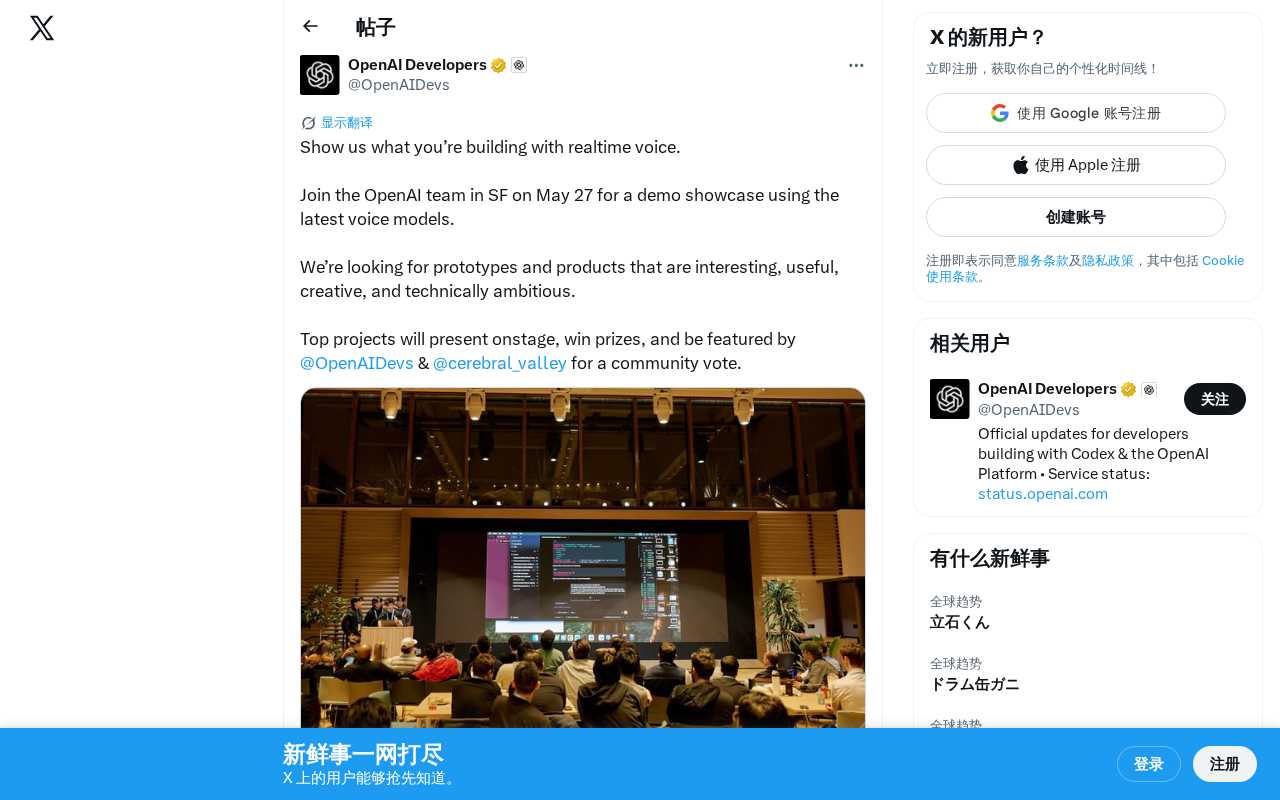
Submission Requirements and Judging Criteria
OpenAI has clearly stated they're looking for voice AI projects with the following qualities:
- Interesting: Capable of capturing attention and sparking curiosity
- Useful: Solving problems in real-world scenarios
- Creative: Demonstrating unique design thinking
- Technically Ambitious: Pushing boundaries in technical implementation
These four evaluation dimensions reflect OpenAI's expectations for voice AI applications — not just technical demonstrations, but projects with real-world value and innovation.
Event Rewards
Selected outstanding projects will receive three types of rewards:
- Stage Presentation: Top projects will perform onstage demos at the event
- Win Prizes: Specific prize details have yet to be announced
- Community Exposure: Joint promotion by OpenAI's official developer account (@OpenAIDevs) and the prominent Silicon Valley AI community Cerebral Valley (@cerebral_valley), with community voting open to the public
The Strategic Significance of Realtime Voice Technology
OpenAI's Rapid Voice Model Iteration and Technical Architecture
OpenAI has been making aggressive moves in the voice space recently. From GPT-4o's multimodal voice capabilities to the launch of the Realtime Voice API, and now this developer community Demo call, voice interaction has become one of the core pillars of OpenAI's product strategy.
The OpenAI Realtime Voice API is a low-latency voice interaction interface officially launched in fall 2024, built on the GPT-4o multimodal architecture. Unlike traditional voice processing pipelines (the three-stage ASR→LLM→TTS architecture), the Realtime API adopts an end-to-end audio processing approach, performing understanding and generation directly at the audio stream level, compressing interaction latency to under 300 milliseconds — approaching the response rhythm of natural human conversation. The API supports WebSocket real-time streaming, enabling developers to build advanced conversational features such as interruption handling, emotional awareness, and multi-turn context retention.
The core challenges of realtime voice technology extend far beyond speech recognition accuracy. First is end-to-end latency control: from when the user finishes speaking to when the AI begins responding, the industry-recognized natural conversation threshold is under 500 milliseconds — beyond this, users noticeably perceive a pause. Second is barge-in handling: in real conversations, users may interrupt the AI at any time, requiring the system to detect voice activity in real-time (VAD, Voice Activity Detection) and gracefully terminate current output. Third is noisy environment adaptation: background noise, multiple speakers, and other interference in real-world scenarios place extremely high demands on model robustness. Fourth is natural expression of emotion and intonation, which directly affects users' perception of whether the AI "sounds human." By hosting events like this, OpenAI is both discovering innovative voice AI application scenarios and building a developer ecosystem around its voice models.
The Competitive Landscape of Voice AI Developer Ecosystems
The voice AI space has developed a multi-layered competitive landscape: at the foundation model layer, giants like OpenAI, Google (Gemini Live), and Meta dominate with their computing power and data advantages; at the speech synthesis layer, ElevenLabs has achieved a valuation exceeding $1 billion with its high-fidelity TTS technology; at the emotional voice layer, Hume AI focuses on emotionally expressive voice interaction; at the speech recognition layer, Deepgram captures the developer market with low-cost, high-accuracy ASR APIs. OpenAI's Realtime API attempts to integrate the full stack, consolidating competitors' point advantages into a unified solution — this is the strategic motivation behind hosting developer events and building application ecosystems.
The collaboration with Cerebral Valley also deserves closer attention. Cerebral Valley is an in-person AI practitioner community that emerged in San Francisco in late 2022, self-organized by a group of Silicon Valley AI entrepreneurs, with high-density technical sharing, Demo showcases, and founder networking as its core activities. After ChatGPT ignited the AI boom, Cerebral Valley quickly became one of the Bay Area's most influential gathering places for AI entrepreneurs, with its events regularly attracting researchers and engineers from top AI labs including OpenAI, Anthropic, and Google DeepMind. The joint promotion means project exposure will directly reach the most core AI early adopter community — a proven and effective ecosystem-building strategy.
Implications for Voice AI Developers
For developers exploring voice AI applications, this event sends several important signals:
- Realtime voice is the current frontier: OpenAI's willingness to invest resources in promotion shows their confidence in the commercial prospects of this direction
- Application-layer innovation is valued: They're looking not only at technical depth but also at product thinking and creativity
- Community-driven product discovery: OpenAI is using community events to identify potential killer applications
Whether or not you can attend the in-person event on May 27, developers should pay attention to the capabilities and boundaries of the OpenAI Realtime Voice API — especially its technical features in low latency, interruption handling, and emotional expression — and consider landing possibilities in vertical domains such as customer service, education, healthcare, and entertainment. The application window for voice AI has opened, and early positioning is key to gaining a competitive edge.
Key Takeaways
- OpenAI will host a Realtime Voice Demo showcase event in San Francisco on May 27
- Judging criteria cover four dimensions: interesting, useful, creative, and technically ambitious
- Outstanding projects can present onstage, win prizes, and gain community exposure
- The event is co-hosted with the Cerebral Valley community, with community voting open to the public
- The Realtime Voice API uses an end-to-end audio processing architecture, compressing latency to under 300 milliseconds
- This reflects OpenAI's positioning of realtime voice interaction as a core strategic direction, integrating full-stack capabilities to compete against vertical competitors
Related articles
 Tech Frontiers
A Rare Quiet Day in AI: Recursive Self-Improvement Stirs Beneath the Surface
A rare quiet day in AI sees multiple sources go silent simultaneously. Behind the calm, Recursive Self-Improvement (RSI) research continues. What this means for the industry.
 Tech Frontiers
Reve 2 vs. Ideogram 4: A Deep Dive into Layout Control in AI Image Generation
A deep comparison of Reve 2 and Ideogram 4's layout control capabilities, covering technical approaches, real-world use cases, and industry trends for designers and creators.
 Tech Frontiers
In the Weights: Check Your Influence Score in the AI World
In the Weights is an AI influence search engine that quantifies your presence in the AI world with a score. Explore how it evaluates practitioners and what it means for digital identity.