OpenAI Releases GPT-6.1 Sol: Stronger Coding Capabilities at One-Fifth the Price of Astra

OpenAI's GPT-6.1 Sol delivers near-flagship coding performance at one-fifth the price of GPT-6 Extra.
OpenAI has released GPT-6.1 Sol, a cost-efficient model targeting coding and automation workflows. At $2/million input tokens and $0.10/million for cached input, it costs roughly one-fifth of GPT-6 Extra while approaching its performance on DeepSWE-1.1 and AutomationBench. Ultra Fast variants reaching 8× Extra's speed are also available on the new $500/month Pro plan. Notably, the anticipated GPT-6.1 Extra was cancelled due to safety issues found in internal testing — a sign that safety review frameworks are now materially shaping release timelines.
OpenAI Quietly Launches GPT-6.1 Sol
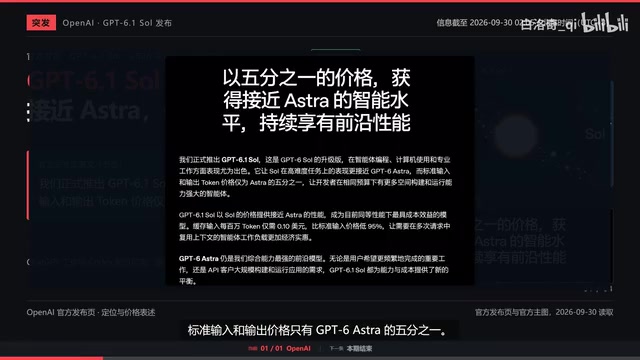
OpenAI has once again accelerated its product release cadence, launching GPT-6.1 Sol — officially positioned as an upgrade to GPT-6 Sol, with enhanced capabilities for coding, computer use, and professional workflows. The most notable aspect is its pricing: standard input and output costs are just one-fifth those of GPT-6 Extra, lowering the barrier to high-performance AI by a full order of magnitude.
GPT-6.1 Sol is now available in ChatGPT Workbench and Codex for users on Plus through EDU plans, though it hasn't rolled out to the standard chat interface yet. Developers can access it via API using the model name GPT-6.1 Sol. This "professional tools first, consumer rollout later" approach reflects OpenAI's clear prioritization of coding and automation use cases.
Performance: Approaching Extra at a Fraction of the Cost
According to official benchmark data, GPT-6.1 Sol's core selling point is its cost-effectiveness. On the DeepSWE-1.1 benchmark, it comes close to GPT-6 Extra's performance at roughly one-fifth the cost, while also scoring 6.4 percentage points higher than the previous best from GPT-6 Sol.
On AutomationBench, GPT-6.1 Sol outperforms Opus-5.5 by 2.2 percentage points at approximately one-third the cost. In short, this model aims to redefine the "good enough and affordable" benchmark for coding and automation tasks.
OpenAI does make clear, however, that GPT-6 Extra remains the most capable flagship model. GPT-6.1 Sol is better understood as a "high-efficiency alternative" — delivering near-flagship performance on most professional tasks while keeping costs within acceptable range.

DeepSWE-1.1 is a large model evaluation benchmark specifically designed for software engineering tasks. Its full name is the Deep Software Engineering Benchmark, and it measures a model's ability to complete bug fixes, feature implementations, and code refactoring within real-world codebases. Unlike earlier benchmarks that only tested code completion accuracy, the DeepSWE series emphasizes "end-to-end resolution of real engineering problems" — drawing evaluation scenarios from actual open-source project issues and requiring models not just to generate code, but to understand project context, identify problems, and produce patches that pass tests. AutomationBench, meanwhile, focuses on computer-use automation, testing model performance in scenarios like browser navigation, desktop application control, and multi-step task execution — closer to the real-world demands of AI Agents. The selection of these two benchmarks itself signals OpenAI's intended positioning for GPT-6.1 Sol: not general-purpose conversation, but coding and automation workflows.
Pricing Details: Cached Input Pricing Takes Center Stage
On the pricing side, GPT-6.1 Sol's standard API rates are $2 per million input tokens and $10 per million output tokens. Cached input is priced as low as $0.10 per million tokens — a 95% discount over standard input pricing. For applications that repeatedly use the same context, this cost advantage is substantial.
Alongside this launch, OpenAI also introduced GPT-6 Extra Ultra Fast and GPT-6.1 Sol Ultra Fast — accelerated variants claimed to reach speeds up to 8× that of Extra — available to the new $500/month Pro plan.

Community discussion has largely centered on pricing. According to community feedback relayed by a Bilibili content creator, the top-voted comment on Hacker News cited the official page noting that cached input pricing has dropped to $0.10 per million tokens — half the cached price of GPT-6 Sol. This tiered price reduction is continuously driving down the marginal cost of calling large language models.

Token caching (Prompt Caching) is an API-level optimization: when a request contains a prefix identical to a previous call — such as a fixed system prompt, long document, or codebase context — the server can reuse already-computed intermediate states, skipping redundant computation and significantly reducing the cost for that portion of the request. OpenAI prices this separately as the "cached input price." For applications that carry large amounts of fixed context in every request — such as developer tools querying against a full codebase, or customer service bots with lengthy system prompts — the higher the cache hit rate, the closer the actual per-call cost gets to the cached rate rather than the standard rate. GPT-6.1 Sol's cached input price of $0.10 per million tokens equals just 5% of the standard input price, which has a significant impact on cost structures for high-frequency, long-context use cases.
The Missing GPT-6.1 Extra and Safety Concerns
Notably, the widely anticipated GPT-6.1 Extra was not released alongside this update. According to a report from The Wall Street Journal, the model was cancelled after safety issues were identified during internal testing.
This detail reveals the tradeoffs OpenAI is navigating between expanding capabilities and maintaining safety controls. The delay or cancellation of a flagship-tier model suggests that internal red lines before market release are tightening — particularly as model capabilities inch closer to autonomously completing complex tasks. For practitioners focused on AI safety, this may carry more signal than the pricing changes.
The "issues found during internal testing" in AI safety reviews typically span multiple dimensions: jailbreak robustness (whether the model can be induced to produce harmful content), autonomous behavior assessment (whether the model executes unauthorized actions in agent scenarios), and dangerous capability evaluation (whether the model has crossed thresholds that could assist with bioweapons, cyberattacks, or other high-risk tasks). As model capabilities continue to grow, leading AI labs have broadly adopted tiered safety evaluation frameworks — Anthropic's "AI Safety Levels" and OpenAI's "Preparedness Framework" are examples. If a model triggers a red line on any dangerous capability assessment, it may be delayed or required to undergo targeted mitigation before release, even if its overall performance is strong. The cancellation of GPT-6.1 Extra stands as one of the more public examples of such a framework actually constraining a product launch.
What This Means for Developers
Taken together, the release of GPT-6.1 Sol signals several clear trends: coding and automation are becoming the core battleground for large model competition; the price war continues, with caching mechanisms serving as the key lever for cost reduction; and safety reviews are beginning to meaningfully affect product release timelines.
For teams building API-powered applications, one-fifth the price at near-flagship performance means many projects that were previously cost-prohibitive are now viable. The Ultra Fast variants offer new options for latency-sensitive real-time applications. Under a tiered strategy where Extra remains the flagship and Sol handles the cost-efficiency tier, developers will need to more carefully match model tier to task type.
Related articles

iPhone Duo Battery Life Tested: One Charge a Day Is Unavoidable, and the Large Screen Is the Culprit
iPhone Duo battery test: heavy use needs at least one charge a day, and about 30% remains after 6.5 hours of screen-on time. How often the large screen is unfolded is key; a MagSafe battery pack helps, and long-term degradation is also worth watching.

Kimi K3.1 Pro Open-Sourced: 2.8 Trillion Parameters Close In on Opus
Moonshot releases the open-source MoE model Kimi K3.1 Pro, with 2.8T total parameters and 104B activated, trailing Opus 5.5 by under 1 point on Terminal Bench 4.0.

Costco Tech Price Guessing: Are Monitors, Keyboards, Mice, and Bose Speakers Worth It?
A YouTube blogger guesses prices of Costco tech products: 2K 180Hz monitor, Logitech keyboard and mouse, Bose speaker, and CyberPower UPS, revealing warehouse-store selection and brand premium.