OpenAI Responds to Musk's Lawsuit: Truth Is on Our Side, Ready for Sworn Testimony in Court

OpenAI aggressively responds to Musk's lawsuit, calling it jealousy-driven and demanding sworn testimony.
OpenAI issued a forceful statement responding to Musk's lawsuit, declaring "truth and the law are on our side" and characterizing the suit as a jealousy-driven attempt to hinder a competitor, while demanding Musk testify under oath before a California jury. The core dispute centers on whether OpenAI's transformation from nonprofit to for-profit company betrays its founding mission, and whether Musk's true motivation stems from xAI's competition with OpenAI. The case's verdict will profoundly impact AI industry organizational governance and financing models.
Latest Developments in the OpenAI vs. Musk Lawsuit
OpenAI recently published a strongly worded statement on social media, directly responding to the lawsuit filed by Elon Musk. This legal battle over the future direction of the AI industry continues to escalate, drawing widespread attention across the tech world.
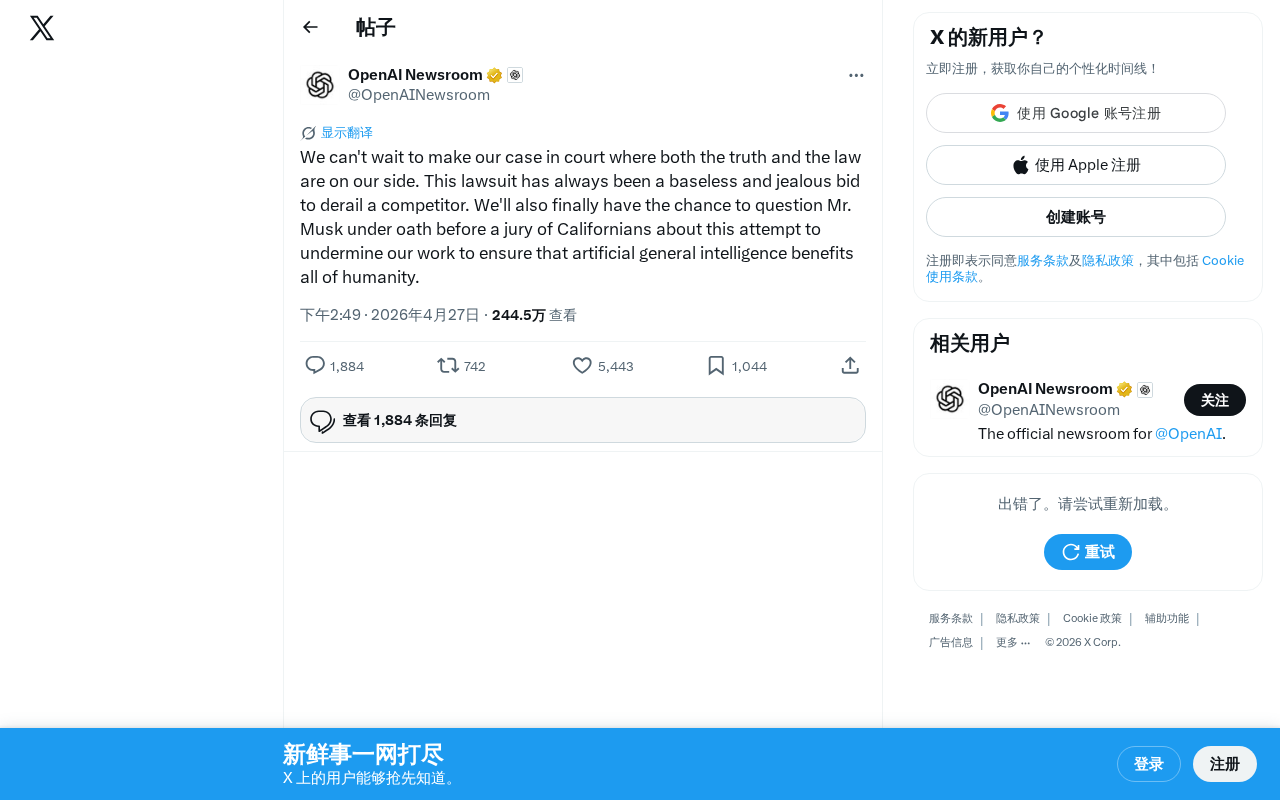
OpenAI's Core Position: Truth and the Law Are on Our Side
Characterizing Musk's Lawsuit
In its statement, OpenAI expressed strong confidence in the upcoming court proceedings, explicitly stating that "truth and the law are on our side." This declaration signals OpenAI's high confidence in its legal standing and indicates thorough preparation for litigation.
More notably, OpenAI characterized Musk's lawsuit as "a baseless, jealousy-driven attempt to hinder a competitor's progress." This sharp language directly attributes Musk's legal action to commercial competitive motives rather than the public interest claims he has put forward.
Demanding Musk Testify Under Oath
The most noteworthy part of OpenAI's statement is its explicit desire to have Musk questioned under oath before a California jury. This strategy carries multiple layers of significance:
- Legal dimension: Sworn testimony means every word Musk says will be subject to perjury constraints, severely limiting the exaggerated rhetoric he typically employs in public discourse
- Public opinion dimension: Having the case tried before a California jury may be more favorable to OpenAI — California, home to Silicon Valley, generally holds more open attitudes toward technological innovation
- Strategic dimension: Proactively seeking confrontation rather than avoidance demonstrates OpenAI's offense-as-defense litigation strategy
OpenAI's specific emphasis on a "California jury" carries important legal strategic significance. California is the global epicenter of the tech industry, and local jurors tend to have greater understanding and acceptance of tech companies' business logic and innovation culture. Additionally, California's legal system typically applies a "reasonable business purpose" standard for contract interpretation, which may be more favorable to OpenAI's transformation. The requirement for Sworn Testimony is another sharp weapon — in public settings, Musk habitually uses exaggerated, emotionally charged language, but after taking an oath in court, any false statements constitute Perjury, carrying criminal prosecution risk. This strategy forces Musk to convert his public accusations into specific factual evidence that can withstand legal scrutiny, significantly raising his litigation costs.
The Core Dispute: AGI Mission and OpenAI's Nonprofit Transformation
At the end of its statement, OpenAI reaffirmed its core mission — ensuring that Artificial General Intelligence (AGI) benefits all of humanity. This is precisely the central point of contention in Musk's lawsuit.
The definition of AGI itself is one of the key points of dispute. Artificial General Intelligence (AGI) refers to an AI system capable of performing intellectual tasks across any domain like a human, fundamentally different from current "narrow AI" (such as systems specialized in playing chess or recognizing images). There is still no unified academic definition of AGI — OpenAI's internal documents show that the company has specific internal criteria for "when AGI is achieved," and once that threshold is reached, Microsoft's licensing agreement would automatically terminate. Part of Musk's legal argument rests on this: Has OpenAI in fact approached or achieved AGI while deliberately obscuring the definition to maintain its commercial partnerships?
OpenAI's nonprofit transformation history is equally complex. OpenAI was founded in 2015, initially operating as a nonprofit organization with a core commitment to advancing AGI research in an open, transparent manner, preventing AI technology from being monopolized by narrow commercial interests. In 2019, OpenAI underwent structural reorganization, creating a "Capped-Profit" subsidiary model — investor returns were limited to 100x their initial investment, with anything beyond that belonging to the nonprofit parent. However, following ChatGPT's explosive success and Microsoft's tens of billions of dollars in investment, OpenAI announced plans in 2024 to further transform into a fully for-profit company (Public Benefit Corporation), completely removing the profit cap. It was this transformation that triggered Musk's lawsuit.
As an early co-founder and funder of OpenAI, Musk alleges that OpenAI has betrayed its original nonprofit mission and shifted toward a profit-driven, closed model. However, OpenAI's response implies that Musk's true motivation is not protecting the public interest, but stems from the direct competitive relationship between his xAI company and OpenAI.
The Musk-OpenAI feud has deep historical roots. Musk was one of OpenAI's co-founders, establishing the organization alongside Sam Altman, Greg Brockman, and others, providing approximately $100 million in early funding. In 2018, Musk resigned from the board citing "conflicts of interest" — at the time, Tesla was heavily developing autonomous driving AI, creating potential competition with OpenAI's research direction. After leaving, Musk repeatedly criticized OpenAI publicly for "betraying its founding principles" and in 2023 founded xAI, launching the Grok series of large language models to compete directly with the GPT series. In 2024, Musk formally filed suit, alleging OpenAI violated its founding agreements and nonprofit mission, seeking a court injunction against its for-profit transformation. The lawsuit has thus been interpreted by observers as involving both genuine ideological differences and intense commercial competitive motives.
What This AI Lawsuit Means for the Industry
The significance of this lawsuit extends far beyond a commercial dispute between two companies — it touches on several fundamental questions for the AI industry:
- Boundaries of nonprofit AI organization transformation: Under what conditions can AI research institutions founded as nonprofits reasonably transition to for-profit models?
- Legal definition of founder rights: Do early founders and funders retain legal authority over an organization's direction after departing?
- Rule-setting for AI competition: When competitors in the AI space use legal means to constrain each other, what impact does this have on the industry's innovation ecosystem?
This case has been called "Silicon Valley's trial of the century" because its verdict will directly affect organizational governance norms in the AI industry. Currently, several important global AI research institutions (such as Anthropic, early DeepMind) have adopted similar hybrid for-profit/nonprofit structures, attempting to attract commercial capital while maintaining public benefit missions. If the court supports Musk's claims and determines that OpenAI's transformation violated its founding commitments, it will create a chilling effect on the entire industry's financing models and organizational structures — future AI institutions may find it harder to obtain early funding through nonprofit forms, as both investors and founders will face greater legal uncertainty. Conversely, if OpenAI prevails, it means AI organizations will have greater legal flexibility in evolving their missions, but this could also intensify concerns about unchecked AI commercialization, potentially driving stricter regulatory legislation.
Case Outlook
As the case enters the formal trial phase, evidence exchange and court proceedings between both parties will reveal more previously undisclosed internal information. Regardless of the final verdict, this lawsuit — dubbed "Silicon Valley's trial of the century" — will have lasting implications for the AI industry.
Related articles
 Tech Frontiers
A Rare Quiet Day in AI: Recursive Self-Improvement Stirs Beneath the Surface
A rare quiet day in AI sees multiple sources go silent simultaneously. Behind the calm, Recursive Self-Improvement (RSI) research continues. What this means for the industry.
 Tech Frontiers
Reve 2 vs. Ideogram 4: A Deep Dive into Layout Control in AI Image Generation
A deep comparison of Reve 2 and Ideogram 4's layout control capabilities, covering technical approaches, real-world use cases, and industry trends for designers and creators.
 Tech Frontiers
In the Weights: Check Your Influence Score in the AI World
In the Weights is an AI influence search engine that quantifies your presence in the AI world with a score. Explore how it evaluates practitioners and what it means for digital identity.