OpenAI Retracts Three Math Results: AI Research Credibility Under Scrutiny Again

OpenAI retracts three math results, exposing the gap between LLMs' plausible-sounding and formally verifiable proofs.
OpenAI recently retracted three previously claimed mathematical research results, sparking community debate about AI research reliability. The core tension lies in the probabilistic nature of LLMs: they excel at mimicking the form of mathematical argument but cannot guarantee rigorous logical validity, potentially producing convincing yet flawed "proofs." The incident underscores that formal verification systems like Lean and Coq are an essential threshold for AI involvement in real mathematics — and that the standard for AI math ability is shifting from "producing answers" to "producing answers that can be independently and formally verified."
Overview
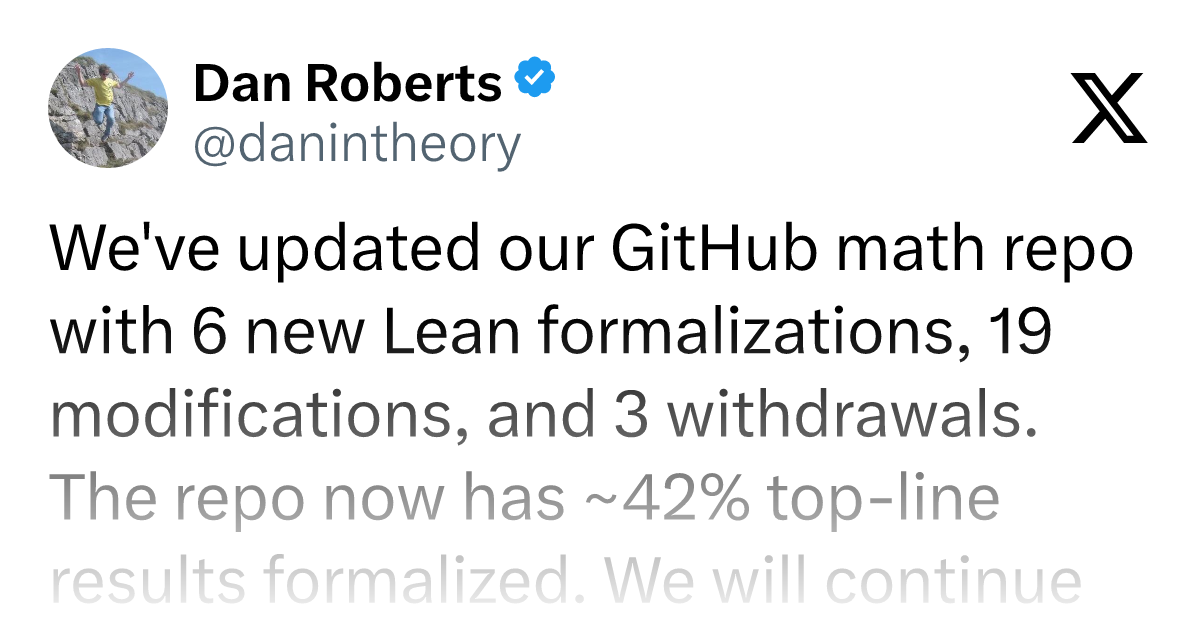
OpenAI recently retracted three mathematical research results it had previously claimed, sparking discussion across technical communities like Hacker News. While the original post generated modest engagement (only 9 upvotes and 2 comments), the conversation it sparked cuts to a core issue in AI development: just how reliable are the outputs of large language models in frontier research — particularly in formal mathematics?
For a company that has long championed AGI as its mission and repeatedly made high-profile demonstrations of its models' problem-solving abilities, voluntarily retracting research conclusions is a noteworthy signal. It can be read either as an act of scientific integrity, or as evidence of a gap between prior claims and actual capabilities.
Why Math Results Are Prone to Failure
Mathematics is fundamentally different from most natural language tasks — it requires every step of reasoning to hold strictly, with no room for "plausible-sounding" approximations. Large language models are, at their core, probabilistic text generators. They excel at mimicking the form of mathematical argument, but they cannot guarantee that the logical chain is airtight.
This is the root cause of the recurring problems when AI claims mathematical breakthroughs. A model may generate a "proof" that looks structurally complete and uses all the right terminology, yet contains a flawed key lemma or relies on an intermediate conclusion that doesn't actually hold. Without peer review or verification by a formal proof system (such as Lean or Coq), the reliability of such results is impossible to guarantee.
Retracting three results likely means these conclusions failed to survive rigorous scrutiny. Whether the specific cause was a reasoning gap, a result that had already been proven, or a substantive error in the formulation, the message to the field is clear: any "new" mathematical result produced by AI must be independently verified before it can be trusted.
Formal Proof Assistants are software tools specifically designed to rigorously verify mathematical reasoning. Systems like Lean and Coq require users to write out every proof step in a precise formal language, then systematically check whether each inference holds strictly within the given axiomatic framework — any vague or skipped reasoning fails to compile. Compared to human peer review, formal verification has the advantage of exhaustively checking every detail in the logical chain, free from the limitations of a reader's attention or professional bias. In recent years, mathematician Kevin Buzzard's Lean community and DeepMind's AlphaProof project have both worked to migrate classical mathematical theorems into formal environments, building a machine-readable "library of mathematical truth" — providing reliable verification infrastructure for AI-assisted mathematical research.
A Cautionary Tale for AI Research Publicity
Over the past period, AI companies have tended to emphasize "breakthrough" achievements when showcasing model capabilities, including performance on math olympiad problems and scientific research tasks. This publicity strategy is effective for attracting attention and investment, but it also plants the seeds of an expectation management problem.
When a publicized result is ultimately retracted, the damage extends beyond the credibility of a single event — it also shifts the baseline by which the public judges AI's overall research capabilities. The skepticism in technical communities often converges on one question: were these results put through sufficiently rigorous verification before being announced?
On the positive side, proactively retracting rather than concealing errors aligns with the fundamental norm of self-correction in science. Admitting mistakes and withdrawing unsupported conclusions is exactly how the scientific method is supposed to work. The problem is that this kind of correction should ideally happen before public announcement, not after.
Mismanaged expectations are far from unique to OpenAI. When Google released its Bard demo in 2023, a factual error in the promotional video wiped over $100 billion from the company's market cap in a single day. Meta's Galactica model was pulled just three days after launch after it was found to generate authoritative-sounding but error-filled scientific text. These cases collectively reveal a structural pressure: in a fiercely competitive AI arms race, commercial companies have an inherent incentive to release capability demonstrations ahead of rigorous internal verification. Academia typically relies on peer review as a quality gate, but the product release cadence at tech companies often bypasses this buffer mechanism, making it easier for exaggerated claims to reach the public.
Formal Verification Is an Unavoidable Step
For AI to genuinely participate in mathematical research — rather than simply generating plausible-sounding text — formal verification is nearly an essential path. With automated theorem provers, every reasoning step can be machine-checked, and only verified proofs are accepted.
In recent years, the research direction of combining large language models with formal proof systems has received growing attention. The model proposes proof strategies and candidate steps; the proof assistant rigorously validates them. This combination can significantly reduce the probability of a "false proof" making its way out into the world. Had the results OpenAI retracted been subjected to formal verification from the start, there likely would have been no need for a retraction.
This also suggests that the standard for measuring AI's mathematical ability is shifting from "can it produce an answer" to "can the answer be rigorously verified." The latter is the threshold that truly matters in a research context.
Conclusion
This brief post from a technical community reflects a long-standing challenge in AI capability assessment: in domains that demand high certainty, there remains a considerable gap between impressive demonstrations and verifiable results. Retracting findings is not necessarily a bad thing — what matters is whether the industry can use moments like this to build more cautious mechanisms for publishing and verifying results. For observers following AI research progress, rather than chasing every "breakthrough" headline, the more meaningful question is whether these results can withstand independent replication and formal verification.
Related articles

Gemini 4 Argon Hands-On: AI Builds Board Games, Constructs Temples, and Trains Robots Autonomously
Gemini 4 Argon hands-on roundup: AI autonomously builds a desk racetrack and temple in Blender, writes a ray tracing engine, trains a humanoid robot to sink 7 shots, plus API pricing and developer access.

The Magic Octagonal Coin: Why Only 9% of People Can Predict Its Flip?
Only 9% of people can correctly predict the Magic Octagon coin flip. This article explains its spatial rotation mechanism, common cognitive pitfalls, and a new hypothesis based on Relevance Theory, exploring the limits of human spatial reasoning.

Sam Altman: AI Is Entering the Era of Scientific Discovery — Math Breakthroughs Will Replicate in Biology and Energy
Sam Altman says AI is entering the era of scientific discovery — math breakthroughs will replicate in biology, materials science, and energy to help develop new drugs and energy sources.