OpenAI's 5% Equity Offer for Political Cover: Rescue Mission or High-Stakes Business Gamble?

OpenAI's 5% equity offer to the U.S. government: political cover for a structurally unprofitable AI giant.
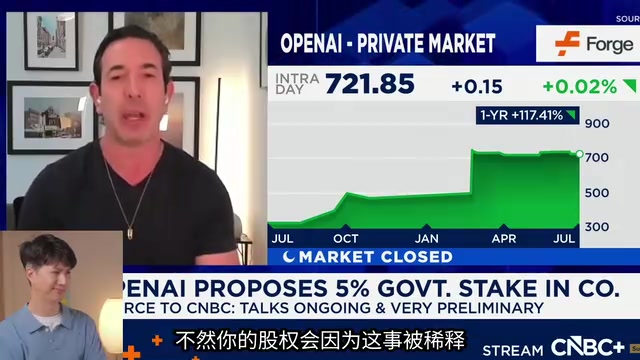
OpenAI has reportedly proposed giving the Trump administration a 5% equity stake in exchange for regulatory relief — mirroring how an Intel stake transformed presidential hostility into praise. But with $38.5B in annual losses and deteriorating margins, critics question whether this is revenue sharing or a disguised bailout. The move also raises regulatory capture and nationalization risks.
A Headline Worth a Second Look
A recent news story has sent ripples through the tech and finance worlds: OpenAI has reportedly proposed giving the Trump administration a 5% equity stake in exchange for regulatory relief from Washington. As Bloomberg commentators have noted, the phrasing matters — this isn't "the government acquiring shares," but rather "the company voluntarily offering them."
Why would a high-flying AI company worth tens of billions proactively hand the government a slice of its pie? The answer comes down to one phrase: buying political protection. And this playbook has precedent.
The Intel Precedent: Equity as a Political Currency
Trump had previously attacked Intel's CEO in notably harsh terms. But after the U.S. government took a stake in Intel, the president did a complete 180 — suddenly singing the company's praises. That episode illustrates exactly what "giving up equity" is worth as a political chip: it can transform hostility into patronage.
OpenAI clearly sees the same pathway. But there's a crucial detail — the reported proposal isn't limited to OpenAI alone. The suggestion is reportedly that all tech companies contribute 5% equity to some form of a "domestic sovereign wealth fund." That's a much harder sell.
The Global Landscape of Sovereign Wealth Funds and Government Equity Stakes
The target of OpenAI's proposed equity offer — a "domestic sovereign wealth fund" — touches on a rapidly evolving global policy debate. Sovereign wealth funds (SWFs) are state-controlled investment vehicles; prominent examples include Norway's Government Pension Fund Global (the world's largest, at over $1.7 trillion), Singapore's Temasek, and Saudi Arabia's Public Investment Fund (PIF). The U.S. currently has no federal-level sovereign wealth fund, though the Trump administration has signaled since 2025 that it intends to establish one. Government direct ownership of tech companies is not without precedent: China's "national team" holds "golden shares" with special voting rights in several internet giants; Singapore's Temasek holds equity in multiple tech and telecom firms. However, government equity stakes in tech companies within democratic systems face a unique governance dilemma — the tension between shareholder interests, regulatory duties, and the public good can be suppressed in authoritarian systems, but in the U.S. political environment it will be a constant source of controversy.
Altman's Public Narrative vs. the Real Motivation
In a signed op-ed in the Financial Times, Sam Altman offered the official rationale: this is about revenue sharing. His argument is that if AI models are built on the accumulated knowledge of all of society, then the public should share in the returns.
But critics offer a sharper reading. Is this about sharing the upside, or offloading future downside? If AI turns out to be a bubble, getting the government on the cap table is essentially securing a backstop for a potential collapse — in other words, a de facto bailout.
The Regulatory Capture Play: "Get in the Room First"
Even more notable is Altman's recent public push for an "AI regulatory board." On the surface, this looks like a responsible stance. But the deeper motive may be this: Altman wants to be the first person in the room where rules are written — to personally shape regulations that favor his company while raising barriers for competitors. This is a textbook case of regulatory capture.
Regulatory capture is a classic concept in public choice theory, formally introduced by Nobel Prize-winning economist George Stigler in 1971. The core idea: regulatory agencies, over time, tend to shift from "serving the public interest" to "serving the interests of the industries they regulate." This shift typically occurs through the revolving door effect (movement of personnel between regulators and industry), information asymmetry (industries hold technical details while regulators depend on them for information), and lobbying and political contributions. The tech industry has ample precedent: Facebook, Google, and others were deeply involved in lobbying during the drafting of the EU's General Data Protection Regulation (GDPR), ultimately securing favorable interpretations of certain provisions. Against this backdrop, Altman's active advocacy for an AI regulatory board takes on a different hue — defining the rules of the game proactively is far more commercially advantageous than passively accepting regulation.
The Financial Black Hole: An Unavoidable Reality
No matter how compelling the political narrative, OpenAI's financial data is staggering.
According to audited financial figures reported by the FT, OpenAI burned through $20.9 billion in cash in a single year. Revenue was approximately $13.07 billion, while losses reached $38.5 billion.

The truly fatal issue isn't the scale of the losses — it's the structural flaw in the business model: these companies' margins are deteriorating, with costs growing linearly alongside revenue. Critics point out there is no evidence they can improve margins — neither specialized chips nor next-generation architectures can fundamentally reduce costs.
Understanding this structural flaw requires understanding the underlying cost logic of large language models (LLMs). The appeal of traditional software businesses lies in their "near-zero marginal cost" characteristic — adding one more user costs almost nothing, so margins expand dramatically with scale. But LLMs break this logic: LLM operating costs consist primarily of three components — training costs (one-time but astronomically high; GPT-4-level model training is estimated in the hundreds of millions of dollars), inference costs (the compute consumed every time a user calls the API, which scales linearly or even super-linearly with the user base), and infrastructure costs (data centers, electricity, cooling). Every token generated requires real compute. More users means higher costs. This is the structural root of "margins deteriorating linearly with revenue growth." Unless there are major algorithmic breakthroughs — such as mature commercial deployment of model distillation or sparse activation architectures — this cost structure is unlikely to change fundamentally.
For this reason, OpenAI's IPO plans are reportedly at risk of being delayed or even cancelled altogether. Some observers have bluntly noted that it's hard to find a company with financials this bad still attempting to go public — except perhaps WeWork — and OpenAI's situation is "significantly worse than WeWork's."
The WeWork cautionary tale deserves a close read. WeWork was fundamentally a "sublease operator" — taking long-term commercial real estate leases and subletting short-term to startups — but packaged itself as a "tech company," claiming a technology premium through "space as a service." Before its 2019 IPO attempt, its valuation reached $47 billion. Yet its prospectus revealed 2018 revenue of $1.8 billion alongside losses of an equal magnitude, with losses expanding in lockstep with revenue. Institutional investors, upon scrutiny, identified a fundamental margin ceiling in the core business, and the IPO ultimately collapsed, with the valuation plummeting to under $10 billion and founder Neumann forced out. The lesson: when a company's valuation depends entirely on a narrative about "future potential" rather than current financial reality, once the narrative breaks, the collapse tends to be swift and severe.
The Dilution Cost
For existing investors, there's a direct pain point in this deal: equity dilution. Unless the entire 5% comes from Altman's personal stake, every existing investor will be diluted. Unless OpenAI can clearly tell investors "the government approvals we receive in exchange will generate X additional revenue," this math is very hard to justify.
Wall Street's Divided Camp
The debate around AI has produced a sharp split in the financial world.
Representing the bull camp, Wedbush's Dan Ives remains ebullient. He emphasizes that hyperscalers' $700 billion in data center investment is "funding the AI revolution," compares the current moment to "the Las Vegas Strip under construction in 1955," and points to enterprise-level deployments by Meta, Microsoft, and Amazon as evidence.
Noteworthy timing: right as the AI bubble debate reaches a fever pitch, Dan Ives announced his departure from Wedbush after eight years to launch a "modern merchant bank" spanning tech, energy, infrastructure, and finance. That pivot is itself a signal worth reading.

The Token Economy's Spinning-Wheels Problem
Palantir CEO Alex Karp offered sharper industry candor on Squawk Box. He relayed the prevailing mindset among enterprise clients: "I don't want to waste my time on tokens, getting no value, and giving away my IP."
Tokens are the basic unit LLMs use to process text — roughly speaking, each English word equals approximately 1–1.5 tokens. Major AI providers (OpenAI, Anthropic, Google) all use per-token pricing models. This model has several inherent contradictions: it incentivizes verbosity — longer answers consume more tokens, and LLMs do tend toward generating lengthy outputs; it completely decouples the billing unit from the business outcomes users actually care about, meaning enterprises are buying tokens rather than solutions; and per-token billing makes costs highly unpredictable, posing budget-control risks when enterprises attempt to deploy at scale. In contrast, traditional SaaS models price by seat or feature module, with costs that are highly transparent and predictable for enterprise buyers. This is a core reason why many large enterprises, after a proof-of-concept phase, struggle to truly scale AI tools in practice.
Karp's comments cut to three key vulnerabilities in the AI business model:
- Encouraging waste — billing by token rather than outcome, because LLMs are inherently prone to hallucination;
- Eyeing customer IP — critics noted that Anthropic's Claude Design appeared to draw heavily from Figma's work, reportedly shocking even Figma's Dylan Field;
- Lacking product moats — the fact that both Altman and Anthropic's Dario Amodei repeatedly say "I can't wait to see what you build with it" reveals that neither of them actually knows where the killer app is.

The Nationalization Undercurrent
Perhaps most unsettling is the topic Karp kept returning to throughout his interview: nationalization. He claims he has spent the past six months telling industry titans: "We're going to get nationalized." Their invariable response: "We're so beloved, we create so much value — who would ever want to nationalize us?"
Karp's view: the political momentum is shifting toward those who support nationalization. If the industry doesn't proactively acknowledge the problems AI creates — job displacement, rising electricity bills — it will be regulated badly by politicians who don't understand economics, or simply nationalized outright.
"Nationalization" isn't an empty threat — it has concrete political-economic context. Historically, nationalization tends to reach the political agenda in several scenarios: critical infrastructure facing private monopoly (early power grids, railways), major industries requiring bailouts during crises (bank nationalizations post-2008), and when technological capabilities are deemed elements of national security. AI is simultaneously triggering the latter two logics: on one hand, major AI companies are deep in losses and dependent on external capital infusions, fitting the financial profile of entities that "need rescuing"; on the other, large-model training capacity is increasingly viewed as a strategic asset on par with nuclear weapons and semiconductors. Furthermore, AI's potential impact on labor markets is generating political pressure from both the left (concerns about rising inequality) and right-wing populism (concerns about the middle class being displaced by technology). It's worth noting that outright "nationalization" remains an extreme option in the American political context — but government deep involvement through "golden shares" (special voting rights) or "regulatory permission in exchange for equity" is, in substance, a form of soft nationalization. OpenAI's proposal sits precisely in that gray zone.
Shareholder as Regulator: A Fundamental Conflict of Interest
Commentators have sharply identified the central contradiction: if the government is simultaneously a shareholder in OpenAI, how can it impartially regulate OpenAI? When the regulator and the regulated are wearing the same pair of pants, any public trust in AI oversight becomes impossible to establish.
The more immediate political risk is this: the more tightly OpenAI binds itself to the current administration, the more exposed it becomes to a reckoning if power changes hands — effectively painting a giant target on its own back.
Conclusion: Rescue or Mutual Gain?
From the Intel precedent, to Altman's equity proposal, to Karp's nationalization prophecy, a clear thread emerges: these AI giants at the top of the food chain are seeking a government backstop for a business model that may not be self-sustaining.
No matter how elegantly the official narrative dresses it up, the fundamental problem remains unsolved: injecting equity into a state treasury won't reassure ordinary people worried about losing their jobs, nor will it satisfy residents bearing higher electricity bills. It addresses none of the real public anxieties.
For investors, practitioners, and the general public alike, this battle over equity, regulation, and nationalization warrants close and vigilant attention. When giants begin openly discussing "bailouts" and "conscription," the cracks in the bubble may already be faintly visible.
Key Takeaways
Related articles

CrowLLM: One OpenAI-Compatible Endpoint Aggregating All Major AI Models
CrowLLM offers an OpenAI-compatible endpoint aggregating Claude, Gemini, GPT, DeepSeek and more, with failover, cache discount pass-through, free tier and credits, built independently by an 18-year-old developer.

FlipPrice: An Open-Source Pricing Copilot for Vintage Resellers
FlipPrice is an open-source pricing copilot for vintage resellers: snap a photo, fill a few fields, and get a listing draft, fair price range, and net take-home after fees — with local open-source inference and zero per-item cost.

Alguard: Building a Dual-Layer Trust Defense for AI Agent Shopping
Alguard, an Amazon Developer Hackathon project, designs a dual-layer trust architecture for Alexa+ agent shopping. Through physical isolation between an MCP server and a human approval channel, it replaces prompt defenses with structural constraints to block unauthorized purchases caused by prompt injection.