OpenAI's Four-Front Offensive: A Deep Dive into GPT-5.6, Codex, Voice AI, and Work Agent

OpenAI simultaneously launches GPT-5.6, a work agent, a unified Codex super-app, and voice AI in a sweeping industry push.
In just two days, OpenAI released four major products spanning foundation models, workplace AI agents, developer tools, and voice interaction. This analysis breaks down GPT-5.6's token strategy, ChatGPT Work's threat to AI startups, Codex's super-app consolidation, and why GPT Live's natural voice AI may be the most underrated breakthrough of the entire release.
OpenAI Launches Multiple Major Products Across Four Strategic Fronts
In just two days, OpenAI unleashed a wave of dense product announcements that once again shook the entire AI industry. This update spans four major areas — foundation models, AI agents, developer tools, and voice interaction — reshaping the competitive landscape of AI products almost simultaneously.
The core products include: GPT-5.6 rolled out to global paying users, ChatGPT Work focused on workplace scenarios, a unified Codex super-app combining three products into one, and GPT Live, a voice AI product widely praised for its naturalness. This time, OpenAI isn't just upgrading its underlying models — it's directly entering multiple application sub-markets.
It's worth noting that some version names and competitor product names circulating online (such as "Cloud Farber5" or "Firewall5") appear to be mishearings or transcription errors. Readers should refer to official OpenAI announcements. This article focuses on the core logic and industry significance of each product.
GPT-5.6: Leading on Both Cost-Efficiency and Performance
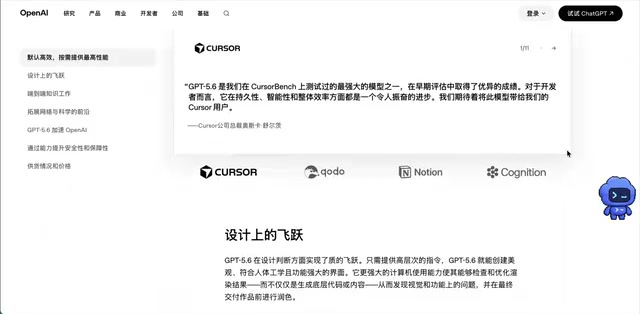
GPT-5.6 has officially rolled out to paying users worldwide. Its flagship version ranks near the top on multiple benchmarks, with strong performance across cost, latency, and output quality.
One notable aspect is the token usage policy. Tokens are the basic unit by which large language models process text — think of them as the amount of text a model can read and write in one session — and they directly determine how powerful a model a user can access and how often. OpenAI allows paying users to apply their full token quota to the most powerful version, whereas some competitors previously capped access to flagship models (e.g., limiting usage to 50% of quota). This strategy reflects a careful balance between compute costs and user retention. As capability gaps between models narrow, "usage freedom" itself is becoming a key differentiator.
GPT-5.6 also continues the tiered version strategy — from flagship to lightweight — covering different budgets and use cases. The "same family, multiple price points" approach has become standard practice among top model providers, essentially maximizing user reach through price segmentation.
ChatGPT Work: Big Tech Enters the Office Agent Arena Directly
Strategically, the most significant product in this release cycle may be ChatGPT Work — OpenAI's first foray into building its own AI agent product specifically designed for workplace scenarios.
An AI agent is an AI system capable of perceiving its environment, planning autonomously, and executing multi-step tasks — distinct from a chatbot that merely responds to questions. A typical agent has a closed-loop "perceive-decide-act" architecture and can invoke external tools, read and write files, trigger APIs, and more, rather than simply generating text. ChatGPT Work is built on this architecture: it can connect to a user's computer, data, and workflows, automatically completing tasks by reading files and data. Whether it's accounting reports, sales analysis, marketing planning, data science, or engineering development, it can process and summarize information using real user data. It also supports team collaboration through integrations with tools like Slack, handling both personal and team tasks within a single platform.
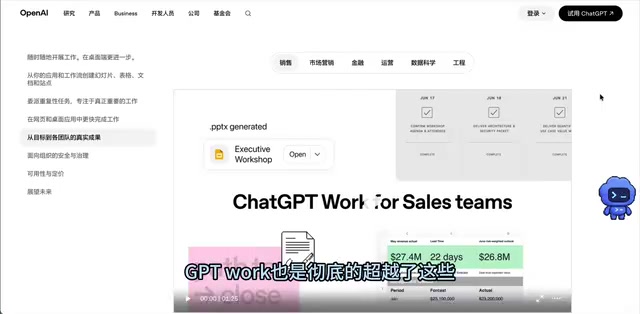
This raises a sharp question: building AI applications as a startup is getting harder. Most office agent startups that have emerged over the past two years are built on top of large model APIs with workflow orchestration and UI layers on top — a relatively thin technical moat. Once the underlying model providers integrate these capabilities directly and offer them at lower prices or as bundled features, months or even a year of startup effort can lose its competitive edge overnight. This phenomenon has a name in SaaS history: "platform eats the application layer." ChatGPT Work is yet another confirmation of this brutal pattern — a structural risk that today's AI entrepreneurs must confront head-on.
Codex Fully Upgraded: A Three-in-One Super App Arrives
Codex has received a major update, merging the existing ChatGPT, Codex, and the newly launched ChatGPT Work into a single unified entry point — a "super AI app."
The concept of a "super app" originated in the mobile internet era, referring to a product strategy that integrates multiple services within a single entry point to maximize user time-on-app and usage frequency — WeChat being the most iconic example. Users can now write code, handle office tasks, and conduct everyday Q&A all within the same interface. The app also includes playful features like a "virtual pet" that tracks work progress and recent query history in real time. This gamification of productivity tools is fundamentally designed to increase daily usage stickiness, while also accumulating richer behavioral data to power more personalized model capabilities.
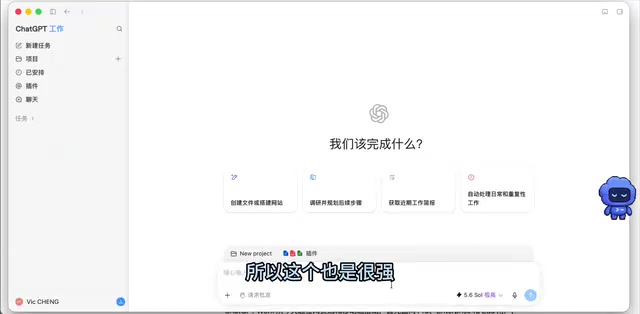
In practice, users can freely switch between different models within the app and use a slider to tune between "faster" and "smarter" — the further toward the smart end, the faster tokens are consumed. Real-world testing suggests the flagship tier is "quite token-hungry," consuming roughly 3% of quota in just a brief conversation. Non-professional subscribers are advised to select tiers based on actual needs. Codex now also supports mobile, further completing the cross-device experience.
GPT Live Voice AI: The Most Underrated Breakthrough of This Release
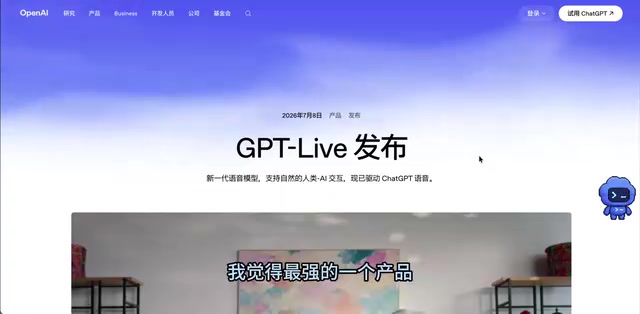
While public discussion has largely centered on GPT-5.6, from a product experience standpoint, the real standout of this release cycle may be the voice product GPT Live.
To appreciate the significance of this breakthrough, it helps to understand the technical evolution of voice AI. Early voice AI systems used a three-stage pipeline: speech recognition (ASR) → text processing → speech synthesis (TTS). Each module ran independently, causing noticeable latency and a disjointed feel. GPT Live represents a new generation of voice interaction built on an end-to-end multimodal model architecture, understanding and generating directly at the audio signal level. This dramatically reduces latency and preserves paralinguistic information like tone and rhythm.
GPT Live's voice interaction is nearly indistinguishable from a natural conversation — there's barely any detectable "AI accent." Users can ask it to switch between different accents (Beijing, Shanghai, Sichuan, Cantonese, or British vs. American English), and the overall interaction feels continuous. It no longer operates in a turn-based mode where you finish speaking before it responds. Instead, it can proactively ask follow-up questions or add context mid-conversation, just like a real person. This non-turn-based capability for interruptions and follow-ups relies on the model's real-time modeling of conversational state — an interaction paradigm that traditional voice assistants (like early Siri or Xiao Ai) simply couldn't achieve.
This capability is particularly disruptive to the online language learning sector: users can subscribe and converse with GPT Live anytime, receiving real-time grammar and pronunciation corrections in an experience that approaches having a live human tutor. Looking further ahead, backed by GPT-5.6's powerful reasoning capabilities, voice AI has enormous untapped potential in areas like elderly companionship and mental health support. The shift from text interaction to natural voice interaction may be the true inflection point in the human-machine relationship — voice AI is migrating from "tool" to "companion."
Competitive Landscape: Grok and Meta Move in Parallel
Meanwhile, other major U.S. AI players have also been making moves around the same time. Grok released a new version, and Meta quietly updated its own model — both roughly on par with the previous generation of flagship products.
Grok, developed by Elon Musk's xAI, has a distinctive competitive edge rooted in data diversity: massive volumes of real-time social text from X (formerly Twitter), and multimodal sensor data collected by Tesla's self-driving fleet. The former gives Grok near-real-time world knowledge updates; the latter provides training material for embodied intelligence and physical-world understanding that other large models struggle to replicate. Grok's long-term potential deserves continued attention: powered by this proprietary data flywheel (data → model → product → more users → more data), its capabilities could reach a critical release point at some future juncture. Its narrowing gap with top-tier models through continuous data iteration once again confirms — data scale remains the core variable in today's large model competition.
Conclusion: From the Model Race to a Full Reconstruction of the Application Layer
Taken together, the significance of this OpenAI release extends well beyond "stronger models." By simultaneously making moves across model cost-efficiency, office agents, developer tool integration, and voice interaction, it marks a transition for large model companies from competing at the infrastructure level to actively reconstructing the application layer.
For everyday users, the natural voice interaction of GPT Live may be the most immediately perceptible change. For entrepreneurs, ChatGPT Work once again sounds the alarm about the fragility of application-layer moats. A word of caution: much of the current public information comes from third-party reporting, and some version names and capability figures may contain inaccuracies. Actual performance should be verified against official releases and independent benchmarks.
Key Takeaways
Related articles

Disaster and Glory of the Apollo Program: The History We Must Revisit Before Returning to the Moon
From the fatal Apollo 1 fire to Apollo 8's daring lunar orbit to Apollo 11's successful landing—revisiting the disasters, fears, and compromises of the Apollo program and their lessons for today's return to the Moon.
Netflix Trust Exercise Turns Into Firing Trap: Where Are the Boundaries of Corporate Trust?
A Netflix employee was fired after sharing private info in a trust exercise. We analyze the risks of corporate trust exercises and how employees can protect themselves.

AMD CDNA5 Architecture Deep Dive: Technical Evolution and the AI Computing Competition Landscape
Deep analysis of AMD's CDNA5 architecture covering Chiplet packaging upgrades, HBM memory evolution, and low-precision compute optimization, examining how AMD challenges NVIDIA's AI chip dominance.