OpenAI's Humanoid Robot Plan: Altman Says the AI Brain Matters More Than the Body
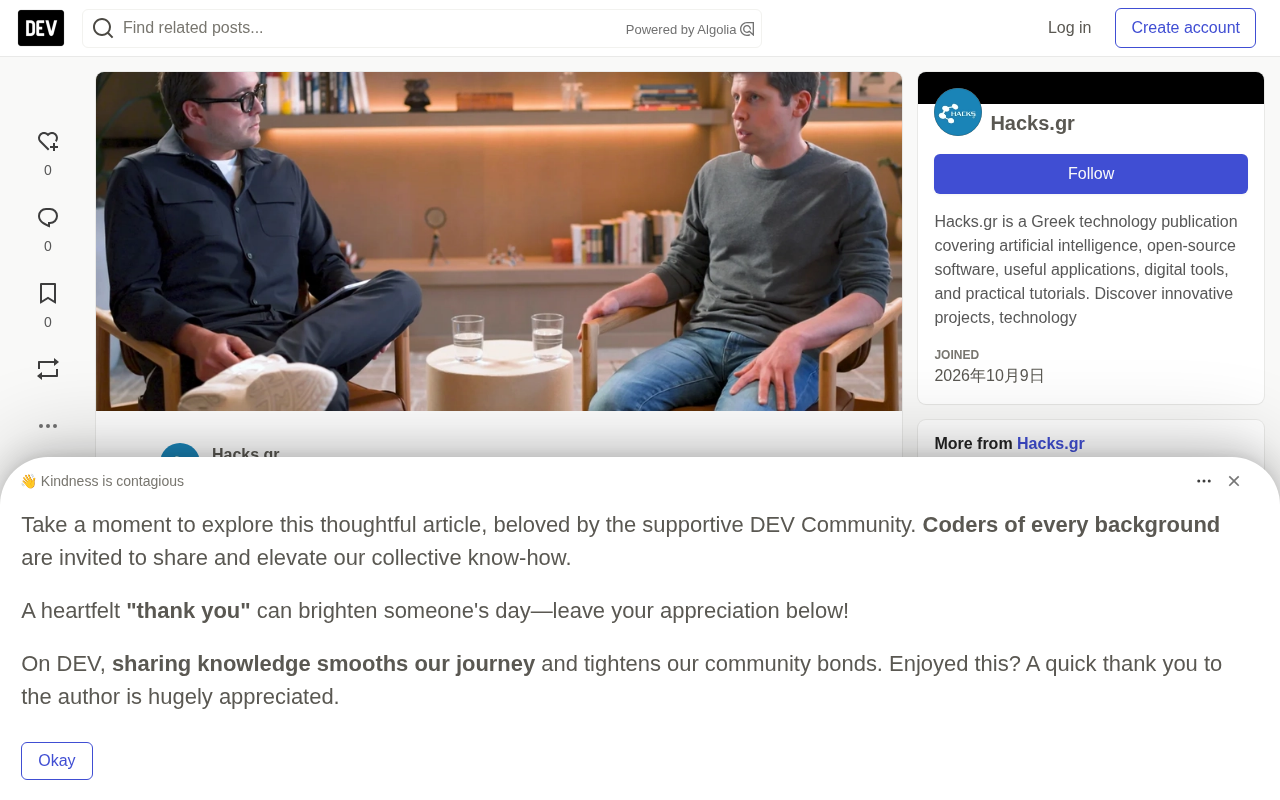
OpenAI pushes its humanoid robot project; Altman says the AI brain matters more than the body, with a first demo expected in 2027.
OpenAI is advancing its humanoid robot project, with CEO Sam Altman emphasizing that the AI brain matters more than the physical form. The humanoid design lets robots plug into a world built for humans. OpenAI has 27 robotics roles open covering motion control, state estimation, and ML infrastructure, plus hardware hires. The earlier Dactyl project built sim-to-real experience. Goals are phased: near-term infrastructure work, long-term home use. Altman expects an "interesting demo" by 2027, with pricing and release date undisclosed.
OpenAI is pushing forward with its humanoid robot project, and CEO Sam Altman has made it clear that developing the robot's AI brain matters more than its physical form. The statement shifts public attention from the hardware race back to the essence of intelligence—a robot's value lies not in having limbs, but in knowing how to use them.
Why Humanoid: The World Is Built for People
Speaking on the Sources podcast, Altman explained that the choice of a humanoid design is not technological romanticism but practical logic: our world—from door handles to stairs, from tools to workbenches—is built around human ergonomics. A humanoid robot can plug directly into existing environments without remaking the world for machines.
When asked whether OpenAI will eventually build such a robot, Altman answered yes. But he repeatedly stressed a core point: giving a machine arms and legs is not enough—if it doesn't know how to use them, the hardware itself is meaningless. This effectively draws the line between OpenAI and pure hardware robotics companies—the intelligence layer is the high ground of competition.
What the Job Postings Reveal About the Technical Roadmap
OpenAI's job listings outline the project's technical focus. The 27 currently open robotics positions cover motion control, state estimation, whole-body behavior, and machine learning infrastructure. The job titles themselves tell the story: the company is building the capability for robots to interpret sensor input, understand instructions, make decisions, coordinate body movements, and correct errors during execution.
Hardware is not being neglected either. The job descriptions show OpenAI is also hiring for mechanical motors, sensor systems, and thermal management. This shows that "intelligence-first" does not mean "hardware-light"; rather, it means building a data-driven closed loop between the two—intelligent algorithms need high-quality actuators and sensory feedback to be realized.
According to Altman in an interview with Fortune, the company expects to have an "interesting demo" by 2027, but it will be several years before robots actually hit the streets. OpenAI has not disclosed the specifics of the demo, what the robot will look like, or when outsiders will be able to see it.
State Estimation
State estimation is a key bridge between robot perception and control. A robot needs to infer in real time the angles and velocities of its joints, its body posture, and the contact state of the external environment from multiple sources such as encoders, IMUs, cameras, and force sensors. Because the sensors themselves have noise and latency, state estimation is essentially a probabilistic inference problem, with common methods including Kalman filtering, particle filtering, and learning-based estimators. For humanoid robots, the body is on the edge of dynamic imbalance during bipedal walking, and a millisecond-level state estimation error can cause a fall, so this component directly determines the reliability of motion control.
From Dactyl to Humanoid: A Path with Accumulated Experience
OpenAI is not starting from scratch. The earlier Dactyl research project trained a robotic hand to manipulate objects in simulation, and the related technology was later applied to solving a Rubik's cube. The value of that project lay in exposing the gap between software theory and the real world—success in simulation does not automatically translate into reliable manipulation in the physical world.
The challenge facing humanoid robots is a scaled-up version of Dactyl: coordination of two arms and two legs, dynamic balance, real-time perception and decision-making—every link needs repeated calibration under real physical constraints. What Altman calls "finding the method to manipulate the mind" points precisely to the intersection of this set of problems.
The Sim-to-Real Gap
The problem exposed by the Dactyl project is known in robotics as the "sim-to-real gap." In physics simulators, physical laws such as gravity, friction, collisions, and material deformation are computed with approximate models, and policies trained there often achieve near-perfect success rates. But factors in the real world—sensor noise, actuator latency, surface wear on objects, and lighting changes—cause policies learned in simulation to fail quickly. To narrow this gap, researchers typically use domain randomization—randomizing parameters such as friction coefficients, mass, and texture during training to force the policy to remain robust to physical uncertainty. What OpenAI accumulated on Dactyl is exactly this methodology, and humanoid robots scale this challenge from a single robotic hand to whole-body coordinated control, with difficulty rising exponentially.
Layered Goals: From Construction Sites to the Home
OpenAI has set phased goals for the robot. The near-term direction is a general-purpose robot that assists skilled workers in infrastructure construction—a scenario with clear demand, a relatively structured environment, and quantifiable commercial value. The long-term goal is a personal home robot, but the latter demands orders of magnitude more in safety, generalization capability, and cost.
To date, OpenAI has not announced any finished robot, pricing, subscription model, release date, or data protection framework. For a project still in the hiring and R&D stage, these gaps are normal, but they also mean the public's imagination about humanoid robots will have to wait for the 2027 demo to be calibrated.
What Intelligence-First Means
Altman's statement reveals an industry judgment: the bottleneck for humanoid robots is not whether we can build a body that walks, but whether we can build a brain that understands the world. Motion control, state estimation, machine learning infrastructure—these hiring keywords all point to one fact: OpenAI is betting on the ability to transfer general intelligence into the physical world.
Whether this approach can deliver a convincing demo by 2027 will determine OpenAI's position in the robotics race. Hardware companies can speak with specs and shipment volumes, while OpenAI needs a demo to prove that once a robot understands the task, its body becomes truly useful.
Transferring General Intelligence to the Physical World
What Altman calls "finding the method to manipulate the mind" points, in technical terms, to the core proposition of embodied AI: how to transfer the commonsense reasoning capabilities that large models have learned in language and vision to physical tasks that require real-time perception and action output. Unlike pure software AI, embodied agents must complete the "perceive—reason—act" loop within a limited time, and every wrong action has a real physical cost. This requires models to possess both high-level task planning capabilities and low-level motion control interfaces, and the current research frontier is attempting to unify these two levels with vision-language-action (VLA) models. What OpenAI is betting on is precisely that its accumulated experience with large-scale pretrained models can accelerate this transfer process.
One-line Summary
OpenAI is advancing its humanoid robot project; Altman stresses the AI brain matters more than the physical form, with a first demo expected in 2027.
Paragraph Summary
OpenAI is pushing forward with its humanoid robot project, and CEO Sam Altman has made it clear that developing the robot's AI brain matters more than its physical form. The humanoid design was chosen because the world is built around human ergonomics, allowing robots to plug directly into existing environments. OpenAI currently has 27 open robotics positions covering motion control, state estimation, whole-body behavior, and machine learning infrastructure, while also hiring for motors, sensors, and thermal management on the hardware side. The earlier Dactyl robotic hand project accumulated experience in sim-to-real transfer. The company has set phased goals: near-term assistance in infrastructure construction, long-term entry into the home. Altman expects an "interesting demo" by 2027, but actual deployment is still years away, and details such as pricing and release date have not been announced.
Related articles

iPhone Duo Hands-On: Is the $2,000 Small-Screen Foldable Worth It?
YouTube's Allison shares her iPhone Duo hands-on: dual-screen multitasking doubles efficiency, great video viewing, nice matte finish—but thick body, small outer screen, and a $2,000 luxury price.

Sentry's Ad Cracks Up Developers: Can On-call Actually Be Fun?
Sentry's ad short film taps into developers' on-call anxiety, using humorous dialogue to showcase its observability platform—errors, logs, traces, metrics, replays, and releases in one place.

LLM App Getting Worse With Every Change? Build an Effective Evaluation System in Three Steps
How do you know if your LLM app is getting better or worse? A Reddit-based guide to test sets, automated regression evaluation, LLM-as-judge scoring, and structured agent tracing.