OpenAI's New Model Claims to Match Its Flagship — But Real-World Tests Reveal an 80-Point Gap: Value Trap or Genuine Deal?

GPT-6.1 Sol promises near-flagship AI at 1/5 the cost, but third-party tests show an 80-point gap and a hidden breaking API change.
OpenAI's GPT-6.1 Sol is a point-release upgrade on existing architecture, not a new base model. Its core pitch — near-Astra intelligence at one-fifth the price — falls short under third-party scrutiny: LMSYS Arena scores Sol at 1362 versus Astra's 1442, an 80-point gap OpenAI never directly addresses. The real story is the prompt caching mechanism, which cuts costs nearly 50% in real-world scenarios. However, a silent breaking change — the removal of the `none` effort parameter — forces legacy systems onto the new Responses API, posing serious risks for production pipelines caught off guard.
A YouTube benchmark video has sparked heated debate: OpenAI's newly released GPT-6.1 Sol pitches itself as "near-flagship performance at one-fifth the cost" — but third-party benchmarks reveal an 80-point performance gap. Is this a genuine value tool for enterprise AI deployment, or just another marketing-wrapped "point release" upgrade?
An "Economic Restructuring" Without a New Base Model
The most intriguing aspect of this update is what it isn't: OpenAI hasn't introduced a new foundation model. Instead, it's a point-release upgrade on the existing GPT-6 Sol architecture, simply renamed GPT-6.1 Sol. On the surface, the pricing structure is unchanged — developers still pay $2 per million input tokens and $10 per million output tokens.
The real pitch is buried in a single performance claim: OpenAI says this point release reaches intelligence levels that "nearly match" its flagship model, GPT-6 Astra. The financial leverage here is precise — if the performance claim holds up, architects can deploy near-flagship reasoning at one-fifth the cost of querying Astra. In other words, the core logic of this release isn't "more powerful" — it's "equally smart, much cheaper."
The reviewer breaks this release down into three pillars: a set of unverified performance gains, an aggressively priced caching discount, and a "silent" breaking API change. Together, they form an economic offensive squarely aimed at high-frequency agent workflows.
The 80-Point Gap: Marketing Claims vs. Real-World Data
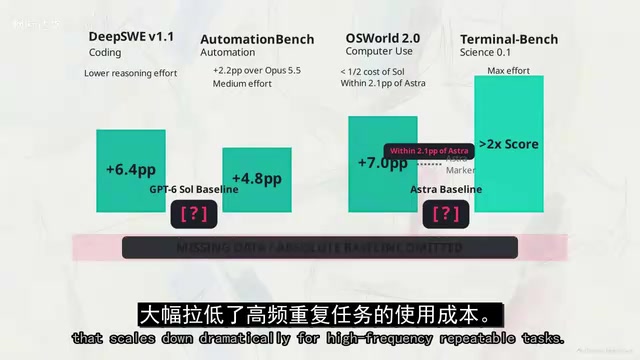
OpenAI's official numbers look impressive at first glance. On the DeepSWE 1.1 coding benchmark, the new model outperforms the base Sol by 6.4 percentage points — at lower inference intensity. On AutomationBench, it leads the previous generation by 4.8 points and beats Anthropic's Opus 5.5 by 2.2 points.
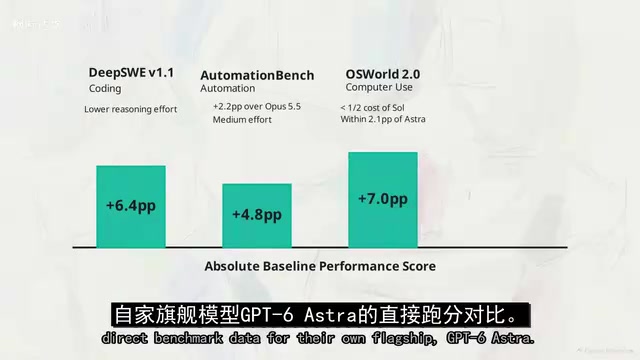
The problem lies precisely in how those numbers are reported. OpenAI selectively published comparisons against "equivalent-capability models" (including its own older GPT-6 and Opus 5.5), while conspicuously omitting any direct benchmark data against its own flagship, Astra. If OpenAI is marketing Sol as Astra's close neighbor, the absence of verifiable direct comparisons is a red flag in itself.
To fill that gap, the reviewer turned to crowdsourced data from LMSYS Chatbot Arena. The results are telling: Sol scores 1362 — just one point higher than the previous-generation GPT-5 — while the latest flagship, Astra, scores 1442. That's a gap of exactly 80 points. In practical terms, Sol sits in the "high complexity" tier, roughly on par with Gemini 1.5 Pro and Claude 3.5 Haiku — but still a long way from flagship territory.
That said, the reviewer acknowledges that given the 5:1 cost difference, this value proposition remains highly compelling for many specific workflows.
About LMSYS Chatbot Arena: LMSYS Chatbot Arena is an open-source LLM evaluation platform operated by UC Berkeley and partner institutions. It uses a "blind battle" mechanism: users submit prompts to two anonymous models simultaneously and vote on the better response. Scores are calculated using an Elo rating algorithm — the same system used in chess rankings — meaning score differences can be directly translated into win rates. An 80-point Elo gap corresponds to roughly an 11–13 percentage point win-rate advantage in head-to-head matchups. While the platform has limitations (users tend to ask interesting rather than representative questions, and voting introduces noise), its large sample sizes and resistance to vendor manipulation make it the most credible third-party reference beyond official benchmarks.
Prompt Caching: The Real Economic Lever
If the performance claim is the headline, the caching mechanism is where this update actually changes the game. Base rates remain unchanged, but the new caching system offers a 50% discount on repeated content — enterprises can "anchor" a standard system prompt and reuse it across multiple requests at $1 per million tokens instead of $2.
The reviewer illustrates this with a real-world scenario: a mid-sized tech company previously spent $175 per day automating customer service workflows with GPT-6.0. After switching to GPT-6.1 Sol with prompt caching enabled, daily costs dropped to $88 — the same workload at 49% lower operating cost, effectively doubling automation throughput within the same budget.
From a unit economics perspective, cached input token rates are cut in half — from $0.20 to $0.10 per million tokens. For an enterprise agent processing 100 million tokens per month at an 80% cache hit rate, monthly costs drop from $56 under GPT-6 Sol to $48 under GPT-6.1 Sol — a 14.3% reduction. As multi-agent persistent context loops push cache hit rates above 80%, these savings scale linearly.
How Prompt Caching Works: The core mechanism is straightforward: when multiple API requests share identical prefix content (such as system prompts, fixed RAG document chunks, or few-shot examples), the server computes the KV cache for that prefix only once. Subsequent requests reuse the pre-computed key-value pairs, bypassing redundant attention computation. Cache hit rate directly determines savings magnitude — in agent workflows, system prompts and tool definitions often account for 60–80% of each request's token count, making consistently high hit rates achievable. One important caveat: with caching enabled by default on shared infrastructure, cached entries theoretically carry a risk of cross-request data residue — which is precisely why the reviewer specifically flags the need for teams to audit their data pipelines and determine which content can be safely cached versus which contains sensitive user data that must actively bypass caching.
The Breaking API Change Hidden in a Point Release
What truly warrants caution is the third pillar the reviewer repeatedly emphasizes: an unannounced "silent" breaking change.
After making caching opt-out by default, OpenAI removed the requirement for the cache-control request header. The benefit is simplified integration with no configuration overhead; the cost is that developers lose fine-grained control over what data persists in the cache. This isn't merely an optimization — it's a structural shift that forces teams to re-examine their data pipelines to ensure sensitive information isn't accidentally leaked or persisted.
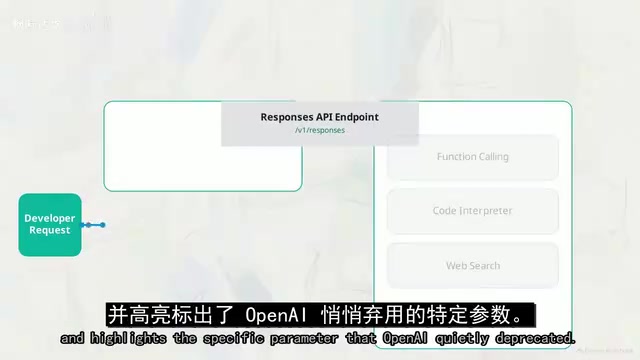
More critically, the none effort parameter has been removed entirely from the schema. Under the old architecture, chat completions endpoint function calls required the effort parameter to be set to none. Removing it directly breaks tool-calling functionality for any legacy system still relying on that endpoint. To restore functionality, developers must migrate traffic to the updated Responses API. In other words, this is a forced compatibility migration disguised as a point-version update.
About the Responses API: The Responses API is OpenAI's next-generation interface, introduced in 2025 to replace the original Chat Completions endpoint. It natively supports tool calling, multi-turn state management, and streaming function execution. Unlike the old endpoint, it internalizes "effort (reasoning intensity)" parameter control into the model itself, no longer allowing developers to forcibly bypass reasoning steps via external parameters. The none effort parameter originally let developers skip the model's chain-of-thought reasoning during function/tool calls, trading lower latency for reduced cost. Its removal means any production system that relied on this parameter to control reasoning overhead will break outright without modification. This type of "silent breaking change" is particularly dangerous in engineering practice — automated CI/CD pipelines typically don't catch API schema-level changes, and failures only surface when production traffic triggers the issue, at which point the debugging cost far exceeds that of a planned migration.
A New Routing Logic for Enterprise Deployment
Taken together, GPT-6.1 Sol rewrites the standard rules for enterprise model routing. If it truly approaches Astra's intelligence ceiling, the flagship should be reserved exclusively for extreme-complexity edge cases; standard and mid-tier agent routing now has a solid financial justification for defaulting to 6.1 Sol.

But adoption requires teams to first pay down their technical debt: completing the migration to the Responses API. The reviewer also flags a trust deficit — there are currently no independent papers that can verify OpenAI's relative performance claims, and even the safety alignment system card appendix has been excluded from the primary evidence package, leaving evaluators to hunt for external documentation themselves. Proximity metrics like "2.1 points from Astra" are meaningless for routing decisions without absolute baseline scores — teams have no choice but to rely on internal empirical testing.
The release notes also contain one high-interest variable: an upcoming ultra-fast Codex variant that OpenAI claims can generate tokens at up to 8× the current baseline speed. If that speed materializes and is stacked on top of the aggressive caching economics, it could reshape the architectural profile of the next generation of coding agents.
Related articles

Claude Code + Codex Multi-Agent System Tested: The Real Problem Behind a 98% Cache Rate
Developer shares 7-day test of a Claude Code + Codex multi-agent system: 98% cache rate, 354:1 input/output ratio, but stuck on orchestration and output share.

Cursor SDK New Feature: Real-Time Steering of Running AI Agents
Cursor SDK adds run.steer(), letting developers inject messages in real time while an AI agent runs to adjust its direction. Subagents move to the background on steer.

AI Tools Are "Invading" Retro Games: A Game of Creativity vs. Copyright
AI tools are dramatically lowering the barrier to retro game porting—browser-based Halo, iPhone Wind Waker, and MR Smash Bros. are going viral, but sparking copyright disputes and regulatory concerns.