OpenAI's New Model GPT-6.2 Betelgeuse Rumor: A Trust Crisis in AI News
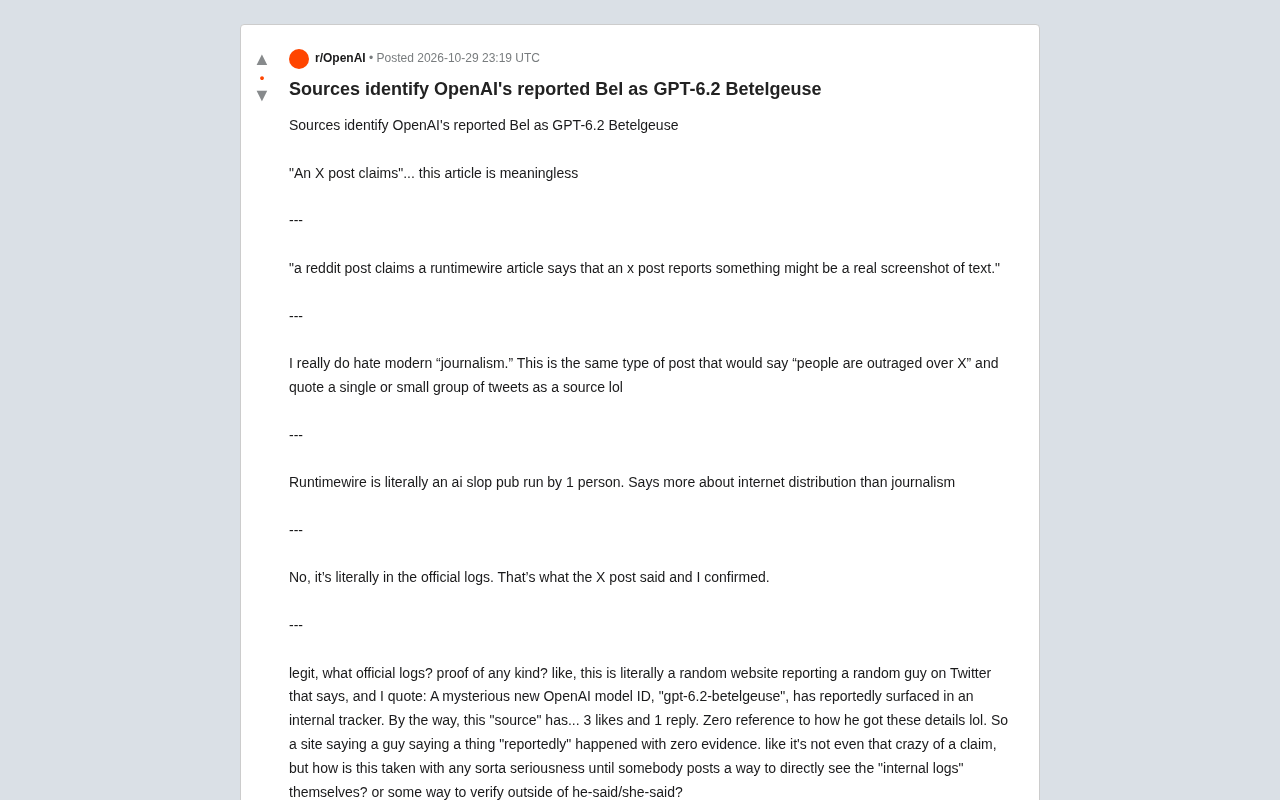
A tweet with just 3 likes claiming OpenAI is testing GPT-6.2 Betelgeuse, amplified by an AI slop site, exposes the trust deficit in AI news.
The article traces the Reddit rumor that OpenAI is testing a "GPT-6.2 Betelgeuse" model, noting its origin in an X tweet with only 3 likes claiming the model ID appeared in "official logs" without ever providing verifiable evidence. The chain runs from the tweet through Runtimewire (described as a one-person AI slop site) to Reddit, with each link lacking first-hand verification and forming a fragile single-chain citation rather than multi-source cross-verification. The Reddit community consensus is that the lack of evidence is the core problem, yet no one can show the "official logs." The discussion also spawned satire about increasingly complex AI model naming. The article uses this to reveal the trust deficit in the AI news ecosystem: verification costs are shifted onto readers, AI-generated content worsens information pollution, and community discussion itself amplifies the rumor's heat.
Where Did the Rumor Come From?
Recently, a post on Reddit sparked heated discussion: a "source" claimed that OpenAI is testing a model called GPT-6.2 Betelgeuse, with the internal codename "Bel" also surfacing. According to the post, the information originated from a user on X (formerly Twitter), was subsequently reported by a site called Runtimewire, and then shared and discussed by Reddit users.
However, this seemingly explosive news doesn't hold up at any link in the chain. As one commenter summarized: "An X post claims... this article is meaningless."
The Broken Information Chain: From "Official Logs" to a Tweet with Three Likes
What is the core evidence behind the entire rumor? The poster claimed the model ID appeared in "official logs." But when users asked "What official logs? Is there any evidence?" no verifiable link or screenshot was ever provided.
One user pointed out bluntly: "This 'source' post has only 3 likes and 1 reply, and doesn't mention at all how he got these details." In other words, a website cited a Twitter user claiming something "allegedly" happened, and there is no evidence behind the "allegedly."
This is not an isolated case. Another user criticized: "People get outraged at X, then cite a tweet or a small group of tweets as a source — that's the typical operation of modern 'news.'"
More critically, the credibility of Runtimewire itself was questioned. One comment noted: "Runtimewire is an AI slop site run by one person." The problem this reflects is more intriguing than journalism itself — in an era of rampant AI-generated content, information spreads far faster than it can be verified.
AI slop site refers to sites that primarily use large language models to mass-produce low-quality, homogeneous content to drive traffic. Such sites are typically run by individuals or small teams, lack editorial review processes, have extremely short content production cycles, and often quickly "rewrite" or piece together hot topics. The harm lies in this: they can rapidly provide a seemingly "media-reported" shell for unverified rumors, giving a low-credibility tweet pseudo-authority within a citation chain. Identifying features include: unfamiliar domain names, vague author information, templated article structures, and heavy use of vague phrasing like "allegedly" and "reportedly" without providing first-hand links. In the AI news ecosystem, such sites have become significant nodes of information pollution.
Multi-Source Cross-Verification: Consensus and Divergence
Around this rumor, several points of consensus emerged in the Reddit discussion:
- The lack of evidence is the core problem. Whether supportive or skeptical, most users agreed: without independently verifiable "official logs," the rumor cannot be treated as fact.
- The news chain is too fragile. From the X tweet to the Runtimewire article to the Reddit post, each link cites the previous one but provides no first-hand evidence.
- The credibility of a single source is extremely low. The tweet with only 3 likes was seen by multiple users as a textbook case of "zero verification."
Divergence appeared in the interpretation of "official logs." One user insisted: "No, it really is in the official logs. That's what the X post said, and I checked." But when asked to provide proof, the conversation fizzled out. This kind of "I checked" response that cannot show evidence precisely exposes the fragility of the rumor.
Another user tried to press further: "What exactly does the X post claim? That the name appears in official logs... why don't you finish the sentence?" — this points to selective presentation in information dissemination: leakers often throw out only half a sentence, leaving room for imagination.
Cross-verification is a fundamental method in journalism and intelligence analysis: for the same fact, seek two or more mutually independent sources for comparison, and each source should be traceable to first-hand evidence. The key to independence is that there is no citation relationship between sources — if A cites B and B cites C, then A, B, and C do not constitute multiple sources but merely an extension of the same information chain. In this incident, the X tweet, the Runtimewire article, and the Reddit post form a single chain rather than multiple sources, so cross-verification cannot be completed. Effective cross-verification also requires that sources be verifiable, such as official release logs, API documentation change records, or separate confirmation by multiple independent media outlets.
The Carnival of Model Naming: When Jokes Meet Reality
The discussion also featured plenty of humorous sarcasm. One user complained that model choices are becoming increasingly complex: "I just want three modes: kinda smart, smart, very smart."
Someone immediately picked up the thread: "No, you'll get Astra Black Hole, Astra Pulsar, and Astra Neutron Star. And under Astra Black Hole, there are lightweight, medium, heavy, ultra-heavy, ultra-heavy-plus, and ultra-heavy-plus-ultimate editions."
Another user fabricated an even more exaggerated version: "OpenAI is developing an unreleased frontier model family GPT-6.7, where you can choose tiers like Alcubierre, Schwarzschild, and Singularity. The first two have ultra-fast modes that consume 20x tokens for 10x speedup; the last has a superluminal mode that consumes infinite tokens but reasons so fast it breaks causality, letting you complete tasks before you start."
Behind these jokes is collective mockery of increasingly esoteric AI model naming and increasingly complex product lines. But after the laughter, the question remains: when the rumor itself becomes a traffic magnet, who is responsible for the truth of information?
Alcubierre, Schwarzschild, and Singularity are all physics concepts borrowed by netizens to satirize model tier naming. Alcubierre refers to the "warp drive" metric proposed by Mexican physicist Miguel Alcubierre, which achieves faster-than-light travel by compressing space ahead and expanding space behind, without violating general relativity. Schwarzschild refers to the black hole metric solved by Karl Schwarzschild, i.e., the spacetime description of a static, spherically symmetric black hole. Singularity is the boundary in general relativity where spacetime curvature tends to infinity. These terms, like "Betelgeuse" (a red supergiant star), are used to create sci-fi-sounding naming tiers, mocking the inflationary trend of AI product lines moving from "smart" toward "metaphysics."
The Real Problem Behind the Rumor: The Trust Deficit in the AI News Ecosystem
The significance of this incident goes far beyond whether a model codename is real. It reveals structural flaws in the AI news ecosystem:
First, verification costs have been shifted onto readers. Original leakers provide no evidence, media outlets don't verify, and readers are expected to "judge for themselves." One user's retort was apt: "How can this be taken seriously until someone posts a way to directly view the 'internal logs'?"
Second, the flood of AI-generated content exacerbates information pollution. When "an AI slop site run by one person" can easily become a news source, the filtering mechanisms of the entire distribution chain become a mere formality.
Third, community discussion itself becomes part of the spread. Skeptical posts on Reddit in turn increased the topic's heat, letting more people learn the codename "GPT-6.2 Betelgeuse" — even though it was never confirmed.
For readers following the AI industry, a practical suggestion: when you see "reportedly" or "sources say," look for first-hand evidence first. If you can't find it, treat it as a community guessing game rather than industry news.
As for whether OpenAI is really testing Bel or Betelgeuse? Until there is verifiable official information, this is just a story triggered by a tweet with three likes. And a story, after all, is not a fact.
Related articles

Claude Code v2.1.316 Update Analysis: Enterprise Gateway and Multiple Stability Fixes
Claude Code v2.1.316 released: new enterprise gateway pooled group budgets, layered policy mode, subagent effort control, dozens of Shell, network, and session recovery fixes, and Opus 4.8 fast mode deprecated.

17th-Century British Floods and Doomsday Panic: A New Perspective on Weather History
Based on a Hacker News discussion of '17th-Century British Floods and Foreboding,' this piece explores how extreme weather was given divine and political significance, and what weather history teaches us about contemporary climate communication.

Salesforce Acquires Rune for $375M: AI Logistics Tech Bolsters Defense Business
Salesforce reportedly acquires defense tech startup Rune for $375M. Rune's AI logistics tech will strengthen Salesforce's Missionforce defense platform, continuing its M&A spree.