OpenAI Symphony Deep Dive: When AI Starts Pulling Tasks from Your Ticket System, Is Your Team Ready?

OpenAI Symphony lets AI agents pull tickets, write code, and submit PRs autonomously — here's what your team needs to prepare.
OpenAI Symphony connects ticket systems like Linear with the Codex coding agent, enabling AI to autonomously pick up tasks, write code, run tests, and submit PRs. This article breaks down how the workflow operates, why vague requirements become critical failure points, and the four pre-launch checks every team must complete before adopting agent-driven development.
OpenAI Symphony Deep Dive: When AI Starts Pulling Tasks from Your Ticket System, Is Your Team Ready?
The moment AI starts grabbing tickets from your project management system, you realize something: it's not here to take your job — it's here to take your Jira board. The launch of OpenAI Symphony marks a fundamental shift: AI has moved from being a chat assistant you prompt on demand to a team member that picks up tasks and delivers results on its own.
This article breaks down exactly what Symphony changes — and more importantly — what your team needs to do to actually make it work.
Symphony's Core Shift: AI Isn't Just Another Tool — It Got Its Own Badge
AI used to be the intern you had to hand-feed prompts. Symphony just promoted it to a full-time employee who knows how to pull tickets from Linear on their own.
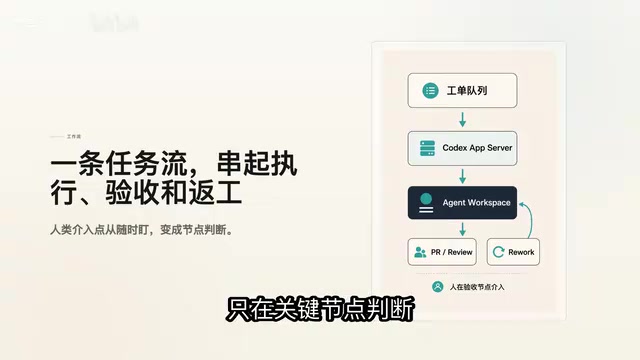
What Symphony does is straightforward in concept: it connects your ticket system (like Linear) with the Codex coding agent. When a ticket changes status, the AI automatically steps in — reads the requirements, modifies the code, runs tests, and submits a PR. Humans only show up at key checkpoints to approve.
The clever part is that it doesn't build a new system from scratch — it plugs directly into your existing workflow. Like a new hire who walks in on day one already knowing where to find the requirements doc and how to submit a PR. Better than most actual new hires, honestly. Tasks no longer live in a chat window; they enter the team's actual work pipeline.
This isn't just another AI tool. This is the first time AI has genuinely been handed its own badge.
The Real Bottleneck Isn't AI Intelligence — It's Human Attention
Once coding agents can actually write code, the first wall a team hits isn't the AI's capability ceiling — it's the human attention ceiling.
An engineer can realistically track 3 to 5 AI sessions simultaneously before things fall apart. It reminds me of playing Command & Conquer as a kid — you'd build a massive tank army and lose them all because your micro couldn't keep up. The problem was never how many units you could build; it was how many you could command.
Symphony's approach is clear-headed: stop making humans babysit AI. The key isn't opening more windows — it's elevating the unit of management from "individual conversations" to "individual tickets." Humans shift from micromanagers to strategic commanders, making judgment calls at critical nodes rather than running alongside every task.
Ticket-Driven Agent Workflows: Why Linear Instead of a Custom System

The entire workflow is designed like a precision assembly line:
- A ticket enters a designated status (e.g., "Ready")
- The agent automatically enters an isolated workspace
- It reads requirements, modifies code, runs validation
- Results are sent back for review
- A human decides to merge or send back for rework
Execution, acceptance, and rework all happen within the same chain.
Choosing Linear over a custom-built system is a smart call — you wouldn't overhaul your entire office infrastructure just to onboard one new employee, would you? For AI to integrate into a team, it needs to follow the team's existing tracks, not the other way around. That's what genuinely pragmatic AI adoption looks like.
Vague Requirements Are the Biggest Landmine: Agents Will Amplify Your Chaos Tenfold
This cannot be overstated: the more agents you deploy, the more critical it is to write clear completion criteria.
A human developer faced with a vague requirement will walk over and ask, "What exactly do you want?" But if you batch-feed that same vague requirement to ten agents, congratulations — you'll receive ten PRs going in ten different directions. It's exactly like texting a group chat "whatever food is fine" and getting ten different delivery orders.
Execution can be handed to AI. Completion criteria absolutely cannot be left ambiguous. Specifically:
- Process documentation isn't decoration — it's the agent's operating manual
- Repository README files must clearly explain how to start the project
- Tests and logs are the foundational infrastructure for stable agent operation
If your repo lacks clear startup instructions and reliable validation, AI won't make your organization more advanced — it'll just expose your chaos faster. Symphony isn't a magic wand; it's a magnifying glass. However messy your processes are, it will magnify them proportionally.
Plummeting Experimentation Costs: Your Team Just Got a Cheap Exploration Layer

OpenAI's official data claims a 500% improvement in pull request delivery speed. That number is striking, but the more interesting shift is in the underlying logic.
Before, an idea required a project proposal, scheduling, and resource allocation — by the time the process completed, the moment had passed. Now? Bug fixes, CI fixes, and tech debt cleanup can be kicked off with an agent first to see what comes back. Ideas don't need to be formally scoped upfront; you get initial results first, then decide.
It's like the difference between hiring a full design firm to produce architectural blueprints versus using AI to render a quick mockup to see if it's worth investing in. Teams now have a cheap exploration layer.
But don't forget: as exploration gets cheaper, taste gets more expensive. AI can rapidly generate ten solutions — but deciding which to keep and which to discard requires sharper judgment than ever. Generating proposals and PR feedback can be delegated to agents; the trade-offs remain a human responsibility.
Four Pre-Launch Checks: Most Teams Will Get Stuck on the First One

Don't rush to copy Symphony's approach without getting your orchestration right first — it will only amplify problems. Before going live, run through these four checks:
Check 1: Ticket Quality — Could a New Hire Start Work Immediately?
Objectives, scope boundaries, acceptance criteria, relevant entry points, and off-limits areas all need to be written down. Honestly, most teams write tickets that even veteran employees can't parse — everything runs on tribal knowledge and "just ask Wang." Agents can't ask Wang.
Check 2: Repository Validation Capability — Can the Agent Run It Independently?
Without tests and a reproducible environment, you'll end up with nothing but "I think I fixed it." Agents need explicit feedback signals, not human intuition.
Check 3: Status Transitions — No Room for Unspoken Rules
Ready, In Review, Needs Rework, Merged — every status must be explicitly defined. Agents can't interpret implicit norms; they can only trigger actions based on clearly defined state rules.
Check 4: Workflows Documented in the Repo — AI Can't Read What's in Your Head
This one hits hardest. All those years of accumulated knowledge — "never touch this interface," "changing this config file requires three restarts" — if it's not written into the repo documentation, the agent is flying blind. Symphony isn't here to rescue chaotic teams; it's here to reward disciplined ones.
The Manager's Role Moves Forward: Future Competition Is About Who Delegates Better, Not Whose AI Is Smarter

Symphony pushes managers to a more proactive position. Before, you could wait for development to finish and review the results. Now you need to define three things upfront:
- Task granularity — how small does a task need to be for an agent to complete it independently?
- Validation systems — how do you determine whether something was done correctly?
- Human intervention points — where do you let go, and where do you stay hands-on?
What gets automated and what stays manual needs to be designed in advance, not figured out on the fly.
The manager's job becomes: first judge whether something is worth doing, then decide whether the result should be merged or discarded. Future competition won't be about whose AI is smarter — it'll be about whose organization can orchestrate a fleet of agents to deliver consistently. It's like restaurant competition eventually coming down not to a chef's knife skills, but to the head chef's menu design and kitchen workflow management.
Engineers won't become redundant — they'll just spend less time watching execution details and redirect their energy toward task orchestration and acceptance. As AI increasingly resembles a capable team member, the question isn't whether it's smart enough — it's whether you know how to delegate.
AI is no longer asking you "what should I do?" — it's heading straight to your ticket system to find work on its own. The real question is: is your ticket system ready to be scrutinized by a colleague who never slacks off, never takes a day off, but also never "reads between the lines"?
Related articles
Deep Dive into AI Agent Skill Design: …
Deep Dive into AI Agent Skill Design: Engineering Practices from Anthropic and Perplexity
A deep dive into Skill design philosophy from Anthropic's Claude Code team and Perplexity's Agent team, covering the Tax Test, Gotchas Flywheel, progressive disclosure, and Eval-First practices for building high-quality AI Agent skill systems.
Deep Dive into OpenAI's Official GPT-5…
Deep Dive into OpenAI's Official GPT-5.6 Prompting Guide: The Shift from Manual to Automatic
A deep dive into OpenAI's official GPT-5.6 Sol prompting guide: conciseness-first, outcome-oriented design, autonomy boundaries, tool routing, and reasoning intensity tuning.
 Deep Dives
Deep Dive into How OpenClaw (Open-Source Crayfish) AI Agent Works
Deep analysis of OpenClaw AI Agent internals: System Prompt, tool calling, SubAgents, Skill system, memory, and Context Engineering explained.