OpenAI Turns Its Coding Tool Into dots: An Always-On Personal Assistant
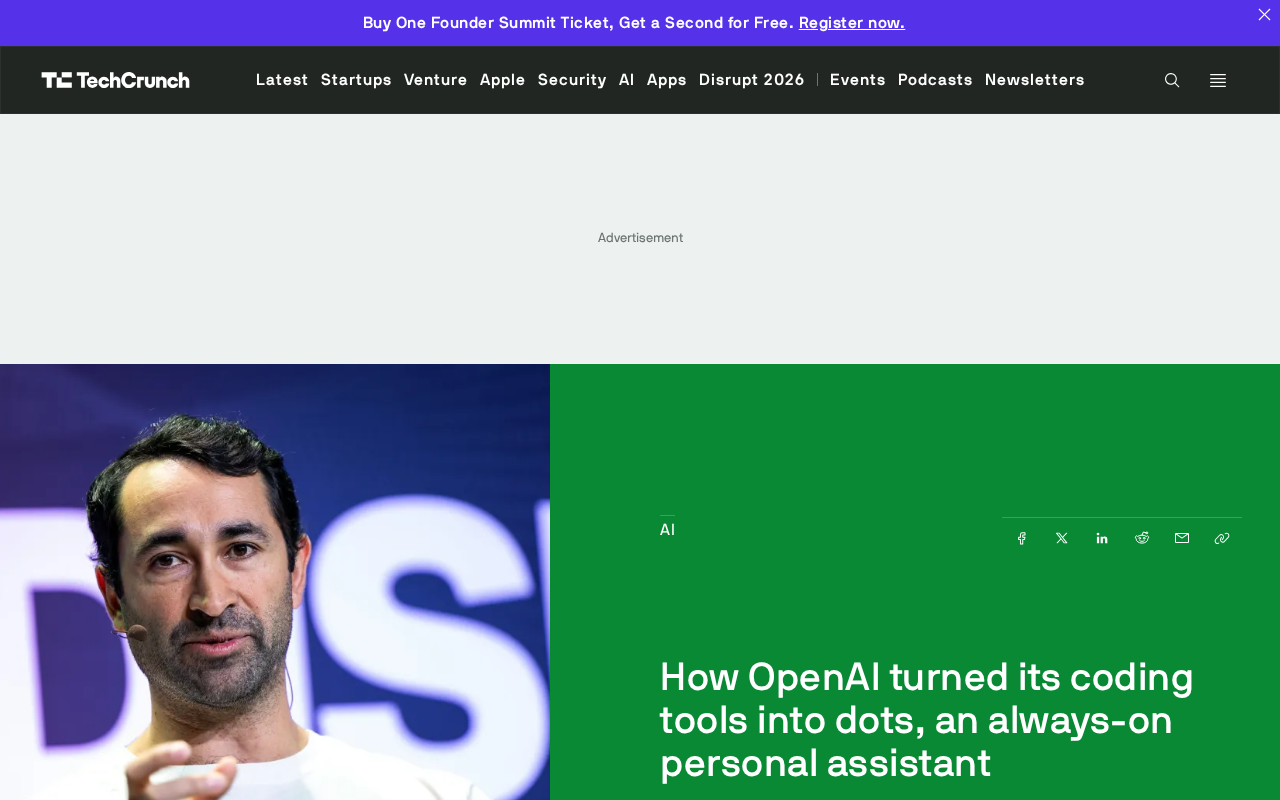
OpenAI transfers its coding tool's capabilities to the always-on personal assistant dots, exploring a new form of AI agent collaboration.
OpenAI is transforming its coding tool from a developer-focused code generator into an always-on personal assistant called dots. Executive Alexander Embiricos says he doesn't want to attend meetings with someone else's AI agent, hinting that AI agents may partially replace direct human communication. The article argues that coding's demands for precision, verifiability, and multi-step execution form the underlying capabilities a personal assistant needs—a path of capability reuse. But the always-on form factor raises unresolved issues around context management, privacy boundaries, and reliability transfer.
OpenAI's coding tool is undergoing a role shift—from a code generator in developers' hands to an always-on personal assistant called dots. Alexander Embiricos, the executive in charge of dots, made a telling remark in an interview: he never wants to attend a meeting with someone else's AI agent. Behind that statement is OpenAI's rethinking of what an AI assistant should be.
From Coding Tool to Always-On Assistant
OpenAI's coding tool originally served developers, with core capabilities centered on understanding, generating, and debugging code. The emergence of dots changes that positioning: it extends the reasoning and execution capabilities accumulated through the coding tool into everyday tasks, turning it into an always-on personal assistant.
This shift is not a simple feature addition. Coding scenarios demand precision, verifiability, and multi-step execution from AI—and these are exactly the underlying capabilities a personal assistant needs. OpenAI is transferring the capabilities honed through its coding tool to an assistant product, following a path of capability reuse.
What Embiricos's "Don't Want to Attend Meetings" Means
Embiricos's statement deserves unpacking. His reluctance to meet with someone else's AI agent points to a product judgment: if every user has an AI assistant they trust, the interface for human collaboration will change, and interactions between AI assistants may replace some direct communication between people.
dots's positioning is precisely "always-on"—persistently online and continuously available. Unlike tools that require users to actively invoke them, an always-on assistant means it remains within the user's context over time, understanding their tasks, preferences, and rhythms. This form factor places higher demands on product trustworthiness and context management capabilities.
AI agent refers to an intelligent entity capable of autonomously perceiving its environment, formulating plans, and invoking tools to execute multi-step tasks—distinct from a chatbot that merely responds to single-turn questions. Its key characteristics include goal persistence, tool-use capability, and a degree of autonomous decision-making. The industry typically uses "agentic" to describe the extent to which such systems advance tasks without step-by-step human instruction. When Embiricos speaks of "someone else's AI agent," he means agent instances acting on behalf of other users; if such agents become ubiquitous, human-AI collaboration will evolve into agent-to-agent negotiation, raising new issues around identity authentication, intent communication, and accountability.
Why Coding Capabilities Are the Foundation for an Assistant
Coding tasks are a touchstone for testing AI capabilities: code can be executed, results can be verified, and errors can be located. A model that can work reliably in coding scenarios typically possesses strong multi-step reasoning and tool-calling abilities.
Applying these capabilities to a personal assistant means dots must not only answer questions but also execute tasks, operate tools, and maintain goal consistency across multiple steps. OpenAI's use of its coding tool as a lever to pry open the assistant market makes logical sense, but whether the product experience can be successfully transferred remains to be seen in actual performance.
Tool use / function calling is a mechanism that lets large models invoke external functions or APIs beyond generating text: the model outputs a structured call request, which the runtime executes and returns the result to the model to continue the next round of reasoning. It is the technical foundation for multi-step task automation and one source of "verifiability"—tool-returned results can be checked, unlike pure text generation, which is difficult to verify. Coding scenarios inherently require models to use tools frequently and accurately and to handle returned errors, so they are often regarded as a stress test for tool-calling capabilities.
The Competitive Landscape for Always-On Assistants
"Always-on personal assistant" is a direction several AI companies are targeting. dots's differentiation lies in its coding DNA: a stronger emphasis on the reliability of task execution rather than mere conversational fluency.
Embiricos's remark about AI agents attending meetings also hints at dots's long-term vision—it is not just a passively responsive helper but may become an agent that participates in collaboration on the user's behalf. This direction is still in its early stages, with product form, interaction patterns, and trust mechanisms all yet to be settled.
Context window and context management refer to the upper limit of information a model can process in a single pass, as well as the system's strategies for filtering, retaining, and discarding information within it. An always-on assistant remains within the user's context over time, continuously accumulating task history, preferences, and environmental information, and must therefore solve the problem of "what to remember, what to forget, and when to retrieve." Common approaches include summary compression, hierarchical memory (short-term conversation memory and long-term vector retrieval), and on-demand loading. Context boundary management directly affects privacy control and response quality, and is an engineering challenge for making the always-on form factor viable.
Questions Worth Watching
From coding tool to personal assistant, OpenAI's pivot raises several practical questions: how an always-on assistant manages privacy and context boundaries; whether the reliability standards of coding scenarios can be transferred to everyday tasks; and how collaboration rules should be established when AI agents begin interacting with others on users' behalf. Information disclosed about dots is currently limited, and these questions have no clear answers yet—but they will determine how far this type of product can go.
One-line Summary
OpenAI is transferring its coding tool's capabilities to the always-on personal assistant dots, exploring a new form of AI agent collaboration.
Paragraph Summary
OpenAI is transforming its coding tool from a developer-focused code generator into an always-on personal assistant called dots. Alexander Embiricos, the executive in charge, says he doesn't want to attend meetings with someone else's AI agent, hinting that AI agents may partially replace direct human communication. The article argues that coding's high demands for precision, verifiability, and multi-step execution form exactly the underlying capabilities a personal assistant needs, and that OpenAI is following a path of capability reuse. But the always-on form factor also raises unresolved issues around context management, privacy boundaries, and transferring reliability, with product form and trust mechanisms still in their early stages.
Related articles
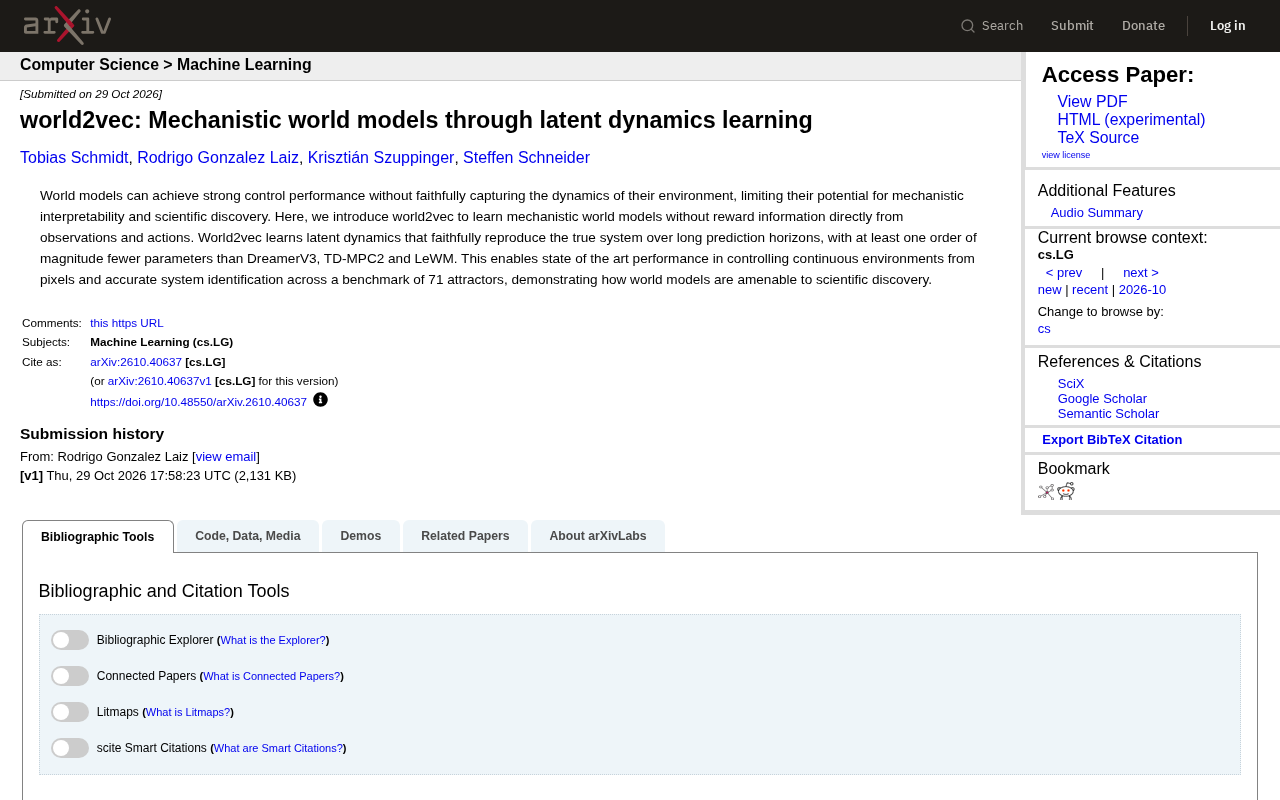
world2vec: Building Mechanistic World Models with Latent Dynamics Learning
world2vec proposes a reward-free method for learning mechanistic world models via latent dynamics, faithfully reproducing systems over long horizons with at least an order of magnitude fewer parameters than DreamerV3, TD-MPC2, and LeWM, and achieving accurate system identification on 71 attractor benchmarks.

A New KL-DRO Paradigm: Adaptive Scenario Generation Around a Learned Density Model
KL-DRO research proposes centering the KL ball on a learned density model instead of the empirical distribution, with adaptive scenario generation guiding sampling toward the worst case. Experiments show lower cost under distribution shift when records are scarce and the model can extrapolate, with comparable in-distribution cost.

ODE Samplers for Discrete Diffusion Models: Exponential Residual Flows Accelerate Generation
Discrete diffusion models lack deterministic ODE sampling? This article introduces Exponential Residual Flows (ERFs), which introduce continuous residual variables per token to construct piecewise ODEs for deterministic sampling and support consistency distillation acceleration. Superior to prior methods on code and text generation tasks.