OpenClaw Enterprise Deployment Guide: Build a Team AI Agent with Sonnet 4.6 + VPS
Deploy OpenClaw with Sonnet 4.6 on VPS for a low-cost, always-on enterprise AI agent.
This article covers the optimal combination of the open-source AI agent framework OpenClaw with Claude Sonnet 4.6. Sonnet 4.6 ranks first on the Computer Use Benchmark while delivering high performance at low cost. VPS deployment enables low-cost, high-availability operation, and three core configuration steps — setting the default model, connecting Perplexity Sonar Pro Search, and configuring the heartbeat mechanism — transform the AI from a passive tool into a proactively working digital employee.
OpenClaw + Sonnet 4.6: The Optimal Combination for Enterprise AI Agents
OpenClawAd is an open-source AI agent framework that's being adopted by an increasing number of enterprises to boost team productivity. Paired with Anthropic's newly released Claude Sonnet 4.6 model, this combination strikes the optimal balance between performance and cost.
Some useful background: OpenClaw evolved from the Agent Zero architecture. The fundamental difference between an AI Agent and a regular AI chat tool is that agents possess the ability to autonomously plan, invoke tools, and continuously execute tasks — not just engage in single-turn conversations. OpenClaw deeply integrates large language models (LLMs) with external tools like file systems, web search, and code execution, enabling AI to complete complex tasks that span multiple steps and require persistent state management.
Sonnet 4.6 ranks first in the world on the Computer Use Benchmark while also being fast and affordable. The Computer Use Benchmark specifically measures an AI model's ability to manipulate graphical interfaces and execute mouse and keyboard operations — a core capability metric for enterprise automation scenarios. Sonnet 4.6's lead in this test means it can more reliably complete real-world business tasks such as web navigation, form filling, and application control.
In Anthropic's model naming hierarchy, Opus, Sonnet, and Haiku correspond to high, medium, and low tiers of capability and cost respectively. The Sonnet series is designed to find the Pareto-optimal point between reasoning ability and inference speed. Compared to Opus 4.6, Sonnet 4.6 performs nearly on par across most benchmarks but with faster inference and lower API costs. For enterprise agents that need to run 24/7, this cost-efficiency advantage compounds over time.
Put simply: you get near-top-tier AI capability for a significantly smaller budget.
VPS Deployment for OpenClaw: A Smart Low-Cost, High-Availability Choice
Many people spend thousands of dollars on a Mac Mini — or even $20,000+ on a Mac Studio — to run OpenClaw. But in reality, a VPS (Virtual Private Server) can handle the job for just a few dollars per month, and outperforms local hardware in multiple dimensions.
A VPS uses virtualization technology to partition a single physical server into multiple independently running virtual machines, each with its own operating system, storage, and network resources. Compared to local hardware, the core advantage of a VPS lies in its network topology — being deployed in a data center means having a stable public IP, high-bandwidth connectivity, and an uptime SLA of 99.9% or higher. A local Mac Mini faces risks like power outages, network interruptions, and system sleep, while the redundant infrastructure design of VPS fundamentally eliminates these single points of failure.
- Access anywhere, anytime: No physical location constraints — usable while traveling or working remotely
- Team sharing: All members connect to the same agent with real-time information synchronization
- Distributed deployment: Can be deployed across multiple global data centers to improve security and availability
- Extremely low cost: Compared to hardware investments of thousands of dollars, VPS monthly fees are virtually negligible
With one-click deployment features from platforms like Hostinger, the entire OpenClaw installation process doesn't require touching the terminal command line — achieving truly zero-technical-barrier deployment.
Three Core Configuration Steps: From Passive Tool to Proactive Agent
Step 1: Set Sonnet 4.6 as the Default Model
OpenClaw supports self-updating and restarting. You simply type something like "Update yourself to use Claude Sonnet 4.6 as the default model, then restart the gateway" in the conversation, and it will automatically complete the configuration. This self-evolution capability is a core feature that distinguishes OpenClaw from other AI tools.
Step 2: Connect Perplexity Sonar Pro Search
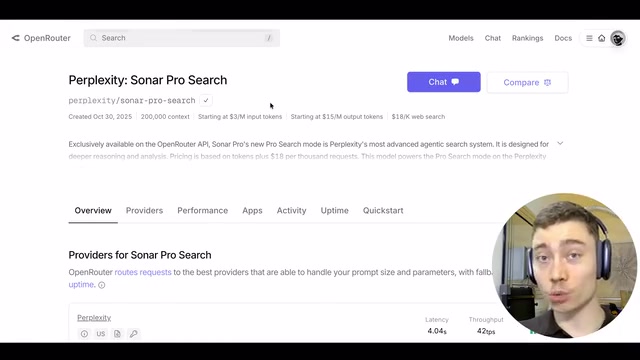
OpenClaw uses Brave Search by default, which works reasonably well, but Perplexity's Sonar Pro Search is currently the most powerful agentic web search tool available.
From a technical standpoint, Sonar Pro is built on a Retrieval-Augmented Generation (RAG) architecture. Unlike traditional search engines that return lists of links, Sonar Pro crawls multiple web pages in real-time, synthesizes information through an LLM, and directly returns structured answers with cited sources. When accessed through the OpenRouter API, each search costs about 1 cent yet returns extremely detailed real-time web information. OpenRouter is a unified AI model API routing platform — developers can access models from dozens of providers including Anthropic, OpenAI, and Google through a single API key, greatly simplifying the engineering complexity of multi-model integration.
The configuration steps are straightforward: obtain an OpenRouter API key, have OpenClaw securely store the key on the VPS, and switch the default search tool to Sonar Pro Search.
Step 3: Configure the Heartbeat Mechanism for Proactive Agent Work
The Heartbeat mechanism is the key to transforming OpenClaw from "you ask, it answers" to "it proactively gets work done." This concept is borrowed from the identically named mechanism used in distributed systems to detect node liveness. In the AI agent context, it transitions the agent from a passive response mode to an active execution mode — a critical technical leap for achieving a true "digital employee."
By default it triggers every 30 minutes, which you can adjust to 15 or even 10 minutes as needed. From a system design perspective, heartbeat frequency must balance response timeliness against API call costs: too high a frequency significantly increases token consumption, while too low a frequency may miss time-sensitive task windows.
A practical heartbeat prompt example:
"Check for official OpenClaw updates. If a new version is available, automatically update and send a brief changelog on Slack."
Related articles
 Tutorials
ChatGPT Plus Subscription Guide: Are GPT-5.5, image-2, and Codex Worth the Upgrade?
A detailed look at ChatGPT Plus features — GPT-5.5, image-2, and Codex — with a Plus vs Pro comparison and a complete step-by-step subscription guide for users outside the US.
 Tutorials
Harness AI Engineering in Practice: Using Claude Code to Master Enterprise-Level E-Commerce Development
Deep dive into Harness AI Engineering: master enterprise e-commerce development with Claude Code using the Rules, Skills, Wiki, and Changes framework.
 Tutorials
Cursor + Codex Dual-IDE Collaboration: A Practical Methodology for Open-Source Project Customization
A complete methodology for open-source project customization based on real-world experience, detailing the Cursor+Codex dual-IDE workflow, seven-stage process, MVP validation, and AI source code reading techniques.