OpenClaw in Practice: A Complete Guide to Building Three Enterprise-Grade AI Digital Workers in Two Weeks

Building three AI digital workers in two weeks with OpenClaw, featuring full recruitment automation.
This article details how a technical team developed and launched three AI digital workers (Junior Development Engineer, Administrative Assistant, and HR Assistant) based on the open-source OpenClaw agent framework within two weeks. It focuses on how the AI HR Assistant achieves full recruitment lifecycle management, including candidate outreach, resume management, intelligent assessment, and process coordination. Technically, it leverages OpenClaw's customizable memory system, Skills tool loading mechanism, and agent persona configuration—enabling enterprise-grade customization without modifying any underlying source code.
Introduction: General-Purpose Agent Frameworks Shouldn't Just Be Chat Toys
Many people install OpenClawAd (an open-source general-purpose agent framework) only to use it for "toy-level" applications like casual conversations, organizing desktops, or summarizing trending news. But in reality, OpenClaw's potential goes far beyond that—it is fundamentally a customizable general-purpose agent foundation that allows you to develop production-ready AI digital workers by modifying long-term and short-term memory along with Skills tool capabilities, all without changing a single line of the underlying source code.
Technical Background of General-Purpose Agent Frameworks: General-purpose agent frameworks represent a critical direction in AI engineering deployment in recent years. Unlike single-function AI tools, agent frameworks enable AI to autonomously decompose tasks, invoke tools, and iterate continuously until complex goals are achieved through a "perceive-plan-execute" loop. Frameworks like OpenClaw are technically derived from the ReAct (Reasoning + Acting) paradigm and early explorations like AutoGPT. The core innovation lies in decoupling the memory system from tool invocation, allowing developers to build highly customized business agents at the configuration layer without touching the underlying reasoning logic.
This article reveals how a technical team developed and launched three AI digital workers based on OpenClaw within two weeks, with a detailed analysis of the complete implementation approach for the most valuable one—the AI HR Assistant.
Three AI Digital Workers Launched in Two Weeks: Covering Core Enterprise Scenarios
Over the past two weeks, the team successfully developed and internally launched three AI digital workers based on OpenClaw, covering core enterprise operational scenarios:
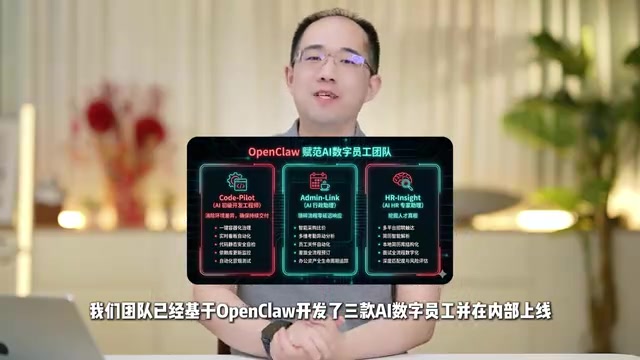
AI Junior Development Engineer
Responsible for maintaining the project development environment and managing development progress. This is essentially an automated DevOps assistant that can monitor project status, manage environment configurations, and reduce the daily operational burden on the development team.
AI Administrative Assistant
Handles daily procurement, attendance tracking summaries, and employee relations care reminders. These types of highly repetitive yet indispensable administrative tasks are ideal entry points for AI automation.
AI HR Assistant (Core Highlight)
Assists HR in completing the full lifecycle management of recruitment activities, unanimously recognized by the team as the most valuable and helpful digital worker.
The Essential Difference Between AI Digital Workers and RPA: The core distinction between AI digital workers and traditional RPA (Robotic Process Automation) lies in "comprehension ability" and "fault tolerance." Traditional RPA is essentially rule-based script automation—once interface element positions change or unexpected inputs occur, the process breaks down and requires manual intervention to fix. AI digital workers powered by large language models possess natural language understanding capabilities, can handle unstructured inputs (such as resumes in various formats), perform semantic-level information extraction, and autonomously decide next steps through reasoning when encountering anomalies. This makes AI digital workers better suited for enterprise business scenarios that are "regular but not rigidly formatted"—and recruitment process management is a prime example.
Deep Dive into the AI HR Assistant: How to Automate the Entire Recruitment Process
This AI HR Assistant's capabilities cover every key stage of the recruitment process, truly achieving end-to-end automation from candidate outreach to hiring decisions.
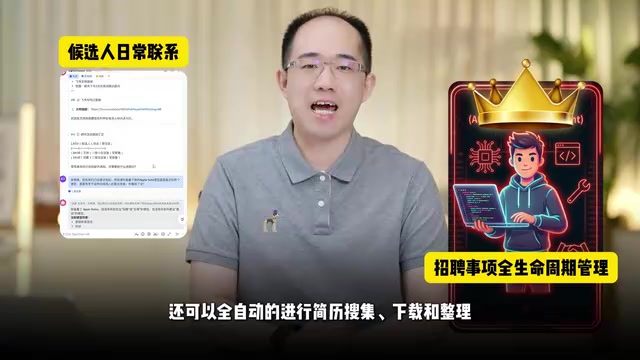
Candidate Outreach and Resume Management
- Automated Greetings: Fully automated daily communication with candidates using recruitment software
- Resume Collection: Automatically downloads, organizes, and archives resumes
- Information Extraction: Extracts key resume information based on preset workflows, including candidate age, gender, educational background, work experience, technical skills, etc.
- Progress Management: Consolidates all information into a recruitment progress tracking sheet
Intelligent Assessment and Candidate Analysis
Based on a knowledge base prepared by professional HR staff, the AI HR Assistant can evaluate candidates across multiple dimensions:
- Position Fit Analysis: Assesses the degree of match between candidates and target positions
- Potential Risk Identification: Identifies possible risk factors associated with candidates
- Interview Audio Transcription: Transcribes and analyzes interview recordings
- Candidate Profile Generation: Comprehensively analyzes candidate performance and interviewer feedback to generate complete profiles and interview reports with one click
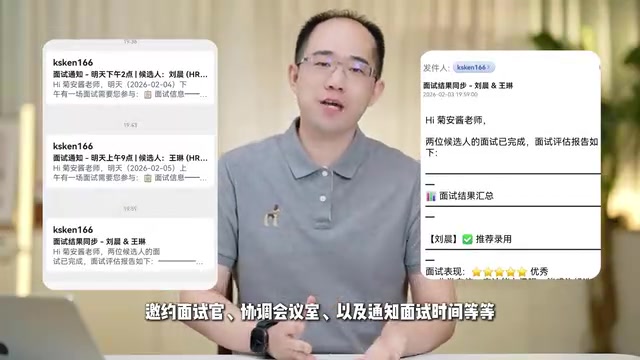
Process Coordination and Information Synchronization
- Fully automated synchronization of information across all stages
- Inviting interviewers and coordinating meeting rooms
- Notifying interview times
- Providing professional recommendations for hiring decisions
OpenClaw Technical Architecture: Three Key Features Supporting Enterprise-Grade Development
From a technical perspective, the reason OpenClaw can serve as a development foundation for enterprise-grade AI digital workers comes down to three core architectural features:
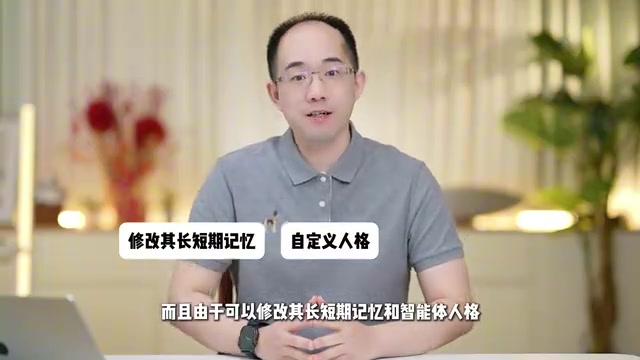
Customizable Memory System
OpenClaw supports modification of both long-term and short-term memory, meaning different "work experience" and "job knowledge" can be injected into digital workers serving different roles. For the AI HR Assistant, long-term memory stores recruitment process standards, evaluation criteria, and similar information; short-term memory is used to track the current status of candidates being processed.
Engineering Significance of the Long/Short-term Memory Mechanism: The memory system is one of the core capabilities that distinguishes agents from ordinary chatbots. Short-term Memory typically corresponds to the current session's Context Window, used to track task execution status; Long-term Memory relies on vector databases (such as Chroma, Pinecone, Milvus, etc.) to achieve cross-session knowledge persistence and semantic retrieval. For the AI HR Assistant, injecting structured knowledge like recruitment SOPs and position evaluation criteria into long-term memory is essentially a RAG (Retrieval-Augmented Generation) engineering practice—the agent automatically retrieves relevant knowledge fragments during task execution to make professional judgments aligned with enterprise standards, rather than relying on the LLM's generalized capabilities for random outputs.
Flexible Skills Tool Loading Mechanism
Through the Skills mechanism, various tools and capabilities can be flexibly loaded onto agents—operating recruitment software, reading and writing Excel spreadsheets, calling calendar APIs, sending notification messages—all can be developed and loaded as independent Skill modules.
Skills Tool Loading Mechanism and Function Calling: The Skills mechanism is highly homologous at the underlying technical level to Function Calling as proposed by OpenAI. Large language models understand the functional boundaries and invocation parameters of each Skill through structured Tool Schemas, autonomously deciding when to call which tool during the reasoning process. This mechanism enables agents to break through the limitations of pure text generation and directly interact with external systems—whether it's web automation for operating recruitment software (based on Playwright/Selenium and other RPA technologies), reading and writing Excel (via libraries like openpyxl), calling Feishu Open Platform APIs, or integrating with enterprise internal calendar systems, all can be encapsulated as standardized Skill modules. This "LEGO brick" style tool loading design dramatically reduces the development and maintenance costs of enterprise-grade agents.
Agent Persona and Role Configuration
By modifying the agent persona (System Prompt), the same OpenClaw foundation can exhibit completely different "professional qualities" and "work styles."
Related articles
 Tutorials
ChatGPT Plus Subscription Guide: Are GPT-5.5, image-2, and Codex Worth the Upgrade?
A detailed look at ChatGPT Plus features — GPT-5.5, image-2, and Codex — with a Plus vs Pro comparison and a complete step-by-step subscription guide for users outside the US.
 Tutorials
Harness AI Engineering in Practice: Using Claude Code to Master Enterprise-Level E-Commerce Development
Deep dive into Harness AI Engineering: master enterprise e-commerce development with Claude Code using the Rules, Skills, Wiki, and Changes framework.
 Tutorials
Cursor + Codex Dual-IDE Collaboration: A Practical Methodology for Open-Source Project Customization
A complete methodology for open-source project customization based on real-world experience, detailing the Cursor+Codex dual-IDE workflow, seven-stage process, MVP validation, and AI source code reading techniques.