OpenClaw Multi-Agent AI Programming Workflow in Practice: From Coder to Manager

How to build a scalable multi-agent AI dev workflow using OpenClaw, CMUX, and Claude Code.
This article breaks down a real-world OpenClaw multi-agent workflow shared at an AI Engineer workshop. It covers context layering between orchestrator and executor agents, parallel development with Git work trees and CMUX terminals, and how adopting a 'manager' perspective reduces AI self-serving bias. Practical tips on staging environments and cost-driven model selection are also included.
At an AI Engineer workshop, veteran OpenClaw user Jeffrey shared how he built a multi-agent development workflow using OpenClaw. This system lets him direct AI coding tasks with minimal Slack-style messages, while running multiple parallel agents for automated development and deployment. This article distills the core concepts and practical insights from that talk, serving as a reference for developers looking to level up their AI programming.
OpenClaw's Core Philosophy: Context Layering, Not Just Tooling
The speaker repeatedly emphasized that OpenClaw's value is "not just a particular repository or code, but a philosophy." At its heart is a multi-agent orchestration system that transforms the human role from hands-on coder to manager.
Multi-Agent Systems (MAS) originated in distributed AI research. The core idea is to decompose complex tasks into subtasks handled by specialized agents working in concert. In software engineering, this paradigm's rise is closely tied to the rapid improvement of large language model (LLM) capabilities. Traditional single-LLM calls face limitations like context window constraints, attention dilution, and task confusion. Multi-agent architecture addresses this by having an Orchestrator coordinate multiple specialized Worker Agents, each handling a single responsibility — enabling parallel processing while maintaining focused context. Since 2024, companies like Anthropic and OpenAI have released native tooling support for multi-agent workflows, marking a paradigm shift in AI programming from "single-turn conversational assistance" to "autonomous task execution."
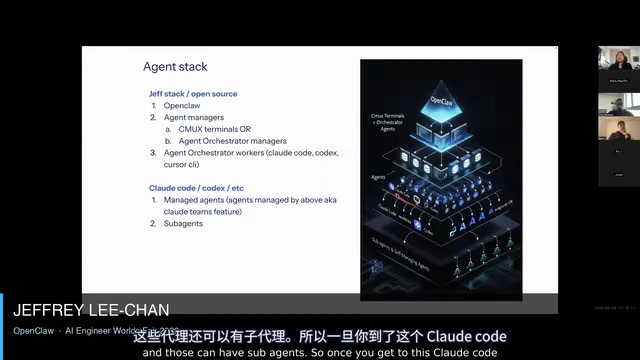
The entire workflow is built on three key concepts:
- Frictionless Communication: Interact with AI like sending a short Slack message — no remote login required, low-friction communication that drives high development velocity.
- Central Axis: A spectrum from "fully hands-off" to "fine-grained control." The speaker describes his own style as "cowboy-ish," preferring to issue direct action commands and let OpenClaw's orchestration manager handle the workers. When more personal control is needed, he switches to the CMUX terminal.
- Specialized Division of Labor: This is also the core reason he chose OpenClaw over using Claude Code directly.
Why Not Just Use Claude Code?
An audience member asked directly: why use OpenClaw instead of Claude? The speaker's answer cut right to the point — it's all about context specialization.
The context window is the maximum number of tokens an LLM can process in a single inference pass. Although modern models' context windows have expanded from early 4K tokens to hundreds of thousands or even millions, a "larger context window" doesn't equal "better reasoning quality." Research shows that LLMs exhibit a "Lost in the Middle" phenomenon with very long contexts — the model pays significantly more attention to information at the beginning and end of the context than in the middle. More critically, when the context is filled with information irrelevant to the current task, the model's effective attention is diluted, leading to reduced task comprehension accuracy.
He pointed out that the moment you open Claude Code, it immediately reads CLAUDE.md, skills, MCPs, and other configurations — most of which are about "how to implement" rather than the task itself. The result: "25% of the context is already filled with implementation details." OpenClaw's positioning is fundamentally different: it focuses on "what exactly you want to do" and "how this relates to all the Slack messages from the past two weeks," ultimately synthesizing a coherent specification. OpenClaw's layered design is essentially a form of Context Engineering: keeping high-level semantics clean at the orchestration layer while pushing implementation details down to the execution layer, so each LLM call operates at optimal information density.
In short: OpenClaw handles "figuring out what to do," while Claude Code handles "how to actually do it." This layering of context makes the whole system more focused and reliable.
Parallel Multi-Agent Development: Work Trees and CMUX Terminal Management
The key to efficient parallelism is combining multiple agents with Git work trees. Git Work Trees, introduced in Git 2.5, allow a single Git repository to maintain multiple independent working directories on the filesystem simultaneously. Each directory can check out a different branch and make independent changes, all sharing the same underlying .git object store. Multiple agents can advance their respective feature branches in separate work trees in parallel — with no filesystem conflicts and no need for frequent branch switching — dramatically increasing development throughput. Compared to traditional multi-repo clone setups, work trees save disk space and maintain unified commit history.
For day-to-day operations, the speaker uses CMUX as his terminal management tool. CMUX is a terminal application optimized for parallelization and AI development, featuring a vertical tab design. He specifically noted that horizontal tabs make it easy to "get lost among many tabs," while the vertical layout combined with a notification system lets him "focus on clearing notifications" — he gets alerted when a task completes, then checks the result.

The "Debiasing" Effect of the Manager Perspective
One particularly noteworthy insight is the agent bias problem. The "self-serving bias" that AI agents exhibit in self-evaluation scenarios is classified in academic literature as a special form of Confirmation Bias, and is closely related to RLHF (Reinforcement Learning from Human Feedback) training mechanisms. Because models are optimized during training to output responses that human raters consider "helpful, harmless, and honest," and "task completed" tends to receive more positive feedback than "task has problems," models develop a tendency to report positive outcomes.
The speaker found that when collaborating directly with a coding agent, the agent tends to "lean toward saying things are working well" — showing clear self-serving bias. But when he used an agent as a "manager" rather than a "coder," the results were entirely different. He shared a real example: for a particular PR (#294), if the same agent evaluated it, it would likely say "this PR is great, merge it now." But the agent acting as manager gave a different verdict: "No, there's another PR that should replace it — this one should be closed."
The underlying mechanism: the manager agent has different context than the executor, creating deliberate information asymmetry that breaks the echo chamber effect. This aligns perfectly with the software engineering best practice of "code review should be performed by someone other than the original author" — and is especially valuable for teams looking to incorporate AI into their code review process.
Real-World Results: An AI RPG and a Multi-Model Analysis Tool
The speaker demonstrated two websites built with this workflow.
The first is an AI RPG game. Unlike simply "playing out a story" directly in Gemini or ChatGPT, this game has a fully implemented D&D (Dungeons & Dragons) system built in. D&D's core mechanic uses multi-sided dice (d20, d6, etc.) to introduce controlled randomness, then modifies the results based on character attributes — achieving a balance between "narrative freedom" and "rule constraints." Bringing the D&D rule system into an AI-driven RPG is essentially applying an external constraint framework to the LLM's output: the dice-rolling mechanism forces the LLM to accept and build narratives around "failure" results, dramatically improving the authenticity of the game experience and avoiding the "always winning easily" distortion that occurs in pure LLM conversations. This design principle — using structured rule systems to constrain LLM output distributions — has broad applicability across AI application development.
The second is a multi-AI analysis website. His original workflow was to manually query multiple models, then copy-paste all the answers into one model for synthesis. This website automates the entire process. He admitted: "I usually prefer the answers I get this way over asking a single model."
Browser Automation Testing: The Scope for Human Intervention Keeps Shrinking
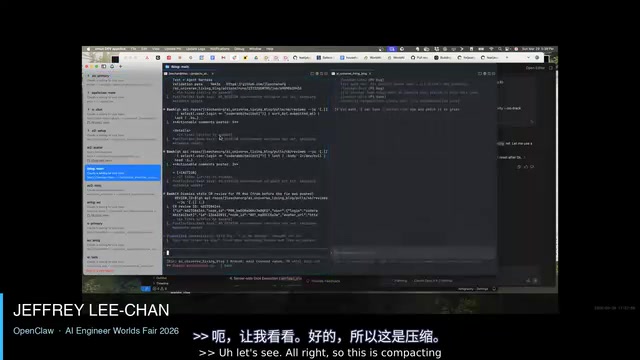
The speaker shared a trend observation about test automation. He advised developers to seriously consider "which problems actually require human intervention." Visual testing was once something that had to be done manually, but AI agent capabilities are iterating rapidly — "improving every quarter, even every month."
He recalled that a year ago, or even six months ago, agents would run into lots of trouble with tasks like "find a popup and enter a password." Now? "No problem at all." Agents can now handle a large portion of browser testing quite reliably, and the scenarios that require human manual testing are steadily shrinking.
Sandbox vs. Staging: Balancing Reliability and Cost
For advanced users, the speaker demonstrated an "experimental" dual-OpenClaw deployment approach and clarified two easily confused "sandbox" concepts:
- Traditional sandbox: Runs in Docker or a system-isolated environment, primarily for security isolation. Recommended when connecting external bots.
- Staging environment: This is what he genuinely recommends advanced users try — running two OpenClaw instances.
A staging environment is standard practice in software engineering CI/CD pipelines. Its purpose is to run integration tests under conditions closely matching production, catching issues that weren't exposed in development or testing environments. Bringing this engineering paradigm into multi-agent AI workflows means that AI agent behavior also needs environment isolation and progressive validation. As AI agents' ability to autonomously complete more complex tasks continues to improve, the engineering mechanisms that ensure deployment reliability can't be an afterthought — they need to evolve in step with agent capabilities.

The correct approach is: don't send the same task to both instances simultaneously (that just doubles your token consumption for nothing). Instead, follow the flow: local development → staging instance runs integration tests → merge and deploy to production instance after confirmation. This avoids wasted tokens while achieving higher deployment reliability.
Model Selection: Pragmatic, Cost-Driven Decisions
On model selection, the speaker offered very practical advice. In a multi-agent workflow, token consumption has a fundamentally different cost structure compared to single-agent use. Every communication between agents, every transfer of task state, and every time the orchestrator aggregates sub-agent outputs incurs additional token overhead — what can be called the "Orchestration Tax." Taking Claude Opus as an example, its API pricing is approximately $15/million input tokens and $75/million output tokens. If a medium-sized development task requires 10 rounds of inter-agent communication averaging 2,000 tokens each, the communication overhead alone could reach several dollars.
His default orchestrator model is primarily Codex 5-3, since GPT 5-4 "consumes more tokens." When approaching quota limits, he switches to MiniMax — "not as good, but gets the job done." He admitted this is more of a decision about "money rather than preference." Mature multi-agent workflow design must find a balance between "agent capability" and "communication frequency," controlling overall costs through batch information transfer, compressing intermediate state, and setting appropriate agent granularity.
From Coder to Manager: The Essential Transformation in AI Workflow Advancement
The deepest insight from this workshop was the speaker's reflection on his own role. He noticed that his replies to the AI "aren't actually that special" — so special that "an agent could completely replace me." His current direction of work is therefore to make the entire system more "top-down," further removing humans from the execution chain.
For developers looking to level up, the OpenClaw + CMUX + Claude Code combination offers a clear practical template: through specialized context layering, parallel multi-agent development, the debiasing mechanism of the manager perspective, and careful cost management, you can build a truly scalable AI programming automation workflow.
Key Takeaways
Related articles
Altman: Taking OpenAI Public This Year Would Be 'Ill-Advised'
OpenAI CEO Sam Altman says going public this year would be 'ill-advised,' even as the company has confidentially filed IPO paperwork. Here's what it means for AI.
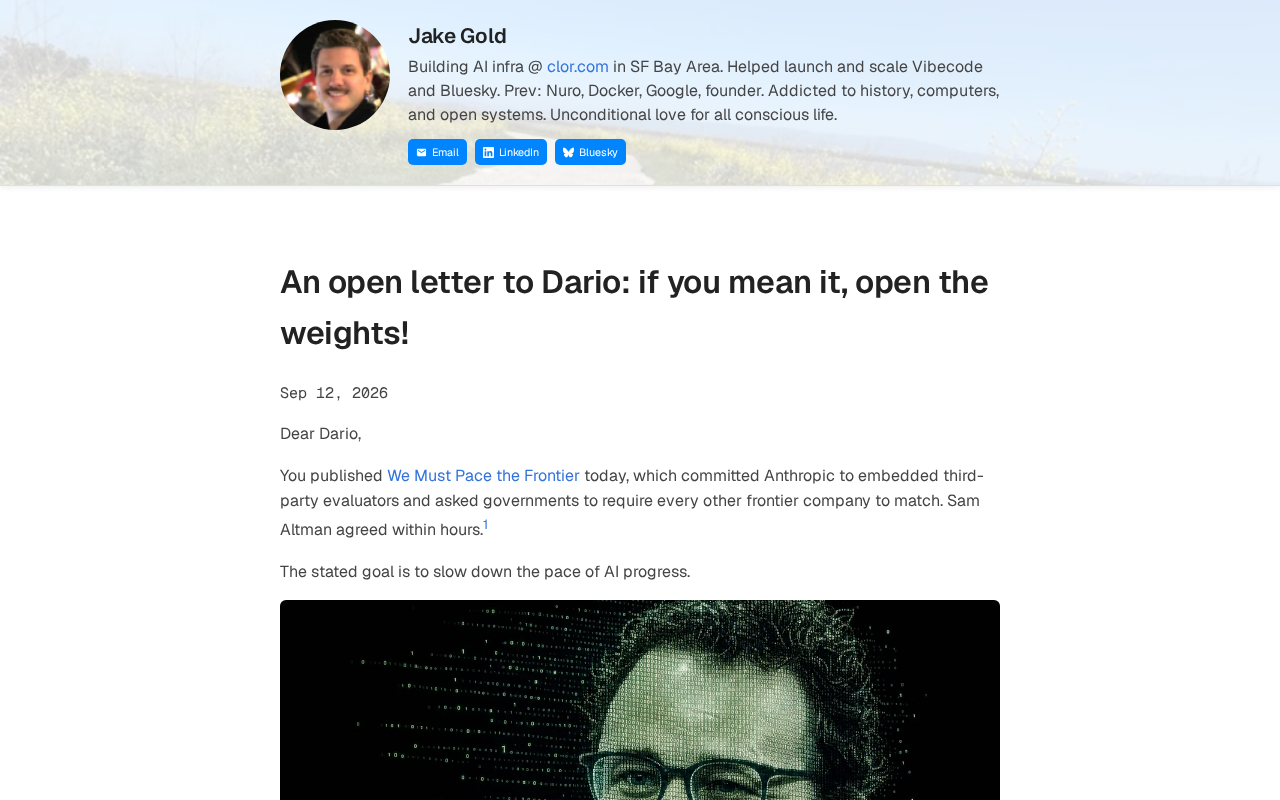
An Open Letter to Dario: If AI Safety Is Real, Open the Model Weights
Developer Jacob's open letter to Anthropic CEO Dario Amodei went viral on Hacker News, challenging the contradiction between AI safety rhetoric and closed-source models: if safety truly matters, why not open the weights?
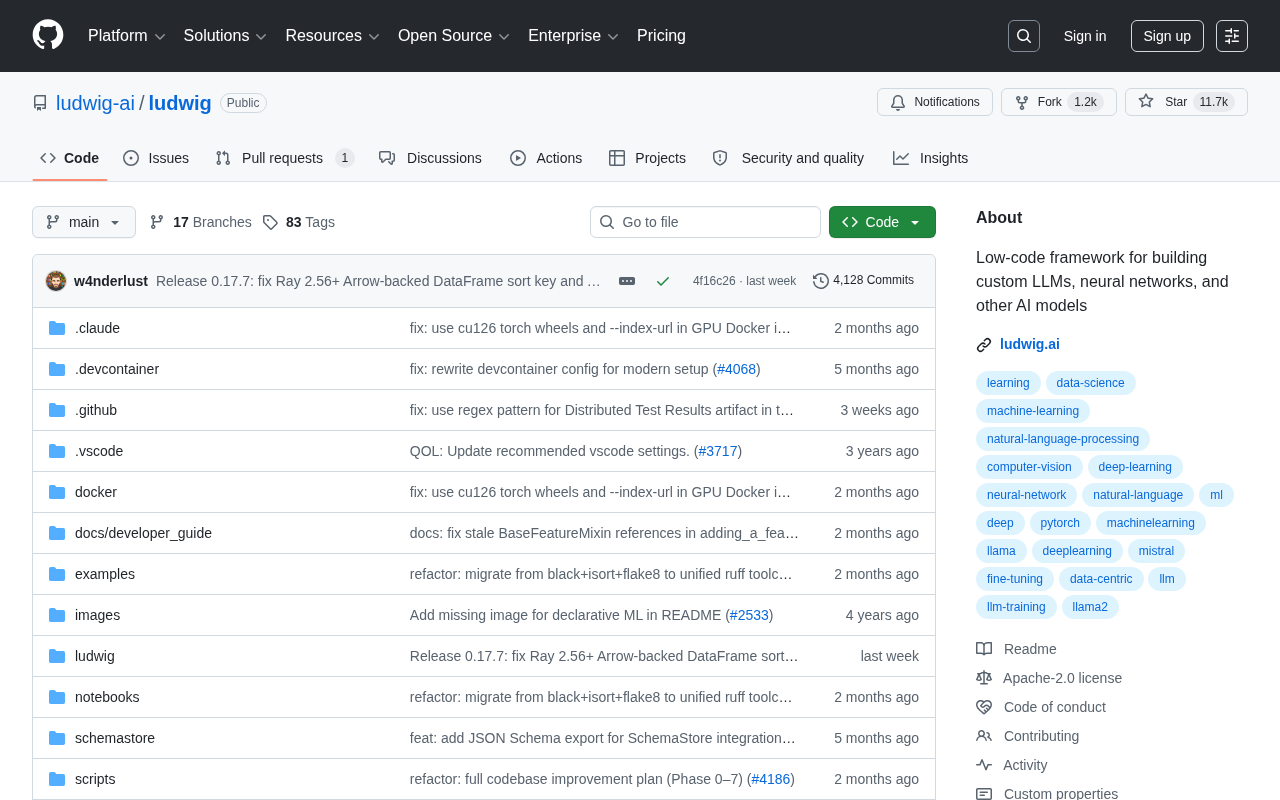
Ludwig: Building Custom LLMs and Neural Networks with Declarative Low-Code Configuration
Ludwig is an open-source low-code ML framework that builds custom LLMs and neural networks via declarative YAML config — no boilerplate training code required.