OpenClaw's Six Rename History: Tracing an Open Source Project's Naming Evolution Through Git Commit Records

OpenClaw's six renames reflect an open source project's evolution from tool to platform.
Simon Willison used a custom Python script to unearth OpenClaw's complete naming journey from Git history: from WhatsApp relay tool Warelay, to AI agent gateway CLAWDIS, to personal AI assistant OpenClaw — six renames in just over two months. Each rename accompanied a major product positioning shift — from feature-driven to vision-driven, from single-platform to multi-platform support, ultimately establishing open source brand awareness with the "Open" prefix.
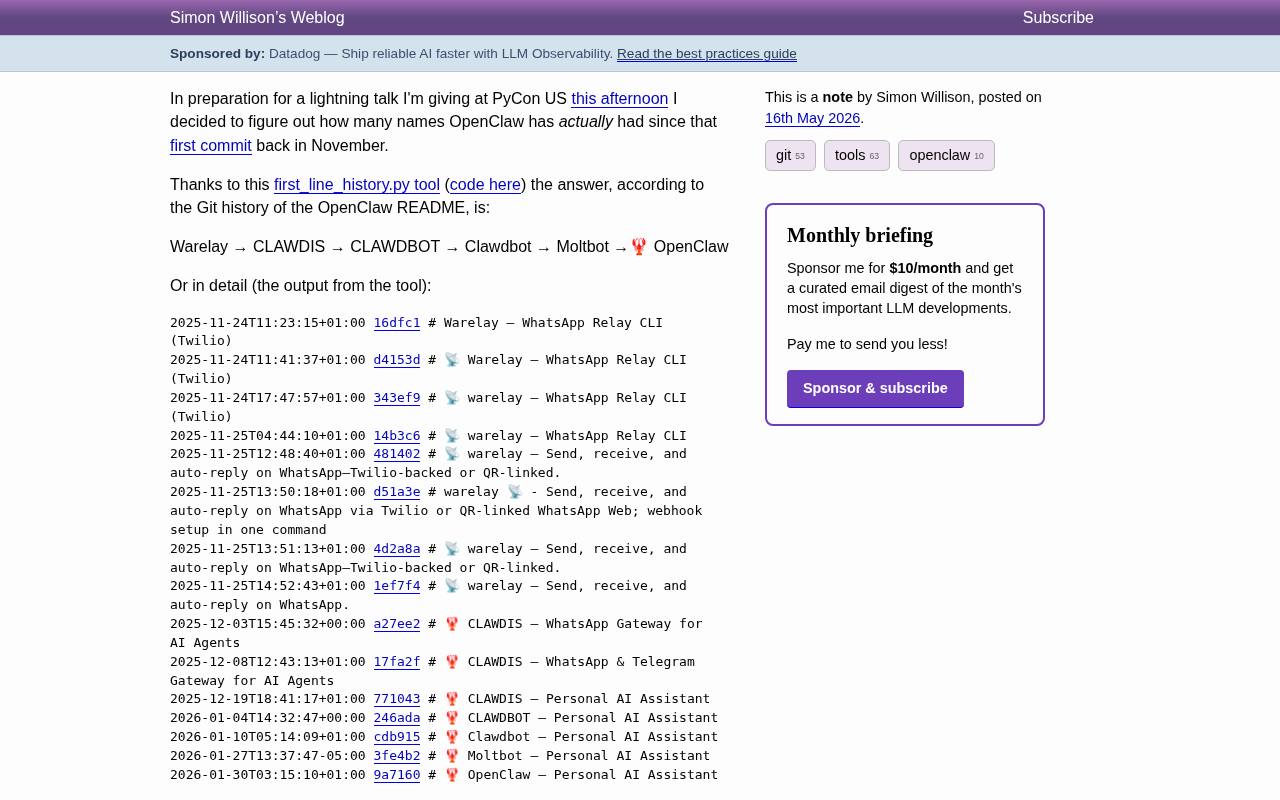
How many times does an open source project get renamed between its first commit and its final name? Before his PyCon US lightning talk, Simon Willison used a tool he wrote to dig through Git history and uncover the complete naming evolution of the OpenClaw project — the answer is six names, spanning over two months.
From WhatsApp Relay to Personal AI Assistant
OpenClawAd's story begins with a commit on November 24, 2025. At that time, it was called Warelay, positioned as a Twilio-based WhatsApp Relay CLI tool. The name itself reveals it was a fairly specific utility — helping developers send, receive, and auto-reply to WhatsApp messages via the command line.
Twilio is a leading global Cloud Communications Platform as a Service (CPaaS) provider, offering developers API interfaces for voice, SMS, video, and instant messaging capabilities. In the WhatsApp ecosystem, Twilio serves as an official Business API partner, allowing developers to programmatically send and receive WhatsApp messages through Twilio's SDK without dealing directly with Meta's complex review process. This explains why Warelay was initially built on Twilio — it dramatically lowered the technical barrier to WhatsApp integration. However, Twilio's approach has limitations including higher costs and WhatsApp Business approval requirements, so the project later added an alternative approach using QR codes to link to WhatsApp Web, which bypasses the official API by directly simulating web client login.
In the first few days, Warelay's README title went through several minor tweaks: adding an emoji 📡, adjusting capitalization, and expanding feature descriptions. By November 25, its positioning had expanded to "send, receive, and auto-reply to messages via Twilio or QR-linked WhatsApp Web."
But the real turning point came on December 3. The project name jumped from Warelay to CLAWDIS, and its positioning upgraded from a WhatsApp CLI tool to a "WhatsApp Gateway for AI Agents." This wasn't merely a rename — it was a fundamental shift in project direction: from a message relay tool to a bridge between AI agents and instant messaging platforms.
AI Agents are one of the hottest paradigms in large language model applications today. Unlike traditional chatbots, AI Agents possess capabilities for autonomous planning, tool calling, and multi-step reasoning — they can not only understand natural language instructions but also proactively call external APIs, query databases, execute code, and even coordinate multiple subtasks to accomplish complex goals. Between 2024-2025, companies like OpenAI, Anthropic, and Google all released Agent frameworks (such as OpenAI's Assistants API, Anthropic's Tool Use, and LangChain's Agent architecture), driving explosive growth in the Agent ecosystem. OpenClaw's pivot from "message relay" to "AI Agent Gateway" rode this wave: instant messaging platforms became natural entry points for AI Agent-user interaction, while the gateway layer handled protocol conversion, message routing, and session management.
The Complete Timeline of Six Names
By analyzing changes to the first line of the README file across Git commit history, the complete naming evolution path is as follows:
- Warelay (2025-11-24) — WhatsApp Relay CLI (Twilio)
- CLAWDIS (2025-12-03) — WhatsApp Gateway for AI Agents
- CLAWDBOT (2026-01-04) — Personal AI Assistant
- Clawdbot (2026-01-10) — Capitalization change only
- Moltbot (2026-01-27) — Personal AI Assistant
- OpenClaw (2026-01-30) — Personal AI Assistant 🦞
Interestingly, the CLAWDIS phase also saw an important feature expansion: Telegram support was added on December 8, transforming it from a single WhatsApp gateway into a multi-platform gateway. By December 19, the project positioning adjusted once more to "Personal AI Assistant," a designation that persists to this day.
The name "Moltbot" survived only three days before being replaced by the final "OpenClaw." "Molt" means to shed skin or shell, which is quite fitting for a project with a lobster 🦞 as its mascot — lobsters grow precisely through molting. A lobster undergoes dozens of molts in its lifetime, increasing in size by about 20% each time, a biological trait that forms a clever metaphor for the iterative evolution of software projects. The ultimate choice of "OpenClaw" clearly communicates the open source (Open) philosophy while retaining the lobster claw (Claw) brand element.
Using Tools to Unearth Stories from Git History
The tool Simon Willison used to trace this history is called first_line_history.py, hosted in his tools repository. The tool's principle is simple: iterate through the Git commit history of a specified file, extract the first line of the file at each commit, and record whenever that first line changes.
This method cleverly exploits a common open source project convention — the first line of a README file is typically the project name and a brief description. By tracking changes to this single line, you can reconstruct the project's naming and positioning evolution. From a technical implementation perspective, this is essentially structured parsing of git log -p output. Git's version control mechanism naturally preserves the complete evolution record of a project, with each commit being a snapshot containing timestamps, author information, and change content. "Code Archaeology" is the practice of using this information to understand the motivations and decision context behind code evolution. Common Git archaeology commands also include git log --follow (tracking file rename history), git blame (tracing the last modifier line by line), and git bisect (binary searching for the commit that introduced a bug).
This small tool also embodies Simon Willison's consistent tooling philosophy: solve specific problems with simple scripts. No complex code archaeology tools needed — a Python script paired with Git commands can tell a complete project evolution story. Simon Willison is a co-creator of the Django web framework and the author of the data exploration tool Datasette. In recent years, he's become well-known in the developer community for his deep exploration of LLM toolchains and highly prolific technical blog. His personal tools repository contains numerous single-file utility scripts written in Python, a methodology deeply influenced by Unix philosophy — combining small, sharp tools to accomplish complex tasks. His demonstration of this tool at a PyCon US lightning talk (a short presentation format typically limited to 5 minutes) perfectly fits the lightning talk tradition of being "short, sweet, and focused on one highlight."
Product Thinking Behind the Naming
From OpenClaw's rename history, we can observe several interesting patterns:
The shift from feature-driven to vision-driven. The name Warelay directly described functionality (WhatsApp Relay), while OpenClaw conveys a grander vision. When a project evolves from a specific tool into a platform-level product, the name needs a corresponding upgrade.
Gradual focus of positioning. From WhatsApp CLI → AI Agent Gateway → Personal AI Assistant, each rename accompanied an adjustment in product positioning. Interestingly, the positioning didn't become increasingly broad but rather increasingly focused on the core scenario of "personal AI assistant."
The awakening of open source brand awareness. The ultimate choice of the "Open" prefix indicates the project team began seriously thinking about community building and brand communication. Open source project naming is a severely underestimated engineering decision — a good project name must simultaneously satisfy multiple constraints: being unclaimed on GitHub, PyPI, npm, and other package management platforms; having sufficient distinctiveness in search engines (avoiding conflicts with common English words); not infringing on existing trademarks; having no negative connotations in multilingual contexts; and being short enough for easy word-of-mouth transmission. Many well-known projects have undergone renaming: Docker was originally called dotCloud, and Kubernetes' internal codename was Project Seven. The "Open" prefix is a classic naming strategy in the open source community (e.g., OpenCV, OpenSSL, OpenTelemetry) — it both communicates open source philosophy and helps distinguish the project from closed-source products with similar names in search results.
For any developer launching an open source project, OpenClaw's rename history serves as a good reminder: you don't need to find the perfect name on day one. As the project evolves, the name will naturally find its proper form. What matters is to keep iterating, just like a lobster molting — each transformation signifies growth.
Related articles
 Tech Frontiers
A Rare Quiet Day in AI: Recursive Self-Improvement Stirs Beneath the Surface
A rare quiet day in AI sees multiple sources go silent simultaneously. Behind the calm, Recursive Self-Improvement (RSI) research continues. What this means for the industry.
 Tech Frontiers
Reve 2 vs. Ideogram 4: A Deep Dive into Layout Control in AI Image Generation
A deep comparison of Reve 2 and Ideogram 4's layout control capabilities, covering technical approaches, real-world use cases, and industry trends for designers and creators.
 Tech Frontiers
In the Weights: Check Your Influence Score in the AI World
In the Weights is an AI influence search engine that quantifies your presence in the AI world with a score. Explore how it evaluates practitioners and what it means for digital identity.