OpenCode Hacked: Analysis of API Key Leak in AI Coding Tool

OpenCode's online platform was hacked, leaking users' API keys; attackers were refused when using AI to analyze malicious code.
The online platform of open-source AI coding agent OpenCode was breached by hackers, and some users' API keys were stolen, allowing attackers to impersonate victims to call models such as OpenAI and Anthropic and generate unauthorized charges. The incident exposes the fragility of AI coding tools in key storage and the security boundary of online services: the open-source local mode is relatively controllable, but once cloud credential handling is introduced, risks rise immediately. Ironically, when attackers tried to use AI tools to analyze malicious code, multiple assistants refused to cooperate due to safety alignment mechanisms, revealing a new "AI versus AI" offense-defense dynamic. The article recommends that developers rotate keys regularly, set usage limits, use secrets management services, and monitor abnormal calls, while calling on open-source projects to strengthen infrastructure security, access auditing, and bug bounty mechanisms.
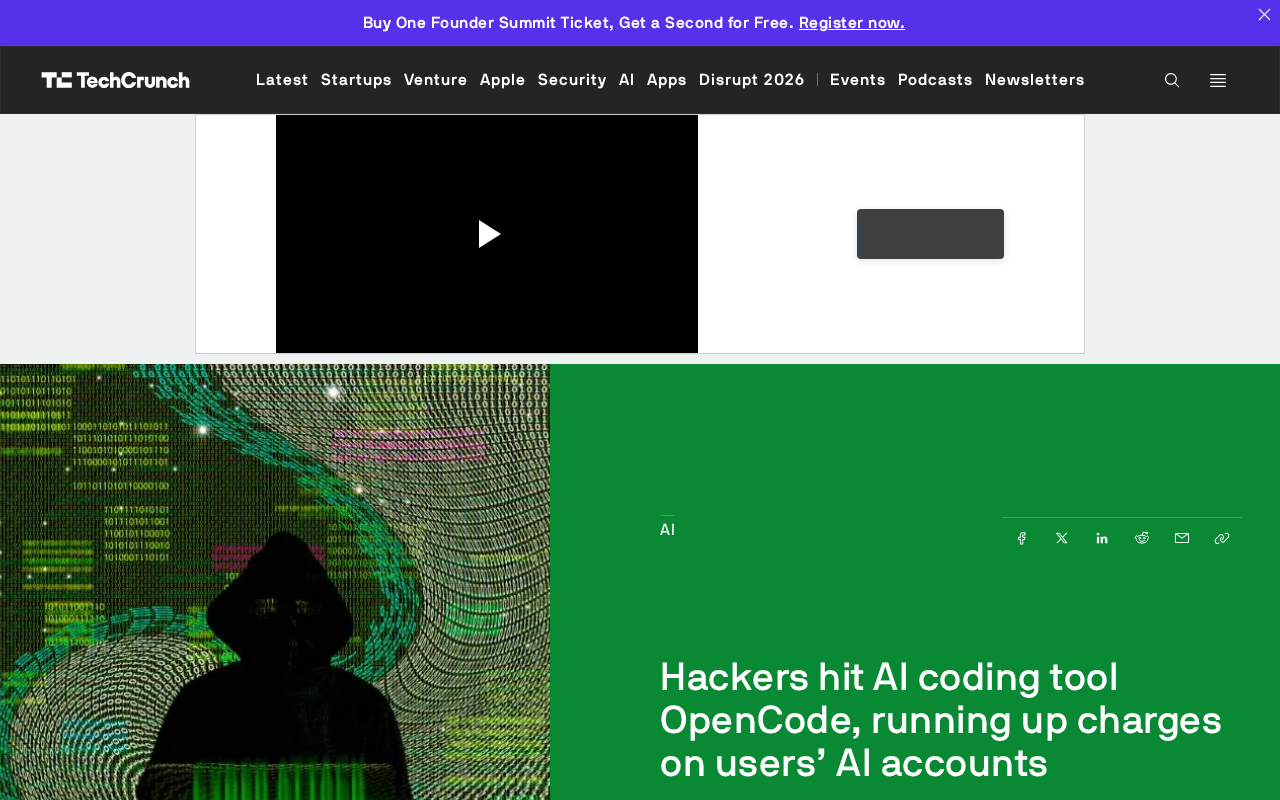
The open-source AI coding agent OpenCode has long been regarded as a strong alternative to Claude Code and Cursor, but its online platform was recently breached by hackers, resulting in the theft of some users' API keys and unauthorized AI account charges. What's more intriguing is that when the attackers tried to use AI tools to analyze malicious code, those tools flatly refused to cooperate.
Incident Recap: How Did the Attack Happen?
According to public reports, hackers infiltrated a component of the OpenCode online platform and stole a batch of users' API keys. These keys are the credentials users rely on to connect to AI services such as OpenAI and Anthropic; once leaked, attackers can invoke models in the victims' names and rack up substantial charges. It is not yet clear exactly how many users were affected, but the incident has already exposed the fragility of API key management in AI coding tools.
As an open-source project, OpenCode's local operating mode is generally considered more secure than cloud services. However, this attack targeted part of its online platform, showing that even for open-source tools, once online services are involved, the security boundary becomes blurred.
API keys are identity credentials for calling cloud-based AI services, typically a random string generated by the provider. Holding a key is equivalent to holding the account's invocation permissions—the server does not perform additional verification of the caller's true identity. Therefore, once a key leaks, attackers can send requests in the victim's name and have them billed without needing to breach the provider itself. Common leak vectors include plaintext storage on third-party platforms, accidental logging, mistakenly committing to code repositories, and supply chain attacks. This is why the industry generally recommends treating keys as password-level secrets and configuring usage caps on the server side as a fallback.
AI Tools' "Refusal to Assist": The Double-Edged Sword of Safety Mechanisms
One rather ironic detail of the incident: during the attack, hackers tried to use AI tools to analyze malicious code, but multiple AI assistants refused to view or process it. This reflects mainstream AI providers' efforts in safety alignment—they proactively block clearly malicious requests. Yet it also shows from another angle that attackers are attempting to leverage AI to assist attacks, while defenders are likewise using AI for interception.
This "AI versus AI" situation makes security offense and defense more complex. For developers, it is not enough to rely entirely on AI tools' safety filters; key protection should be strengthened at the process level.
Safety alignment refers to strategies during training and deployment that cause models to refuse obviously malicious, illegal, or high-risk requests. Common implementations include reinforcement learning from human feedback, system prompt constraints, and input/output filtering classifiers. Alignment mechanisms are not absolutely reliable; attackers can attempt to bypass them by rewriting prompts, submitting content in fragments, and other means. Conversely, defenders also use models to risk-score code and requests. This two-way exploitation shifts offense and defense from simple rule matching to a semantic-level contest, but the refusal behavior itself may also be interpreted by attackers as a signal that "this code is dangerous," creating a new surface for information leakage.
Impact on Developers and Recommended Responses
The direct consequences of API key leaks are financial loss and resource abuse. Victims may receive abnormal bills or find their quotas drained. More seriously, if the key is linked to sensitive data or production environments, it may also create data breach risks.
To address such risks, developers can take the following measures:
- Rotate keys regularly: Do not use the same set of API keys for a long time, especially after keys have been stored on a third-party platform.
- Set usage limits: Configure daily or monthly spending caps in the AI provider's backend to detect anomalies in time.
- Use environment variables or secrets management services: Avoid hardcoding keys in code or configuration files.
- Monitor abnormal calls: Pay attention to API call logs and stay alert to requests made at unusual times.
Secrets management services (such as HashiCorp Vault or cloud providers' Secrets Manager) provide centralized secret storage, encryption, access control, and automatic rotation. Compared with writing keys in environment variables or configuration files, these services can authorize by role, record audit logs for every read, and revoke with one click after a leak. For individual developers, at minimum keys should never be committed to repositories or appear in client-side code, and should be injected via CI/CD encrypted variable mechanisms. It is important to emphasize that rotation and quotas can only reduce the scope of damage; they cannot stop abuse that has already occurred. Therefore, monitoring and alerting must be established in tandem with key usage.
The Security Dilemma of Open-Source AI Tools
The OpenCode incident is not an isolated case. As AI coding tools become widespread, the attack surface around keys, models, and data is expanding. Open-source projects are often maintained by communities with limited security investment, while online platforms must handle user credentials—a natural risk point.
This incident also reminds us that the security of AI tools is not just about alignment at the model level, but also about infrastructure, identity authentication, and key management. For projects like OpenCode, stricter encrypted key storage, access auditing, and bug bounty programs may need to be introduced in the future.
Conclusion
The OpenCode breach is a wake-up call for the booming AI coding tool market. While pursuing efficiency and intelligence, security cannot become a sacrifice. Both tool developers and users need to re-examine the lifecycle management of API keys and establish multi-layered defense mechanisms. After all, when hackers have already begun using AI to assist attacks, defenders have no reason to stand still.
One-line Summary
OpenCode's online platform was hacked, stealing users' API keys; attackers were refused when using AI to analyze malicious code.
Paragraph Summary
The online platform of open-source AI coding agent OpenCode was breached by hackers, and some users' API keys were stolen, allowing attackers to impersonate victims to call models such as OpenAI and Anthropic and generate unauthorized charges. The incident exposes the fragility of AI coding tools in key storage and the security boundary of online services: the open-source local mode is relatively controllable, but once cloud credential handling is introduced, risks rise immediately. Ironically, when attackers tried to use AI tools to analyze malicious code, multiple assistants refused to cooperate due to safety alignment mechanisms, revealing a new "AI versus AI" offense-defense dynamic. The article recommends that developers rotate keys regularly, set usage limits, use secrets management services, and monitor abnormal calls, while calling on open-source projects to strengthen infrastructure security, access auditing, and bug bounty mechanisms.
Related articles

The Truth About AI Agents: A Hundred Lines of Code + an LLM, Deconstructing the Agent's Underlying Logic
AI agents aren't a new AI species—just a language model plus tools, a loop, and a goal. Here's the underlying logic: how 100 lines of Python hit a 75% fix rate, why the harness beats the model, and Gartner's "agent washing."

AI Agent Deployment: Three Things Developers Should Do
AI Agent deployment doesn't require rushing into multi-agent systems. This article outlines an actionable deployment path and engineering acceptance thresholds for developers, covering human baselines, bounded single-agent scope, and a controlled code-modification loop.

From Human-in-the-Loop to Out-of-the-Loop: A Hands-On Guide to Automated News Curation with Durable Agents
IndieDevDan shows how Durable News Agent uses durable agents and triggers to curate news automatically, filtering hype, facts, and signals with feedback weights.