OpenCode's 10x GLM Credit Promotion and Gemini 4 Leak: AI Daily Roundup

OpenCode's 10x GLM-5.3 credits go live, with dense activity from Flint, Intern S2.1, OpenAI, Google, and AMD
This AI Daily Roundup focuses on two main threads: model capabilities and platform ecosystems. OpenCode launched Phase 1 of Operation GLM, offering $100 worth of GLM-5.3 credits for $10, available to all OpenCode Go subscribers. On the model side, Command Code launched Recursive's Flint with 262K context and free access; Meituan open-sourced LongCat Video Avatar 1.6 under MIT license with 10-minute video duration; Shanghai AI Lab released Intern S2.1 Flash, a 320B MoE model for scientific research with open weights. On the platform side, OpenAI added 20+ medical plugins and expanded its academic program to 200,000 researchers; AMD acquired World Labs; Google launched 66 regional voices for Gemini and a suspected Gemini 4 reference appeared.
OpenCode has launched Phase 1 of Operation GLM: pay $10 and get access to $100 worth of GLM-5.3 credits. The offer is available to all OpenCode Go subscribers and is already active within subscription plans. Meanwhile, Command Code, Meituan, Shanghai AI Laboratory, OpenAI, AMD, and Google all have new developments. Here's a breakdown of the core updates.
OpenCode's 10x Credits: A Low-Cost Window to Try GLM-5.3
According to a Bilibili AI Daily video, OpenCode's Operation GLM Phase 1 offers a 10x credit leverage: users pay $10 and receive $100 worth of GLM-5.3 API credits. The offer is available to all OpenCode Go subscribers and is already active within subscription plans. From a product strategy perspective, this is a classic land-grab play—using credit subsidies to lower the barrier for developers to try domestic models and anchoring the subscription relationship to their own platform.
The actual value of this promotion depends on two things: whether GLM-5.3 performs consistently on coding tasks, and whether renewal pricing after credits are exhausted is attractive. The source material does not disclose credit validity periods or purchase limits, so it's advisable to confirm plan terms before participating.
Command Code Launches Flint: A Lightweight Model with 262K Context
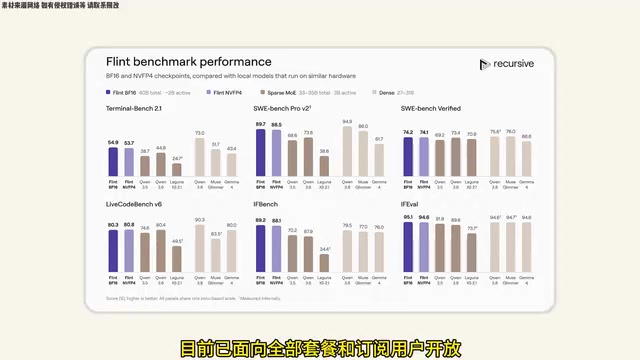
Command Code announced that the Flint model from Recursive is now live and free to use. It features a 262K context window, 40B total parameters, and 2.5B active parameters, and was released last month. The company claims it performs well across multiple benchmarks, surpassing the QA3.6 and 3.5 series with 3B active parameters, though it falls short of QA27B. The model is now available to all plans and subscribers.
The interesting aspect of these specs is the sparse activation ratio: with 40B total parameters supporting a 262K context, actual inference cost is close to that of a small model, yet it's positioned for long-context scenarios. For developers who need to process entire codebases or long documents, the freely available Flint is a low-cost alternative; however, the official comparison data comes from internal testing, and its real-world competitiveness still requires independent evaluation.
MoE and Sparse Activation: Flint's "40B total parameters, 2.5B active parameters" are typical metrics of a Mixture-of-Experts (MoE) architecture. MoE splits the feed-forward layers into multiple "expert" sub-networks, activating only a few of them per token during inference. Thus, total parameters determine the model's capacity ceiling, while active parameters determine per-inference compute cost. 2.5B active parameters mean actual compute requirements are close to a small model, while 40B total parameters provide greater knowledge storage capacity.
Context Window: 262K refers to the maximum number of tokens the model can process in a single pass (roughly over 100,000 Chinese characters or thousands of lines of code); anything beyond that needs to be truncated or chunked. A long context doesn't mean proportionally effective—models typically degrade in mid-context information retrieval, and actual usable length should be judged by benchmarks.
Meituan Open-Sources Digital Human Model: LongCat Video Avatar 1.6
According to Modoscope, Meituan has officially released LongCat Video Avatar 1.6, a digital human generation model. When generating digital human videos from audio, the maximum duration exceeds 10 minutes. The focus is on improving audio synchronization and the naturalness of facial and body movements, with noticeably fewer exaggerated mouth movements during speech. It is now open-sourced under the MIT license.
The combination of 10-minute-scale duration and the MIT license means it can be integrated into longer production workflows for talking-head videos, courses, and marketing content, and is also easy to modify. The source material does not provide metrics such as resolution or generation speed, so actual deployment results need to be tested independently.
Shanghai AI Lab's Intern S2.1 Flash: A Multimodal Agent for Scientific Research
Shanghai AI Laboratory has released Intern S2.1 Flash, officially claimed to have 320B total parameters, using a MoE architecture. It unifies over a dozen types of scientific inputs into a single model, supports in-depth scientific research, scientific programming, and operation of professional research software. It can rely on visual feedback to check intermediate results and adjust strategies. Model weights are now available for download, and a trial API is provided.
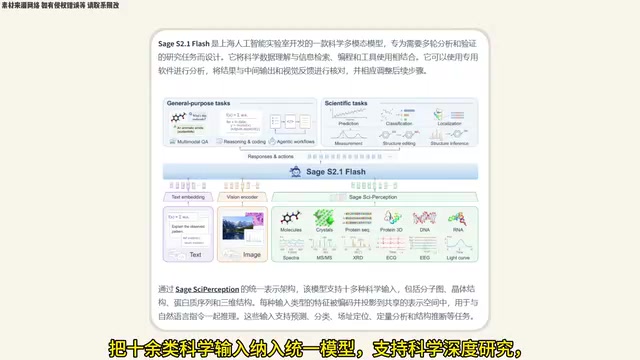
Integrating research software operation and a visual feedback loop into the same model is the essential difference between this type of scientific agent and general-purpose conversational models: it needs to observe results during execution and correct course, rather than producing a one-shot output. Open weight downloads are friendly for research institutions looking to deploy locally.
Agents and Visual Feedback Loops: An agent refers to a model that can autonomously call tools, observe execution results, and adjust subsequent actions across multiple rounds, rather than single-turn Q&A. The "visual feedback to check intermediate results" emphasized by Intern S2.1 Flash means feeding software interface screenshots or plot outputs back to the model as observation signals, enabling it to detect plotting errors, parameter mistakes, and retry. This capability depends on the combination of multimodal input and tool-calling interfaces—a necessary component for scientific computing tasks and a part that general conversational models struggle to replace directly.
OpenAI: ChatGPT Medical Edition Advances and Academic Research Program Expands
OpenAI announced that ChatGPT's medical edition adds over 20 medical plugins, with stronger computer operation capabilities and more reliable clinical responses. According to the source material, multiple medical institutions have used these capabilities for vision authorization, referrals, discharge planning, and inter-visit follow-up evaluations. Of 325 tasks, 99% were rated clinically safe, and of 646 physician evaluations, 93% of doctors found them very helpful.
OpenAI is also expanding the ChatGPT Academic Researchers Program, aiming to reach up to 200,000 researchers worldwide. A new round of applications opens on November 23, with 50,000 sponsored spots allocated on a first-come, first-served basis. Each spot covers the applicant and up to two collaborators, all three of whom can use ChatGPT Plus for free. This round can support up to 150,000 researchers. OpenAI states that user data used through the program is not used for model training by default.
Medical Plugins and Clinical Safety Evaluation: Plugins (plugins/connectors) are extension mechanisms that allow models to access external systems or specialized datasets. The 20+ new plugins in the medical edition mean the model can call tools such as medical records, guidelines, and calculators. The statement "99% of 325 tasks rated clinically safe" is a human-annotated safety evaluation; the evaluation criteria and task distribution determine the scope of the conclusions and cannot be directly equated with performance in real clinical environments. Institutions should still conduct local validation before deployment.
AMD Acquires World Labs, Google Advances Gemini on Multiple Fronts
AMD officially announced that it welcomes the World Labs team to AMD. World Labs was founded by Fei-Fei Li and focuses on 3D world models. Li said she looks forward to starting a new chapter with AMD colleagues. Neither party disclosed transaction terms or specific arrangements.

On Google's side, the Gemini mobile app has officially launched 66 regional voices, covering 7 language categories, including American English, British English, Indian English, and Hindi. Neo Zhou, Product Management Director for Gemini Live, said Google worked with native speakers to faithfully reproduce local speech rate, rhythm, and clarity while avoiding deliberate exaggeration of regional accents. Users can freely switch voices in voice settings.

Separately, an observer spotted a model reference resembling Gemini 4 on the Gemini web page, and foreign media speculate it may be a new Flashlight model. According to TestingCadva's observation, the model is not yet available, and Google has not commented. The general assumption is that Google's new model release cadence is not over yet. This information is speculation from a single source and has not been officially confirmed.
3D World Models: World Labs' 3D world models refer to generating interactive, spatially consistent 3D scenes from images or text, commonly used for robot simulation, gaming, and embodied AI training. Such models have high compute and VRAM requirements and are closely tied to chipmakers' hardware-software collaboration—one reason such teams are acquired by AMD. Transaction terms were not disclosed, and the specific integration approach remains unclear.
Observation: Two Main Threads Accelerating Simultaneously
Taken together, these developments show two trends: first, on the model side, long-context and scientific research agents are rapidly expanding—Flint lowers usage costs with 262K context and low active parameters, while Intern S2.1 Flash introduces a visual feedback loop into research workflows. Second, on the platform side, subsidies and ecosystem lock-in—OpenCode uses 10x credits to attract new users, and OpenAI uses free Plus spots to expand its academic user base. For developers, the short-term focus should be on free offerings and credit promotion trial windows; for institutions, open model weights and local deployment options are worth including in evaluations.
One-line Summary
OpenCode's 10x GLM-5.3 credits go live, with dense activity from Flint, Intern S2.1, OpenAI, Google, and AMD
Paragraph Summary
This AI Daily Roundup focuses on two main threads: model capabilities and platform ecosystems. OpenCode launched Phase 1 of Operation GLM, offering $100 worth of GLM-5.3 credits for $10, available to all OpenCode Go subscribers and already active. On the model side, Command Code launched Recursive's Flint with 262K context, 40B total parameters, 2.5B active parameters, and free across all plans; Meituan open-sourced LongCat Video Avatar 1.6 under the MIT license, with digital human video duration exceeding 10 minutes; Shanghai AI Lab released Intern S2.1 Flash, a 320B MoE architecture supporting research software operation and visual feedback self-checking, with weights available for download. On the platform side, OpenAI added 20+ plugins to ChatGPT's medical edition and expanded its academic research program to up to 200,000 people; AMD acquired Fei-Fei Li's World Labs; Google's Gemini launched 66 regional voices, and a model reference resembling Gemini 4 appeared on the web but has not been officially confirmed.
Related articles

Why Microsoft CEO Nadella Still Backs Nvidia After Jensen Huang's Departure
Microsoft CEO Nadella publicly expresses confidence in Nvidia interim CEO Colette Kress. This article analyzes Nvidia's power transition after Jensen Huang's departure, Microsoft's compute dependency, and the trust logic of the AI supply chain.

Nadella: Critical Infrastructure Is 'Unpatchable' as AI Cybersecurity Arms Race Escalates
Microsoft CEO Nadella addresses AI cyberattack fears, saying much critical infrastructure is unpatchable, downplaying the Outlook outage, and analyzing AI's dual role in cybersecurity.

Musk Backs Jensen Huang: Firing Him Is Like Cutting Jordan
Musk says Jensen Huang is loyal to the U.S. and likens firing him to cutting Michael Jordan—highlighting politicization anxieties in the AI chip industry and defending talent value.