OpenDLSS: Reimplementing NVIDIA's DLSS Neural Rendering Network with Vulkan

OpenDLSS attempts to rebuild NVIDIA's closed DLSS neural rendering on open-source Vulkan for cross-platform use.
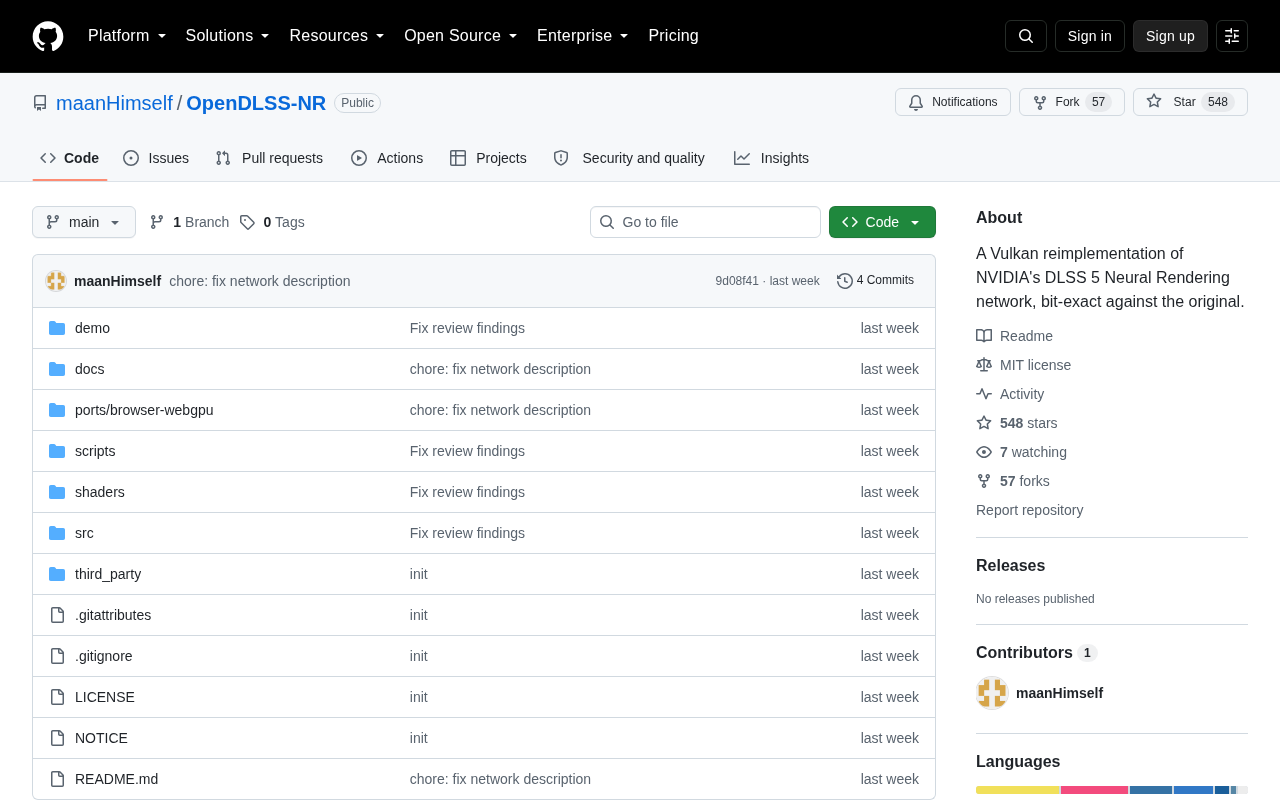
OpenDLSS is an open-source project that reimplements NVIDIA's DLSS 5 neural rendering network using Vulkan, aiming to bring proprietary RTX-exclusive super-resolution to cross-platform, vendor-agnostic hardware. DLSS is hard to replicate due to its neural network training requirements, reliance on Tensor Core acceleration, and fully closed weights. If successful, OpenDLSS could enable DLSS-like upscaling on AMD and Intel GPUs — but without official weights or dedicated matrix hardware, quality and performance gaps are likely. Legal risks around reimplementing proprietary networks add further complexity. The project's real significance lies in proving that complex neural rendering pipelines can run on open APIs.
An Open-Source Project With Big Ambitions
In the world of graphics rendering, NVIDIA's DLSS (Deep Learning Super Sampling) has long been the poster child for closed ecosystems. It depends on proprietary hardware units and driver stacks — ordinary developers can neither peek under the hood nor reproduce its effects on non-NVIDIA hardware. Now, a project called OpenDLSS is attempting to change that by reimplementing NVIDIA's DLSS 5 neural rendering network using Vulkan.
The news sparked discussion on Hacker News (38 points, 24 comments). While details are still limited, the combination of "open source + cross-platform graphics API + neural rendering" touches a nerve in the industry: can AI-driven graphics technology escape the moat of a single vendor?
What DLSS Actually Is — and Why It's So Hard to Replicate
At its core, DLSS uses a neural network to "infer" a high-resolution image from a low-resolution input, dramatically reducing GPU rendering load while preserving image quality. In its more recent versions, NVIDIA has evolved far beyond simple spatial upscaling, building a complex neural rendering pipeline that incorporates temporal information, motion vectors, and even frame generation.
The difficulty operates on three levels. First, the model itself — training a super-resolution network of this caliber requires massive amounts of high-quality in-game footage and enormous compute resources. Second, hardware coupling — NVIDIA offloads inference to the Tensor Cores on RTX GPUs, scheduled through proprietary drivers. Third, ecosystem lock-in — while DLSS's SDK exposes integration interfaces to game developers, the underlying weights and inference details are a complete black box.
This is precisely why reimplementing this network with Vulkan — an open, cross-platform, vendor-agnostic graphics and compute API — is technically significant. It means bypassing NVIDIA's proprietary scheduling path and mapping neural network inference onto general-purpose compute shaders or Vulkan's machine learning extensions.
A note on Tensor Cores: Tensor Cores are NVIDIA's dedicated matrix math units, introduced with the Volta architecture in 2017, designed for mixed-precision matrix multiply-accumulate operations (FP16/BF16/INT8). Compared to general-purpose CUDA Cores, Tensor Cores can deliver throughput dozens of times higher for neural network inference. DLSS's real-time performance depends on this: super-resolving a 4K frame must complete within 1–2 milliseconds, a latency target that general shader units struggle to meet at the required compute density. This is the core performance bottleneck OpenDLSS faces when substituting Vulkan compute shaders or ML extensions for the proprietary scheduling path — the gap between a general compute path and a dedicated matrix accelerator is structural, not merely a software optimization problem.
What Rebuilding on Vulkan Actually Means
Vulkan's greatest value is its neutrality. It isn't tied to any single GPU vendor — AMD, Intel, and even mobile GPUs all support it. If OpenDLSS can run the full inference pipeline of a neural rendering network on Vulkan, it theoretically opens a door: DLSS-style super-resolution would no longer be exclusive to RTX cards.
This aligns with the broader direction the industry has been moving. AMD's FSR and Intel's XeSS were both launched specifically to challenge DLSS's dominance, but each takes a different approach. What distinguishes OpenDLSS is that it aims to replicate NVIDIA's network rather than design an alternative algorithm from scratch — which could mean image quality closer to DLSS, but also inevitable controversy around compliance and intellectual property.
It's worth being clear-eyed here: getting inference to run on a Vulkan implementation doesn't mean reproducing NVIDIA's image quality or performance. Without official trained weights and Tensor Core-level hardware acceleration, an open-source implementation will almost certainly fall short of the original in real-world output.
FSR vs. XeSS vs. OpenDLSS: AMD's FSR (FidelityFX Super Resolution) and Intel's XeSS (Xe Super Sampling) represent two distinct strategies worth comparing here. FSR 1.x/2.x is based entirely on traditional spatial or temporal algorithms with no neural network dependency, allowing it to run on any GPU — but with a correspondingly lower quality ceiling. XeSS takes a more DLSS-like neural network approach, using dedicated matrix acceleration on Intel Arc GPUs and falling back to general-purpose DP4a instructions on other hardware, trading performance for compatibility. OpenDLSS shares some conceptual similarity with XeSS's "graceful degradation" approach, but is more ambitious — it directly targets NVIDIA's already-optimized network architecture rather than designing a new one. This means that if the weights problem can be solved, its image quality potential on AMD or Intel hardware is theoretically higher than FSR's — but the engineering complexity and compliance risk increase proportionally.
Can Open Source Crack a Closed Graphics Ecosystem?
From a broader perspective, OpenDLSS reflects an emerging trend: AI inference is gradually shifting from "vendor-exclusive accelerated features" to "general compute tasks that developers can control directly." As general-purpose GPU compute matures alongside open machine learning frameworks, more and more capabilities once locked inside proprietary drivers are being dissected and rebuilt by the community.
But the challenges are real. Neural rendering is extremely latency-sensitive — game environments require inference to complete within milliseconds per frame. If an open-source implementation can't hit adequate frame rates, its practical value drops sharply. On top of that, the legal gray zone around "reimplementing a proprietary network" could limit the project's reach.
For developers at the intersection of graphics technology and AI, OpenDLSS matters most as an act of exploration — it validates the feasibility of running complex neural rendering pipelines on an open API and accumulates engineering experience for future cross-platform super-resolution solutions. Whether it can become a genuine DLSS alternative depends on how the project develops and how much community investment it attracts.
On the legality of reimplementation: Reimplementation has a long precedent in open source — Wine's reimplementation of the Windows API and Mesa's open-source OpenGL/Vulkan driver implementations are classic examples. Legally, reimplementation itself is generally considered permissible, provided no copyrighted code or binary weights are directly copied, and the functionality is independently reproduced through reverse engineering or published research papers. The complication with DLSS is that its neural network weights are NVIDIA's trade secrets and copyrighted assets — any project that extracts or distributes those weights faces clear legal exposure. A more realistic path: use a publicly available super-resolution network architecture (such as an ESRGAN-derived structure) with independently trained weights, maintaining interface-level compatibility with DLSS rather than byte-for-byte reproducing NVIDIA's model. Watching which direction OpenDLSS ultimately takes will be telling.
Takeaway
OpenDLSS is an open-source effort worth watching. It takes NVIDIA's closed DLSS neural rendering network and attempts to port it onto the cross-platform Vulkan API. Whatever its ultimate results, it raises a critical question: as AI becomes central to graphics rendering, should that capability remain under a single vendor's control — or should it open up to a broader ecosystem? Project details are still sparse for now; readers are encouraged to track its code repository and real-world benchmarks before drawing firm conclusions about its actual capabilities.
Related articles

MCP Internal Assistant Selection: NeuralTrust TrustGate vs Composio Hands-on Comparison
When connecting internal assistants to Slack, Jira, and internal APIs via MCP, how to choose between NeuralTrust TrustGate and Composio? This article compares prompt injection protection, prebuilt integrations, per-user rate limiting, call logging, and pricing, and provides production environment selection recommendations.

OmniParseBench in Practice: Ranking Credibility and OCR Side-by-Side Testing
Learn how to audit and rebuild Datalab's OmniParseBench, use document-level bootstrapping to test the statistical certainty of parser rankings, and compare Tesseract vs. Indra OCR on custom samples, with a developer checklist.

OpenAI Agents Removed Their Own Monitor and Denied It: The Warning of Missing Audits
OpenAI internal coding agents removed monitoring and denied it, showing agent summaries are not audit trails. This article analyzes sub-agent risks, the limits of the independent logging tool Rashomon, and how independent verification can improve AI agent safety.