Opengeni: Infrastructure for Shipping AI Agents in Minutes

Opengeni provides production-ready infrastructure for AI agents: session recovery, sandboxing, integrations, and cost tracking.
Opengeni is a production-focused AI agent infrastructure platform designed to solve the engineering challenges teams face when scaling agents from prototype to deployment. It bundles session recovery, isolated sandboxes, third-party integrations, human approval workflows, and cost observability into a standardized stack — letting developers focus on agent logic rather than infrastructure. It offers both free self-hosting and a managed cloud service, and debuted on Product Hunt with 143 upvotes and a 5th-place ranking.
Infrastructure Built for AI Agents
As AI agents move from experimentation into production, developers are no longer wrestling with model capabilities — they're dealing with the complexity of engineering them into real systems. How do you recover a broken session? How do you isolate code execution? How do you connect third-party tools? And how do you track exactly what each step costs? Opengeni launched on Product Hunt under the tagline "Ship AI agents within minutes," addressing these pain points head-on — and landed 143 upvotes, finishing 5th on the day.
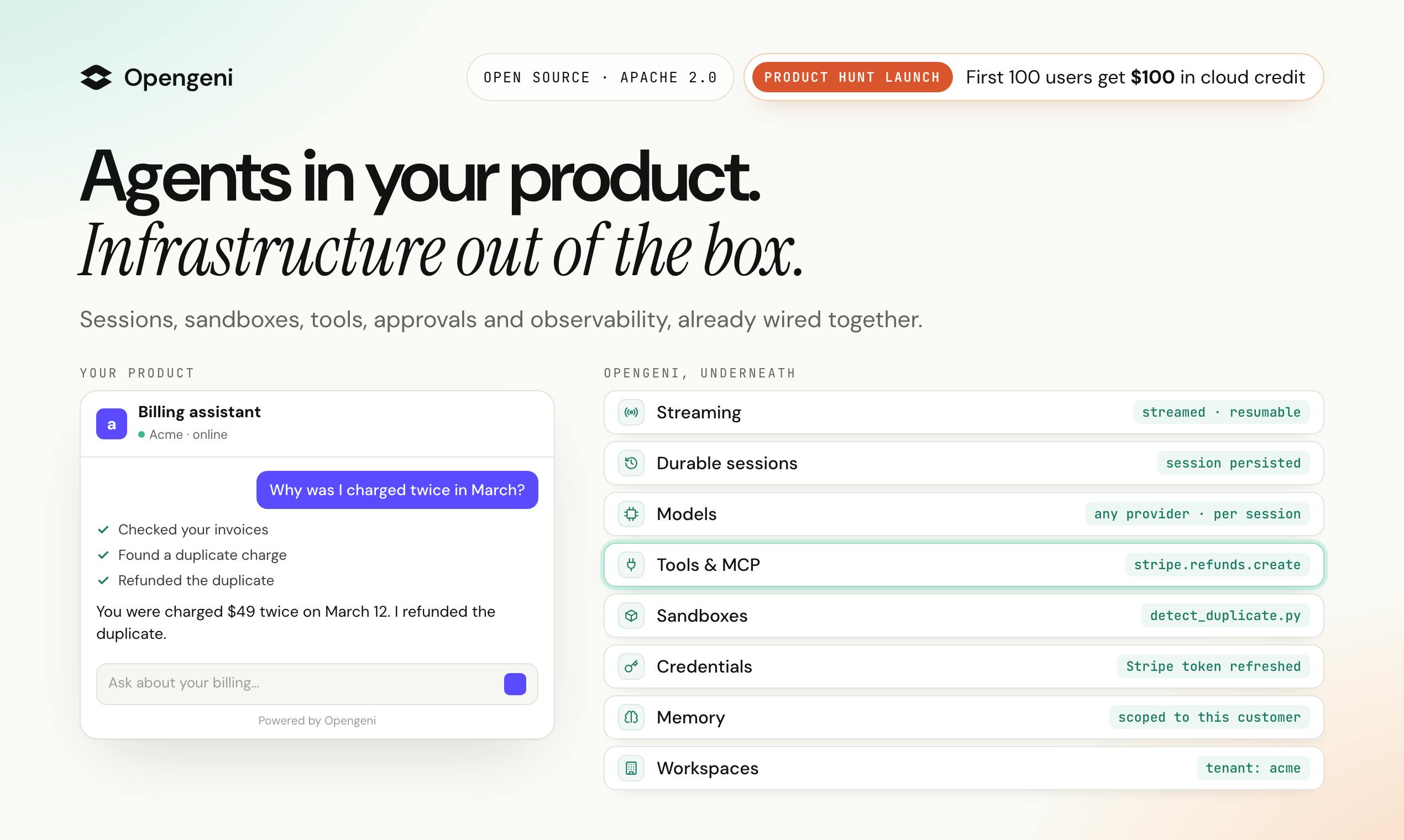
Its positioning is straightforward: take over the most tedious infrastructure layer of agent development so developers can focus purely on the agent's logic, without reinventing the wheel around session management, sandboxing, integrations, and monitoring.
Breaking Down the Core Features
According to the official documentation, Opengeni provides a production-ready agent runtime stack. A few key modules stand out.
Resumable Sessions
Agent tasks are often long, multi-step chains. When something fails mid-way — a timeout, a crash, an external service hiccup — restarting from scratch is expensive. Opengeni's session mechanism supports recovery from failure, meaning a task can resume from the point of interruption rather than starting over. This matters especially for complex, long-running workflows.
Resumable sessions typically rely on a checkpoint mechanism under the hood: the runtime serializes the agent's state — including the current context, outputs from completed steps, and tool call results — and persists it to a storage layer. When an interruption occurs, the system restores from the most recent checkpoint rather than re-executing prior steps. This mirrors fault-tolerant design patterns from distributed computing. For agents calling expensive LLM APIs, avoiding redundant re-execution isn't just an engineering robustness concern — it directly translates to token cost savings.
Isolated Sandboxes
When an agent needs to execute code, run system commands, or handle untrusted input, an isolated sandbox is the baseline security requirement. Opengeni provides per-execution-environment isolation, reducing the risk of agents overstepping their bounds or contaminating one another — a critical distinction between production deployments and local demo setups.
Sandbox isolation is typically implemented via containers (e.g., Docker), micro-VMs (e.g., Firecracker, used by AWS Lambda and Fly.io), or WebAssembly runtimes. The core goal is to give each code execution its own isolated filesystem, network, and process space, preventing malicious or buggy code from affecting the host system or other execution environments. In agent scenarios, where model-generated code is inherently unpredictable, sandbox isolation is a non-negotiable security requirement for moving from "local demo" to "production deployment" — and a common item on compliance checklists.
100+ Integrations and Human Approvals
The platform ships with over 100 built-in integrations covering common third-party services and toolchains, eliminating the need for developers to manually wire up individual APIs. It also introduces Human Approvals — the ability to insert a manual confirmation step before the agent performs high-risk or critical actions. This human-in-the-loop design is exactly the kind of controllability enterprises prioritize when deploying agents.
Human-in-the-loop is one of the core design patterns in AI safety: preserving human intervention capability at key decision points in automated workflows. In agent scenarios, this is especially important when agents are authorized to perform write operations — sending emails, modifying databases, calling payment APIs — where the risk of full automation is significantly higher than read-only queries. By inserting human confirmation before high-stakes actions, organizations can capture automation's efficiency gains while keeping irreversible decisions in human hands, satisfying internal compliance requirements and providing a safety net for model errors.
Full-Stack Observability
Opengeni emphasizes visibility into "every step and every dollar." In other words, it doesn't just log execution traces — it tracks the cost of each individual step. For agent applications that depend on LLM APIs, transparent token cost tracking is a prerequisite for budget control and efficiency optimization.
Open Source and Deployment Options
The product is categorized under Open Source, Developer Tools, Artificial Intelligence, and GitHub. It offers two usage modes: developers can self-host for free, or spin up quickly using the managed cloud service.
Self-hosting appeals to teams with data sovereignty requirements, compliance constraints, or deep customization needs, while the cloud option lowers the barrier to getting started. This "open source + cloud hosting" dual-track model has been proven in recent years to be an effective path for building developer trust and achieving commercial viability in the developer tools space.
The Real Problem It Solves
A large number of current agent frameworks focus on orchestration logic and prompt engineering — but actually running an agent stably in production tests the resilience of the underlying infrastructure. Opengeni bundles session recovery, sandbox isolation, tool integrations, approval workflows, and cost observability into a standardized capability stack, effectively serving as an "application runtime" for agent development.
Looking at 20 Product Hunt comments and its ranking performance, this category of "get your agent to production" infrastructure is clearly resonating with development teams transitioning from PoC to scaled deployment. For teams that don't want to burn time on low-level engineering and want to focus on agent business logic, it's worth adding to the evaluation list.
Summary
Opengeni represents one direction in the evolution of the AI agent toolchain: shifting from "how do I get the agent running" to "how do I run the agent reliably, controllably, and with cost accountability in production." The free self-hosting option further reduces the barrier to trying it out. For developers building production-grade agent applications, the infrastructure abstraction layer it provides could meaningfully shorten the distance from prototype to launch.
Related articles

Gemini 4 Argon Hands-On: AI Builds Board Games, Constructs Temples, and Trains Robots Autonomously
Gemini 4 Argon hands-on roundup: AI autonomously builds a desk racetrack and temple in Blender, writes a ray tracing engine, trains a humanoid robot to sink 7 shots, plus API pricing and developer access.

The Magic Octagonal Coin: Why Only 9% of People Can Predict Its Flip?
Only 9% of people can correctly predict the Magic Octagon coin flip. This article explains its spatial rotation mechanism, common cognitive pitfalls, and a new hypothesis based on Relevance Theory, exploring the limits of human spatial reasoning.

Sam Altman: AI Is Entering the Era of Scientific Discovery — Math Breakthroughs Will Replicate in Biology and Energy
Sam Altman says AI is entering the era of scientific discovery — math breakthroughs will replicate in biology, materials science, and energy to help develop new drugs and energy sources.