Openstatus: A Lightweight Open-Source Incident Management Tool for Small Teams
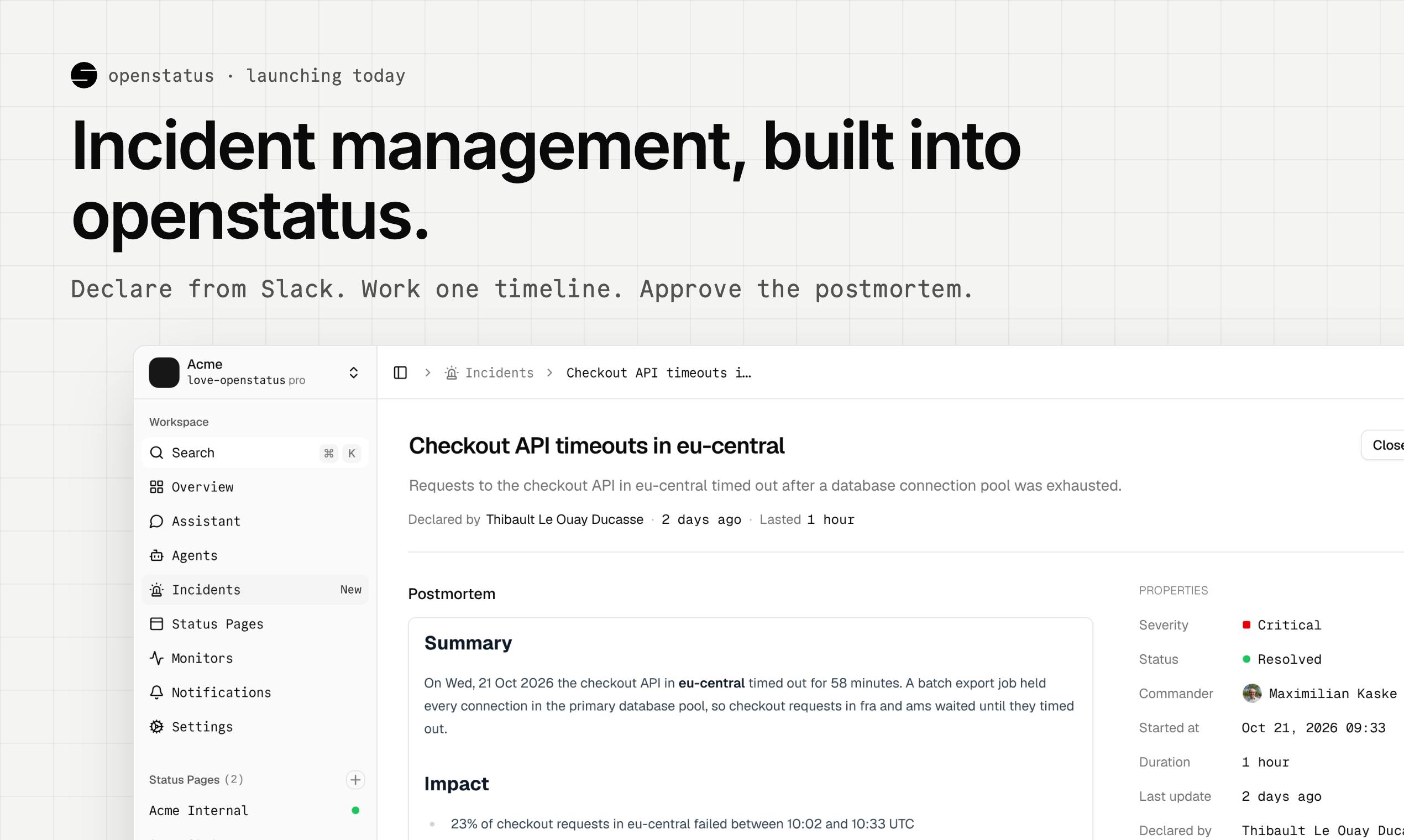
Openstatus launches an open-source incident management feature that helps small teams turn Slack incidents into structured processes.
Openstatus released its Incident Management feature on Product Hunt, integrating monitoring, status pages, and incident management into one open-source product for small teams. Users can declare incidents from Slack with auto-created dedicated channels and use timelines to draft postmortems. Open-source self-hosting sets it apart from commercial platforms like PagerDuty, but it's not suited to larger orgs needing complex on-call rotation or compliance auditing.
Openstatus released its new Incident Management feature on Product Hunt, with a clear positioning: an open-source incident management solution for small teams, living right alongside your existing monitoring and status pages. With 88 upvotes, 7 comments, and a #5 spot on the day, the numbers aren't explosive—but in the developer tools niche, they show it's hit on a real need for some people.
Why Small Teams Need Dedicated Incident Management
Most small teams operate like this: monitoring via UptimeRobot or self-hosted Prometheus, a static page for status, and when something breaks, someone throws together a Slack group on the fly—then post-incident review means someone scrolling through chat logs to piece together a timeline. This works when incidents are rare, but as soon as two or three failures happen at once, information starts scattering—who's handling what, how far along things are, what's been communicated externally—all held together by memory alone.
Openstatus's approach is to bring these pieces together in one place. Its core proposition is that monitoring + status page + incident management belong in a single product, rather than introducing yet another PagerDuty-grade heavyweight platform. For small teams, fewer tools means lower switching costs and less mental overhead during an incident.
Incident Management is a structured response process built around "service outage or degradation" events, typically covering detection, triage, response, communication, recovery, and post-incident review. What distinguishes it from basic monitoring is: monitoring answers "is the service healthy," while incident management answers "when it's not, who does what." Industry practice often draws on ITIL's incident management practices and Google SRE's Incident Command System, the latter emphasizing a designated Incident Commander, clear role assignments, and a cadence for external communication to avoid chaotic parallel decision-making during incidents. Commercial tools like PagerDuty and Incident.io have productized this process. Small teams often neglect process building because of their size, but as noted here, when incidents pile up concurrently, the cost of scattered information grows quickly—and that's exactly where lightweight incident management earns its keep.
Declare an Incident from Slack, Auto-Create a Channel
The most practical design in Openstatus Incident Management is declaring an incident directly from Slack. Once triggered, the system automatically creates a dedicated channel for that incident, where all subsequent discussion, updates, and decisions live—rather than being buried in a general alerts channel.
This solves a very concrete problem: information noise during incidents. Alert bots, unrelated discussions, and notifications from other systems all crowd into the same channel, and the genuinely critical information gets overlooked. One incident, one channel—giving each failure its own clean workspace.
According to the official description, this flow works together with the timeline feature: team members can log key milestones while the incident is ongoing, then draft a postmortem directly from the timeline afterward, without having to reconstruct the process from memory.
A Postmortem is the written report produced after an incident is resolved, typically covering the incident timeline, scope of impact, root cause, issues in detection and response, and follow-up improvements. In SRE culture it's considered one of the most important artifacts, with the core principle of the "blameless postmortem"—focusing on system and process flaws rather than assigning individual blame, thereby encouraging teams to disclose information honestly. A high-quality postmortem depends on accurate time records, which is why the timeline feature is emphasized here: real-time logging during an incident is more reliable than piecing things together from memory afterward.
The Differentiation That Open Source Brings
Openstatus categorizes itself under Open Source and Developer Tools, which is its most obvious distinction from commercial incident management platforms. Open source means small teams can self-host, keeping data on their own infrastructure; it also means they can adapt it as needed—integrating the incident workflow into internal ticketing systems or notification channels, for example.
For budget-conscious small teams, this is especially appealing. Commercial incident management tools typically charge per seat or per incident, and costs climb quickly as a team grows. Self-hosting open source carries operational overhead, but for development teams that already have infrastructure capabilities, the math usually works out.
The maker is Thibault Le Ouay, and the product is still in its early stages—the volume of discussion in the comments also suggests the community is still watching its maturity. Early adoption of open-source projects usually comes with incomplete documentation and gaps in edge-case handling; that's the price you should expect when choosing it.
Self-hosting means deploying open-source software on your team's own servers or cloud accounts rather than using a vendor's SaaS offering. For a tool like incident management, self-hosting carries threefold significance: data sovereignty—incident records and internal communications often contain sensitive system details; cost control—avoiding ongoing per-seat subscription expenses; and customizability—the ability to modify interfaces to integrate with internal systems. The trade-off is that you take on deployment, upgrades, backups, and high-availability operations yourself—and when the infrastructure the incident management tool itself depends on goes down, you may face the awkward situation of "the monitoring system itself is down," which is why in practice it's often paired with an external service as a mutual backup.
Who It's For, and Who It's Not
The fit is fairly clear: development teams of a few to a dozen people that already have basic monitoring in place, need a lightweight process to standardize incident response, and don't want to be locked into a commercial tool's pricing and vendor lock-in. For these teams, Openstatus can connect monitoring, status pages, and incident management into a single thread.
Less suitable are mid-to-large organizations that need strict compliance auditing, complex on-call scheduling, or multi-level escalation policies. These needs typically map to more mature enterprise platforms, and Openstatus's current positioning isn't heading in that direction.
One more thing worth noting: the value of an incident management tool depends heavily on whether the team is actually willing to use it. If people still instinctively just ping someone in a group chat when something breaks, even the best tool is just for show. The prerequisite for adopting a product like this is that the team already has consensus on the incident response process itself.
Summary
Openstatus Incident Management doesn't try to be an all-in-one platform; instead it targets a specific pain point for small teams: pulling incidents out of Slack's chaotic information stream and turning them into a structured process with a channel, a timeline, and a review. Open-source self-hosting is its trump card and the core of what sets it apart from commercial solutions. For small teams looking for a lightweight incident management solution, it's worth adding to the shortlist and giving it a try.
One-line Summary
Openstatus launches an open-source incident management feature that helps small teams turn Slack incidents into structured processes.
Paragraph Summary
Openstatus released its Incident Management feature on Product Hunt, integrating monitoring, status pages, and incident management into a single open-source product aimed primarily at small teams of a few to a dozen people. Its core design lets users declare incidents directly from Slack with automatic creation of a dedicated channel, keeping incident information from being drowned out in general alert channels; combined with the timeline feature, teams can log key milestones during an incident and draft a postmortem directly afterward. Open-source self-hosting is its main distinction from commercial platforms like PagerDuty, avoiding per-seat costs and vendor lock-in—but it requires some operational capability from the team. The article also notes its limitations: it's not suited to mid-to-large organizations needing complex on-call rotation, multi-level escalation, and compliance auditing, and the tool's value ultimately depends on whether the team is genuinely willing to change its incident response habits.
Related articles
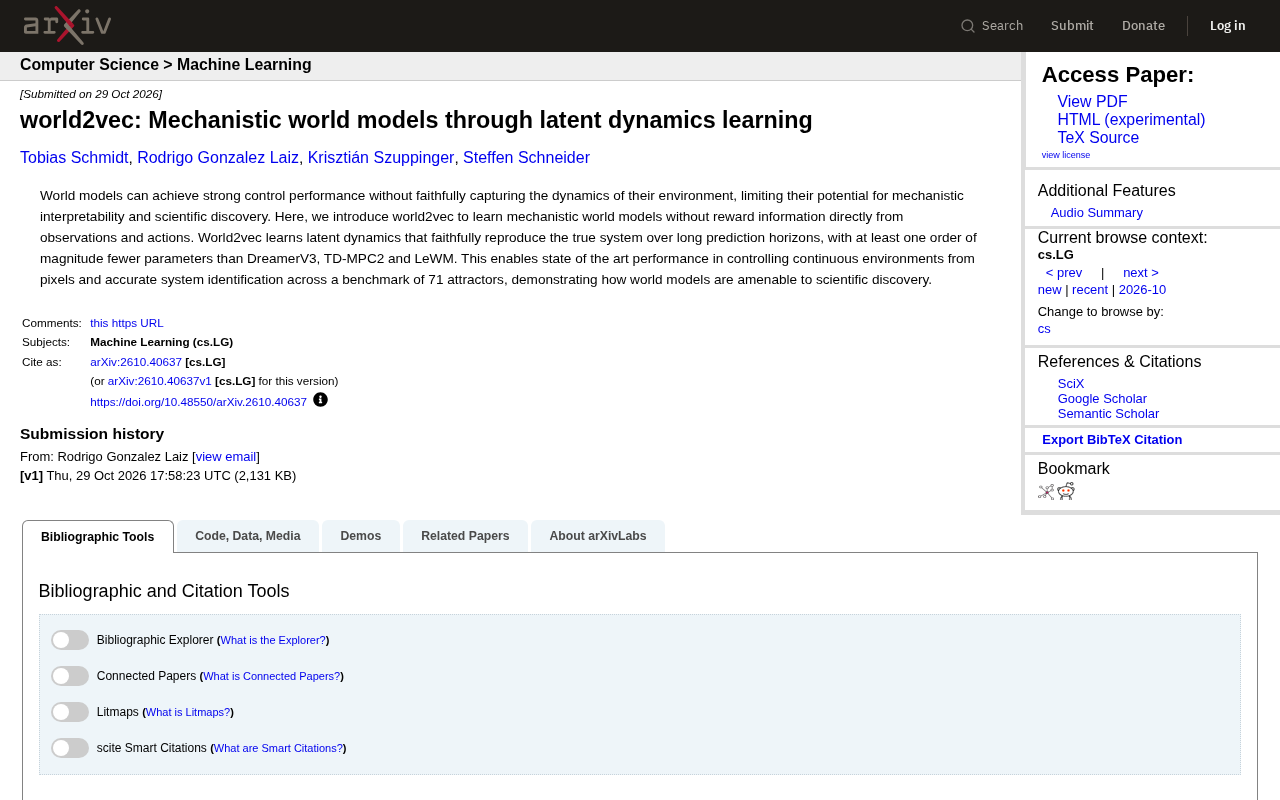
world2vec: Building Mechanistic World Models with Latent Dynamics Learning
world2vec proposes a reward-free method for learning mechanistic world models via latent dynamics, faithfully reproducing systems over long horizons with at least an order of magnitude fewer parameters than DreamerV3, TD-MPC2, and LeWM, and achieving accurate system identification on 71 attractor benchmarks.

A New KL-DRO Paradigm: Adaptive Scenario Generation Around a Learned Density Model
KL-DRO research proposes centering the KL ball on a learned density model instead of the empirical distribution, with adaptive scenario generation guiding sampling toward the worst case. Experiments show lower cost under distribution shift when records are scarce and the model can extrapolate, with comparable in-distribution cost.

ODE Samplers for Discrete Diffusion Models: Exponential Residual Flows Accelerate Generation
Discrete diffusion models lack deterministic ODE sampling? This article introduces Exponential Residual Flows (ERFs), which introduce continuous residual variables per token to construct piecewise ODEs for deterministic sampling and support consistency distillation acceleration. Superior to prior methods on code and text generation tasks.