Operator Surrogates: From Encoder-Approximator-Decoder to Neural Operators

Operator surrogates approximate infinite-dimensional operators with finite parameters, exploiting underlying low-dimensional structure to overcome the curse of dimensionality.
This article systematically reviews the core framework of operator surrogates and two main technical routes. Operator surrogates aim to approximate operators between infinite-dimensional function spaces with finite parameters, and their classical paradigm is the three-stage encoder-approximator-decoder structure, relying on the assumption that data lie near a low-dimensional manifold. At the representation system level, methods are divided into stable linear frameworks (Banach frames) and data-driven methods (PCA, Active Subspaces, nonlinear autoencoders). Architecturally, they divide into the spectral method route (polynomial chaos expansions, PCE) and the neural network route (FNO, transformer, and algorithm unrolling). Theoretical analysis focuses on approximation and generalization errors, pointing out that underlying low-dimensional structures such as holomorphy are the key to overcoming the curse of dimensionality, and that convergence rates depend on the number of parameters and the regularity of inputs and outputs. Practitioners should choose appropriate methods based on the input dimension and regularity of the problem.
In scientific computing and engineering simulation, we often face operators rather than simple functions—the input is a function and the output is also a function. For example, given initial conditions (a function), solving a partial differential equation yields the state at a future time (a function). Traditional numerical solutions to such problems are extremely costly, and Operator Surrogates offer a data-driven approximation path.
What Are Operator Surrogates
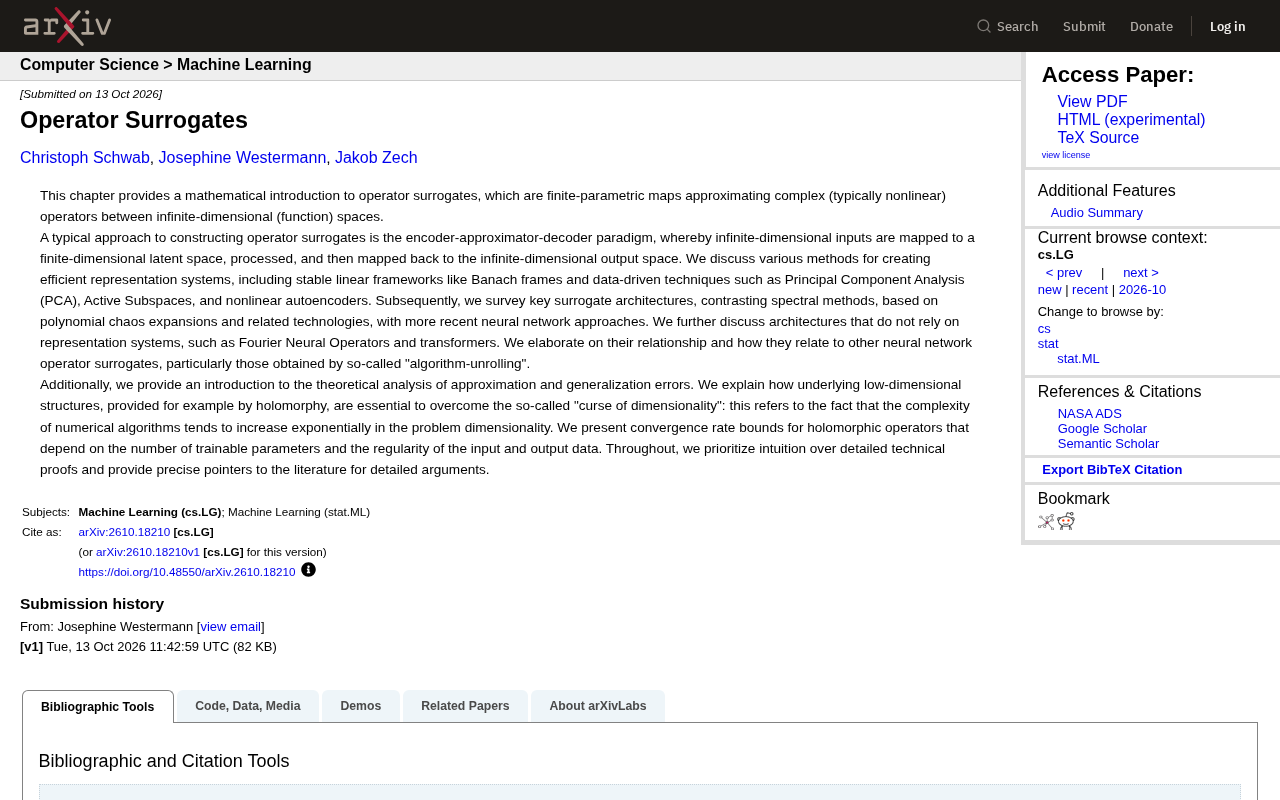
Operator surrogates are a class of finitely parameterized mappings used to approximate complex (usually nonlinear) operators between infinite-dimensional function spaces.
The core challenge is this: the inputs and outputs are infinite-dimensional, while the trainable parameters are finite. How to capture infinite-dimensional structure with finite parameters is the central question of the entire field.
The essential difference between operators and functions lies in the dimensional hierarchy of the mapping. An ordinary function (f: \mathbb{R}^n \to \mathbb{R}) has finite-dimensional vectors as both input and output, whereas an operator (\mathcal{G}: \mathcal{A} \to \mathcal{U}) takes functions (belonging to some function space, such as a Sobolev space or a continuous function space) as its arguments and values. For instance, solving the Navier-Stokes equations can be viewed as an operator: the input is the initial velocity field (a function) and the output is the velocity field at some future time (another function). This hierarchical difference forces finite-dimensional numerical methods (such as finite elements and finite differences) to first discretize the function onto grid points, where the dimension equals the number of grid points; as the grid is refined, the dimension grows accordingly—precisely the bottleneck that operator surrogates aim to circumvent.
Infinite-dimensional function spaces usually refer to complete normed linear spaces (Banach spaces or Hilbert spaces). Common examples include (L^2(\Omega)) (the space of square-integrable functions), (H^s(\Omega)) (Sobolev spaces, requiring the function and its weak derivatives up to order (s) to be square-integrable), and the continuous function space (C(\Omega)). The goal of an operator surrogate is not to approximate some specific function, but to approximate the mapping between these spaces itself; therefore, the training data is a collection of function pairs ({(a_i, \mathcal{G}(a_i))}), rather than a collection of vector pairs.
The fundamental difference between operator surrogates and traditional numerical solvers lies in the mode of generalization. Traditional finite element methods require re-solving linear or nonlinear systems for every new set of initial conditions, with computational cost growing linearly or even superlinearly with problem size and the number of parameter variations. In contrast, a trained operator surrogate can handle any new input function at inference time at a fixed cost (a single forward pass). This "offline training, online inference" paradigm makes it particularly well-suited to scenarios requiring real-time response or multiple queries, such as inverse problems, optimization design, and uncertainty quantification.
The Encoder-Approximator-Decoder Paradigm
The most typical approach to building operator surrogates is the three-stage encoder-approximator-decoder framework:
- Encoder: maps the infinite-dimensional input to a finite-dimensional latent space
- Approximator: processes information in the latent space
- Decoder: maps the latent representation back to the infinite-dimensional output space
The soundness of this paradigm relies on a key assumption: data in the high-dimensional function space actually lies near some low-dimensional manifold. The role of the encoder is to discover and exploit this low-dimensional structure.
Methods for Constructing Representation Systems
The quality of the encoder and decoder depends on the efficiency of the representation system. The source material discusses two major classes of methods:
Stable linear frameworks: represented by Banach frames, which provide linear representations with stability guarantees.
Data-driven methods: including principal component analysis (PCA), active subspaces, and nonlinear autoencoders. PCA and active subspaces seek linear low-dimensional structure, while nonlinear autoencoders attempt to capture more complex nonlinear manifolds.
The advantage of linear methods lies in their ample theoretical guarantees and computational efficiency; nonlinear methods may achieve comparable accuracy with fewer dimensions, but both training and theoretical analysis are more difficult.
A Banach frame is a concept in Banach spaces analogous to a basis, but different from a "basis": a Banach frame allows redundancy in the representation, meaning the same element can be represented by more than one set of coefficients, as long as a stable reconstruction operator exists. Formally, a family of elements ({\phi_i}_{i \in I}) constitutes a Banach frame if and only if there exist constants (0 < A \leq B < \infty) such that for any element (f) in the space, (A|f|^2 \leq \sum_i |\langle f, \phi_i \rangle|^2 \leq B|f|^2). The ratio (B/A) is called the "condition number" of the frame, measuring the stability of the representation system. The core advantage of frames is that they provide a discretization that is both theoretically guaranteed and computationally feasible, with explicit upper bounds on the truncation error for function spaces.
Active Subspaces is a dimensionality reduction method that does not rely on prior knowledge, proposed by Constantine et al. The idea is that although the input function may appear high-dimensional, the variation in the output may be sensitive to only a few directions in the input. The algorithm identifies these key directions (those with large eigenvalues) by computing the eigendecomposition of the gradient covariance matrix of the target function, and then uses linear combinations of these directions as low-dimensional coordinates. For problems where the input dimension is nominally high but the intrinsic degrees of freedom are limited (such as material parameters with hierarchical structure), active subspaces can capture the vast majority of output variation with very few dimensions.
Nonlinear autoencoders learn encoding and decoding mappings via neural networks. The encoder (\phi: \mathcal{A} \to \mathbb{R}^d) compresses the input function into a low-dimensional vector, and the decoder (\psi: \mathbb{R}^d \to \mathcal{U}) recovers it as the output function. Unlike PCA, the latent space of an autoencoder is nonlinear, capable of capturing curved low-dimensional manifolds. The cost is that training requires jointly optimizing the encoder and decoder, and theoretically degenerate solutions may exist (e.g., an encoder that is constant, or a decoder that ignores the input); in practice, these are avoided through regularization, overparameterization, or architectural design.
Two Routes for Surrogate Architectures
The Spectral Method Route
Based on polynomial chaos expansions (PCE) and related techniques. These methods expand the operator output as an orthogonal polynomial series with respect to the input random variables, and are extremely efficient when the input dimension is low and regularity is good. Their theoretical foundations are deep and their convergence analysis is mature.
The Neural Network Route
In recent years, neural network methods have risen rapidly in the field of operator surrogates. The source material particularly distinguishes two categories:
Methods that rely on representation systems: first construct an encoder/decoder, then use a neural network to learn the mapping in the latent space.
Methods that do not rely on representation systems: directly learn the mapping between infinite-dimensional spaces; representative architectures include the Fourier Neural Operator (FNO) and transformers. These methods bypass explicit dimensionality reduction steps and learn the operator mapping end-to-end.
The source material also specifically mentions the relationship between algorithm-unrolling and neural operator surrogates. Algorithm unrolling maps each step of a classical iterative algorithm to a layer of a neural network, thereby gaining learnability while preserving the algorithm's structural priors. This has deep connections with architectures such as FNO and transformers.
The Fourier Neural Operator (FNO) was proposed by Li et al. in 2021; its core innovation is to shift operator learning from physical space to the frequency domain. Each layer of the FNO contains a Fourier transform (\mathcal{F}), a linear transformation in the frequency domain on low-frequency modes (a learnable weight matrix), and an inverse Fourier transform (\mathcal{F}^{-1}), plus a pointwise nonlinear activation. The key design is to retain only the first (k) low-frequency modes (truncating high frequencies), which both reduces computational complexity (the Fourier transform can be implemented efficiently via FFT) and implicitly encodes a regularity assumption that "the operator is insensitive to high frequencies." The number of FNO parameters is decoupled from the grid resolution, and a trained model can perform inference at different resolutions—a property known as "discretization invariance."
The application of the Transformer architecture to operator learning stems from the fact that its attention mechanism is naturally suited to handling non-local dependencies between functions. In a standard transformer, the input is a set of tokens and their positional encodings; in operator surrogates, the input function can be sampled at multiple locations, with each sample point acting as a token. The self-attention mechanism allows the model to learn interactions between any two points, which is structurally similar to the non-local kernels of integral operators. Some works (such as the Galerkin Transformer) replace softmax attention with linear attention, reducing computational complexity from (O(n^2)) to (O(n)), enabling it to handle higher-resolution function inputs.
Algorithm Unrolling has as its core idea the unrolling of each step of a classical iterative algorithm into a layer of a neural network. Taking the solution of linear inverse problems as an example, each step of ISTA (iterative soft-thresholding algorithm) contains a gradient descent step and a soft-thresholding operation; algorithm unrolling parameterizes these two operations as a convolutional layer and a learnable threshold function, respectively, thereby introducing data-driven flexibility while preserving the algorithm's convergence structure. The advantage of this approach is that, compared with pure black-box networks, it retains the prior knowledge of classical algorithms (such as sparsity assumptions), thus requiring less training data and generalizing better; compared with fixed algorithms, it can accelerate convergence by learning adaptive parameters. Each layer of the FNO can be viewed as a fixed frequency-domain operator unrolling, while the attention layers of transformers have structural correspondences with the unrolling of certain iterative algorithms (such as fixed-point iteration).
Theoretical Analysis of Approximation and Generalization Error
The theoretical core of operator surrogates is to answer two questions:
- Approximation error: Given enough parameters, can the surrogate approximate the target operator?
- Generalization error: With limited training data, can the learned model generalize to unseen samples?
Overcoming the Curse of Dimensionality
The curse of dimensionality refers to the exponential growth of the complexity of numerical algorithms with problem dimension. For operator surrogates to be practical, this curse must be broken.
The source material points out that underlying low-dimensional structure—for example, holomorphy—is the key to overcoming the curse of dimensionality. If the target operator possesses holomorphy, then convergence rate bounds exist, and these bounds depend on the number of trainable parameters as well as the regularity of the input and output data.
This means that the difficulty of the problem is not determined by the nominal dimension, but by the intrinsic low-dimensional structure of the data. The stronger the holomorphy and the better the regularity, the fewer parameters are needed to achieve a target accuracy.
Holomorphy is a core concept in complex analysis, referring to the complex differentiability of a complex-valued function within its domain. Generalizing this concept to the operator setting: an operator (\mathcal{G}: \mathcal{A} \to \mathcal{U}), viewed as a mapping from a complex Banach space to a complex Banach space that satisfies the conditions for complex differentiability, is said to possess holomorphy. The key role of holomorphy in operator surrogate theory lies in the fact that holomorphic functions have extremely strong rigidity—their local behavior near a point completely determines their global behavior (analytic continuation), and their Taylor series converge extremely rapidly. This means that if the target operator possesses holomorphy, it can be approximated with exponential accuracy by a finite-term polynomial expansion (such as PCE), and the convergence rate is exponential in the expansion order.
The mathematical root of the curse of dimensionality lies in the following: as the input space dimension (d) increases, the number of samples needed to cover a parameter space of the same density grows as (\varepsilon^{-d}) ((\varepsilon) being the accuracy). For elements in function spaces, the "nominal dimension" is infinite, and direct discretization leads to a dimension equal to the number of grid points, thereby triggering an even more severe curse of dimensionality. However, operator surrogate theory reveals that if the target operator possesses holomorphy or lies on a low-dimensional manifold, convergence bounds exist that are independent of the nominal dimension, and the convergence rate is determined by the "intrinsic complexity of the problem" (such as the regularity index of the operator, the spectral decay rate) rather than the grid resolution. This provides a theoretical basis for designing efficient surrogate models for high-dimensional problems.
An Intuition-First Theoretical Perspective
The source material explicitly states that its exposition prioritizes intuition over detailed technical proofs, and provides precise literature pointers for in-depth arguments. This approach is very practical for researchers and engineers who wish to quickly build a comprehensive picture of the field—first understand why, then decide whether to delve into mathematical details.
Overall, operator surrogates are at a period of convergence between spectral methods and neural network methods. Spectral methods provide solid theoretical foundations and interpretability, while neural network methods exhibit flexibility in handling high-dimensional, complex operators. The two are not opposed; works such as algorithm unrolling are precisely attempts to build bridges between them.
For practitioners, the choice of method depends on the specific structure of the problem: if the input dimension is low and regularity is good, PCE-type methods may be sufficient; if facing high-dimensional, complex geometry or requiring end-to-end learning, FNO and transformer-type architectures are worth trying. Regardless of the method, understanding the existence of underlying low-dimensional structure is the first step in judging whether a problem is solvable.
One-line Summary
Operator surrogates approximate infinite-dimensional operators with finite parameters, the key being to exploit underlying low-dimensional structure to overcome the curse of dimensionality.
Paragraph Summary
This article systematically reviews the core framework of operator surrogates and two main technical routes. Operator surrogates aim to approximate operators between infinite-dimensional function spaces with finite parameters, and their classical paradigm is the three-stage encoder-approximator-decoder structure, relying on the assumption that data lie near a low-dimensional manifold. At the representation system level, methods are divided into stable linear frameworks (Banach frames) and data-driven methods (PCA, Active Subspaces, nonlinear autoencoders). Architecturally, they divide into the spectral method route (polynomial chaos expansions, PCE) and the neural network route (FNO, transformer, and algorithm unrolling). Theoretical analysis focuses on approximation and generalization errors, pointing out that underlying low-dimensional structures such as holomorphy are the key to overcoming the curse of dimensionality, and that convergence rates depend on the number of parameters and the regularity of inputs and outputs. Practitioners should choose appropriate methods based on the input dimension and regularity of the problem.
Related articles

AgentCore in Practice: Connecting Custom Tools and MCP Servers to Agents
DebuggerCafe tutorial shows how to connect custom tools and MCP servers to Amazon Bedrock AgentCore agents, covering tool contract design, MCP reuse, and production concerns.

816B Parameters Scores Only 39? The Real Cost-Effectiveness of the Open-Source LLM Parameter Race
Meta's 816B Muse Spark Open scores just 39 on Artificial Analysis, while 180B Qwen3.8-Flash-Next scores 40. This article analyzes 11 open-weight models' parameters vs. scores, exploring the real impact of activated parameters, quantized size, and deployment cost.

Aerial Manipulators: The Next Step for Drones from 'Seeing' to 'Changing'
Starting from a Reddit discussion, this article analyzes the technical challenges, potential applications, and deployment bottlenecks of aerial manipulators, exploring the key challenges for drones moving from environmental perception to physical manipulation.