OptimAI Studio: From Idea to Final Cut, AI Agents Handle the Entire Creative Workflow

OptimAI Studio uses AI agents to connect image, video, and music generation with browser editing, attempting to handle the entire flow from idea to final cut.
OptimAI Studio is an AI creation tool that debuted on Product Hunt with 23 upvotes and a #19 spot, positioned as an AI creative agent 'from idea to final cut.' Rather than point generation, an agent plans the film structure, calls image, video, and music generation capabilities, and then refines everything in a browser editor, emphasizing consistency in style and narrative within a project. Officially it supports illustrated stories, website publishing, and playable games—a wide span, but the completeness of each format has yet to be publicly verified. The product clearly focuses on the editing stage after generation, letting users make director-level choices about AI output. Its emergence reflects a shift in AI creation tools from point generation to workflow orchestration competition, but early community feedback is small, and its actual closed-loop capability still needs more works to prove.
OptimAI Studio: From Idea to Final Cut, AI Agents Handle the Entire Creative Workflow
Debuting on Product Hunt with 23 upvotes and a #19 spot, OptimAI Studio tries to answer an increasingly urgent question: when AI can generate images, videos, and music, how do creators stitch these fragments into a complete work? Its answer—let an AI agent play director.
One Agent Connecting the Entire Creative Chain
OptimAI Studio positions itself as "your AI creative agent, from idea to final cut." Unlike most point-solution tools on the market, it isn't satisfied with generating a single image or clip. Instead, around a creative project, an AI agent plans the film structure, then calls on image, video, and music generation capabilities, and finally polishes everything in a browser-based editor.
The value of this "agentic" workflow lies in continuity. In traditional pipelines, creators switch between multiple tools and manually maintain consistency in style and narrative; OptimAI Studio pulls planning, generation, and editing into a single environment, with the agent responsible for keeping the project's internal logic and tone unified. The official description mentions output formats including illustrated stories, publishable websites, and playable games—meaning the same agent mechanism can serve multiple content types.
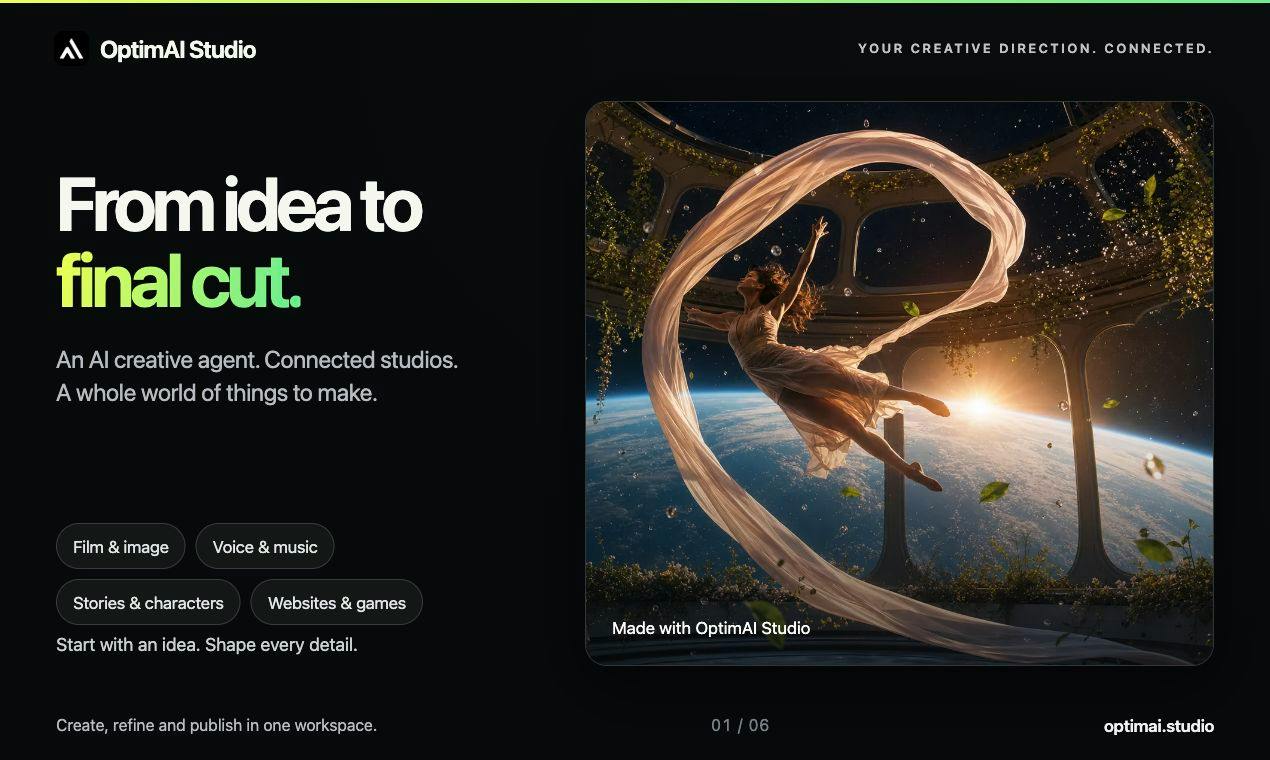
AI Agent here refers not to a simple generative model, but to a system that can autonomously plan, invoke tools, and execute multi-step tasks. Unlike single-shot "prompt in—result out" generation, the agent first decomposes the goal (for example, breaking a story into storyboards), then calls specialized models for images, video, and music as needed, maintaining context and style constraints throughout. The core challenges of this architecture lie in the reliability of task decomposition, error handling for tool calls, and cross-modal consistency. OptimAI Studio places the agent in the director's chair, making generative models a schedulable "crew."
Browser Editor: The "Last Mile" After AI Generation
A common flaw of pure generation tools is that "generation is the endpoint," but OptimAI Studio clearly focuses on what comes after. It provides an in-browser editor for users to fine-tune the agent's output—images, videos, and music. This design decision deserves praise: AI agents excel at laying out structure and producing rapid drafts, but the pacing, emotion, and details of the final cut still require human judgment.
From a product logic standpoint, OptimAI Studio treats the "AI agent" more as a collaborator than a black-box button. The user provides direction, the agent executes planning and asset generation, and the human makes director-level choices in the editor. This division of labor is closer to real creative workflows than "one-click generation" and easier for professional users to accept.
Consistency across multimodal content is the hardest part of agentic creation to automate. Images, videos, and music are generated by different models, each with its own stylistic tendencies and randomness. The agent needs to inject unified style descriptions, character settings, and narrative rhythm at the prompt level, and even filter and regenerate existing assets. But maintaining consistency entirely through the agent isn't realistic yet, so the browser editor takes on the role of manual calibration: users can replace a shot, adjust a music segment, or unify color tones without overturning the entire project. This division—"agent lays out structure, human makes choices"—is a pragmatic compromise for current multimodal workflows.
Ambition and Concerns Behind Multi-format Output
The official claim is that it can create illustrated stories, publish websites, and build playable games—a remarkably wide span. This "we can do anything" narrative is common on Product Hunt, but it also most easily exposes the lack of depth in early products. Different content formats place vastly different demands on agent capabilities: film planning tests narrative structure, website publishing tests information architecture, and game building involves interaction logic and state management.
In currently available information, OptimAI Studio doesn't detail the completeness and limitations of each format. The community feedback volume of 23 upvotes and 3 comments also indicates it's still in early validation. For creators, what's worth watching is whether it can truly achieve a closed loop "from idea to final cut" in a specific vertical scenario (such as short films or illustrated stories), rather than stopping at the demo level.
Who Should Try It
Based on its positioning, OptimAI Studio targets independent creators who need to quickly produce multimodal content, small content teams, and explorers who want to use AI agents to manage complex projects. If you're already piecing together works using multiple generation tools and struggling with consistency in style and process, this kind of integrated agent workflow is worth watching. But if you're after extreme quality in a single stage, dedicated image or video tools remain the safer choice.
OptimAI Studio's emergence reflects a trend: AI creation tools are shifting from competing on "generation capability" to competing on "workflow orchestration." Whoever can seamlessly connect agents, generation, and editing is more likely to become creators' default entry point. As for whether OptimAI Studio can deliver on its promise of "from idea to final cut," more actual works are needed to prove it.
Related articles

A New Paradigm for Text Editing in Compose: TextFieldState Replaces the Old API
Jetpack Compose introduces the TextFieldState API to fix dropped characters and cursor jumps from async input. The old value/onValueChange callbacks will be deprecated in 1.13. This article covers InputTransformation, OutputTransformation, four state hoisting patterns, and new formatted text editing capabilities.

Remote Compose: A New Document-Driven Paradigm for Cross-Platform UI on Android
Remote Compose transmits compact binary documents instead of screen pixels, enabling efficient UI rendering on remote surfaces like Wear OS and widgets. This article covers its document creation API, expression animations, size optimization techniques, and Wear OS progress.

How Crashlytics Eliminates Android Memory and Responsiveness Issues
Through the Chroma Clip case study, this article explains how Firebase Crashlytics uses Application Exit Info, Profiling Manager, GWP ASAN, and ARM MTE to pinpoint ANRs, OOMs, memory limit terminations, and native memory corruption—solving the challenge of stack traces that don't point to the real culprit.