Optimal Sample Complexity Achieved for Agnostic PAC Learning of Partial Concept Classes

A deterministic agnostic PAC learner achieves the optimal sample complexity O((d+log(1/δ))/ε²) for partial concept classes, matching the known lower bound.
This paper resolves the sample complexity upper bound for agnostic PAC learning of partial concept classes. Partial concept classes allow hypotheses to abstain on some inputs (marked as ⋆), and can model semi-supervised learning and classification with abstention. The paper constructs a deterministic learner that uses O((d+log(1/δ))/ε²) samples, achieving the same sample complexity as classical total concept classes and matching the lower bound of Alon et al. (FOCS 2021), thereby establishing optimality. The proof combines the partial VC dimension, symmetrization and concentration inequalities, and techniques for converting partial hypotheses to total concepts. This result completes the theoretical picture, but computational efficiency remains a future research direction.
Introduction: The Sample Efficiency Challenge of Partial Concept Class Learning
In machine learning theory, the PAC learning framework is a cornerstone for analyzing the generalization ability of supervised learning algorithms. Classical PAC learning assumes that every hypothesis in the concept class is a total function, i.e., it assigns a definite label to every input in the domain. However, real-world scenarios often involve partial concept classes: hypotheses may not provide a label for some inputs (marked as $\star$), which brings new challenges to learning theory. Partial concept classes can model many practical learning problems, such as semi-supervised learning, classification with abstention, and certain combinatorial optimization problems.
Although partial concept classes are more expressive, the upper bound on the sample complexity of agnostic PAC learning for them has remained open. Alon et al. (FOCS 2021) gave a lower bound, but a matching upper bound had not been established. A recent paper constructs a deterministic agnostic PAC learner that achieves the optimal sample complexity for the first time, filling this theoretical gap.
PAC Learning Framework: PAC (Probably Approximately Correct) learning theory was introduced by Leslie Valiant in 1984 and is a core framework for analyzing the generalization ability of supervised learning algorithms. In classical PAC learning, the learner selects a hypothesis $h$ from a hypothesis class $\mathcal{H}$ such that, with probability at least $1-\delta$, its generalization error is no more than the error of the best hypothesis plus $\varepsilon$. Sample complexity characterizes the number of samples needed to achieve a given $(\varepsilon, \delta)$ accuracy. In the agnostic setting, the learner does not assume that the data are generated entirely by some target concept; instead, it requires performance close to that of the best hypothesis in the class, which is more realistic than the realizable setting. The VC dimension is a combinatorial measure of the complexity of a hypothesis class. For total concept classes, the optimal sample complexity of agnostic PAC learning is $\Theta((d+\log(1/\delta))/\varepsilon^2)$, where $d$ is the VC dimension. The introduction of partial concept classes changes the form of hypotheses, but the paper shows that the sample complexity remains of the same order as in the classical case.
Core Result: Optimal Sample Complexity
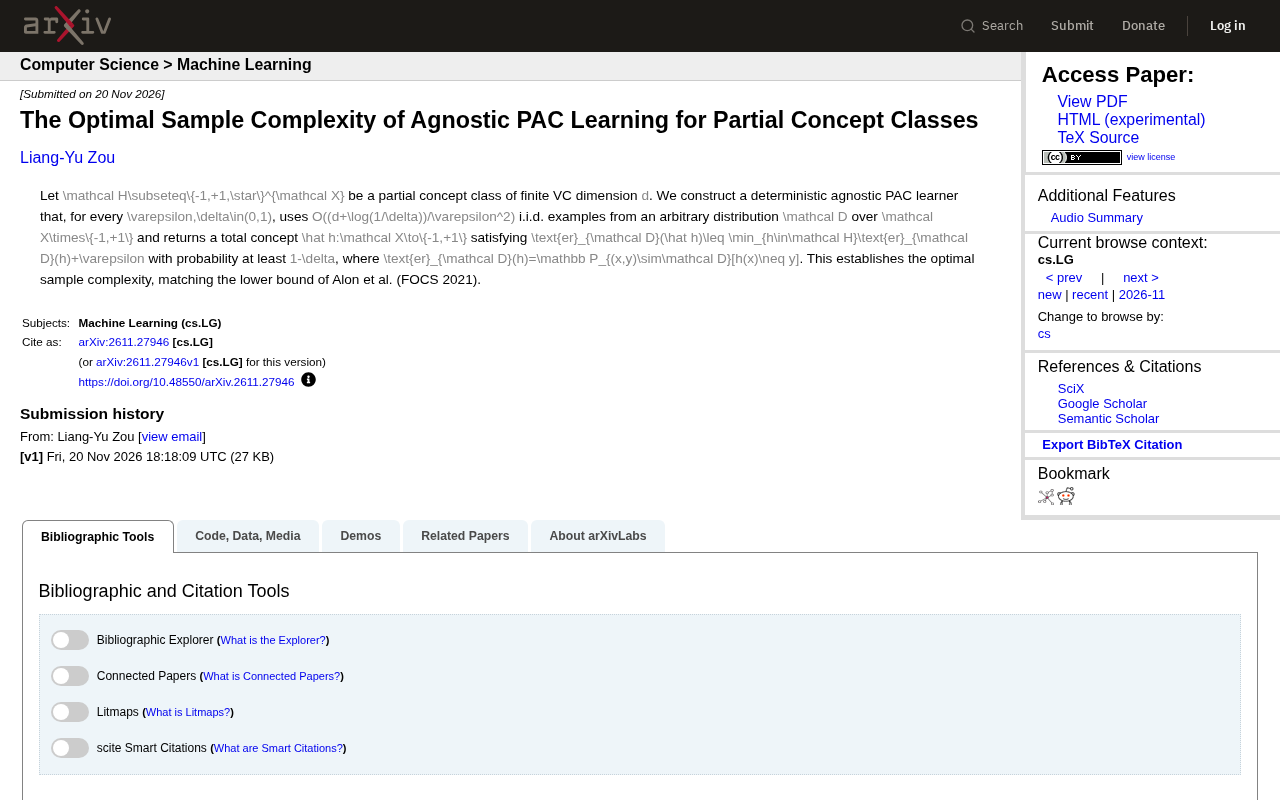
The main theorem of the paper states: let $\mathcal H \subseteq {-1,+1,\star}^{\mathcal X}$ be a partial concept class with finite VC dimension $d$. There exists a deterministic agnostic PAC learner that, for any $\varepsilon,\delta \in (0,1)$, uses $O((d+\log(1/\delta))/\varepsilon^2)$ samples drawn i.i.d. from an arbitrary distribution $\mathcal D$ (defined on $\mathcal X \times {-1,+1}$) and returns a total concept $\hat h: \mathcal X \to {-1,+1}$ such that, with probability at least $1-\delta$,
$$\text{er}{\mathcal D}(\hat h) \leq \min{h\in\mathcal H}\text{er}_{\mathcal D}(h)+\varepsilon,$$
where $\text{er}{\mathcal D}(h) = \mathbb P{(x,y)\sim\mathcal D}[h(x)\neq y]$.
This upper bound exactly matches the lower bound given by Alon et al. (FOCS 2021), thereby establishing that the optimal sample complexity of agnostic PAC learning for partial concept classes is $\Theta((d+\log(1/\delta))/\varepsilon^2)$. Interestingly, this result is formally identical to the optimal sample complexity of classical (total concept class) PAC learning, indicating that partial concept classes do not increase the order of sample complexity, even though their hypothesis space is more complex.
Comparison with Classical Results
The optimal sample complexity of classical agnostic PAC learning is $\Theta((d+\log(1/\delta))/\varepsilon^2)$ (for a total concept class with VC dimension $d$). The upper bound for partial concept classes is the same, which seems to suggest that partiality incurs no additional sample cost. However, this conclusion is not obvious: the definition of VC dimension for partial concept classes needs to be generalized, and the learner must handle hypotheses that may abstain. The contribution of the paper is to prove that even in this more general setting, the sample complexity can still achieve the same rate as in the classical case.
Partial Concept Classes and the Abstention Symbol: A partial concept class $\mathcal{H} \subseteq {-1,+1,\star}^{\mathcal{X}}$ allows hypotheses to not provide a label for some inputs, using the symbol $\star$ to denote abstention or undefined. This setting naturally models semi-supervised learning (unlabeled samples), classification with a reject option (the classifier may refuse to predict), and certain combinatorial optimization problems. In partial concept classes, the definition of VC dimension needs to be generalized: Alon et al. (FOCS 2021) defined the partial VC dimension by considering the behavior of partial hypotheses on samples to characterize their complexity. The learner's goal is usually to output a total concept (assigning a definite label to every input), so partial hypotheses must be converted into total concepts while controlling the additional error introduced by the conversion. The core result of the paper proves that even in this more general setting, the optimal sample complexity of agnostic PAC learning remains $\Theta((d+\log(1/\delta))/\varepsilon^2)$, consistent with the classical total concept class, indicating that partiality does not introduce essential difficulties at the order of sample complexity.
Overview of Proof Techniques
The constructive proof in the paper combines several tools. The learner is based on an improved "uniform convergence" method but needs to handle the additional complexity brought by partial hypotheses. Key steps include:
- VC Dimension of Partial Concept Classes: The paper adopts the partial VC dimension defined by Alon et al., which characterizes complexity by considering the behavior of partial hypotheses on samples.
- Symmetrization and Concentration Inequalities: The VC dimension is used to control the uniform convergence of the hypothesis class on samples, but the abstention symbol $\star$ must be handled carefully.
- Design of the Learner: The learner first finds an approximately optimal partial hypothesis in the partial concept class via empirical risk minimization (ERM), and then converts it into a total concept. The conversion process requires careful handling of abstention regions to avoid introducing too many errors.
The deterministic learner avoids the extra logarithmic factor introduced by randomization, thereby achieving the optimal $\log(1/\delta)$ dependence. This is similar to the classical case where deterministic learners can achieve optimal sample complexity.
Symmetrization and Concentration Inequalities: In VC theory, symmetrization is a common technique that introduces ghost samples to transform the gap between generalization error and empirical error into an empirical process, which is then controlled by concentration inequalities (such as Hoeffding's inequality and McDiarmid's inequality) to establish uniform convergence. For partial concept classes, since hypotheses may output $\star$, the effect of the abstention symbol on error calculation and uniform convergence bounds must be handled carefully. The learner in the paper is based on an improved uniform convergence method, uses the partial VC dimension to control the behavior of the hypothesis class on samples, and designs a deterministic ERM step that avoids the extra logarithmic factor introduced by randomization, thereby achieving the optimal $\log(1/\delta)$ dependence.
Significance and Impact
This result has multiple implications for learning theory. First, it resolves the sample complexity question for agnostic PAC learning of partial concept classes, completing the theoretical picture. Second, the upper bound matches the lower bound, showing that the lower bound given by Alon et al. is tight and ending the search for optimality on this problem. Moreover, the result may provide theoretical guidance for practical learning scenarios involving abstention or partial labels, such as classification with a reject option and certain reinforcement learning settings.
From a broader perspective, partial concept classes have attracted attention in recent years because they can capture learning problems that classical models cannot express. Establishing the optimal sample complexity means that, within the core framework of statistical learning theory, partiality does not lead to essential difficulties—at least from the perspective of sample complexity. This encourages researchers to explore more efficient learning algorithms within the partial concept class framework.
Future Directions
Although the sample complexity is resolved, computational efficiency is still not guaranteed. The learner in the paper is deterministic, but its computational complexity may be high because ERM on partial concept classes may be computationally hard. Exploring the computational complexity of agnostic PAC learning for partial concept classes and designing polynomial-time algorithms are important directions for future work. In addition, extending the result to more general loss functions or more complex hypothesis spaces is also worth studying.
Conclusion
By constructing a deterministic agnostic PAC learner, the paper proves that the optimal sample complexity of partial concept classes is $O((d+\log(1/\delta))/\varepsilon^2)$, matching the known lower bound. This result fills a key gap in the learning theory of partial concept classes and lays a solid foundation for future research. For learning theory researchers, this is an important development worth attention.
One-line Summary
This paper constructs a deterministic agnostic PAC learner, proving that the optimal sample complexity for partial concept classes is O((d+log(1/δ))/ε²), matching the lower bound.
Paragraph Summary
This paper resolves the upper bound question for the sample complexity of agnostic PAC learning for partial concept classes. Partial concept classes allow hypotheses to abstain on some inputs (marked as ⋆), and can model scenarios such as semi-supervised learning and classification with abstention. The paper constructs a deterministic learner that uses O((d+log(1/δ))/ε²) samples, achieving the same sample complexity as classical total concept classes and matching the lower bound of Alon et al. (FOCS 2021), thereby establishing optimality. The proof combines the partial VC dimension, symmetrization and concentration inequalities, and techniques for converting partial hypotheses to total concepts. This result completes the theoretical picture, but computational efficiency remains a direction for future research.
Related articles

Nothing CMF Buds 2A Drops to $17.89 on Black Friday: A New Low for ANC Earbuds
Nothing CMF Buds 2A wireless earbuds Black Friday deal: just $17.89 on Amazon, about $11 off retail and a record low. ANC earbuds at an entry-level price.

When AI Creation Gets Accused of "Spitting": Hacker News Heats Up Over the Glaude Controversy
A Hacker News post, "Spitting in the Face of Glaude," sparks debate on AI creation transparency and attribution ethics. This analysis examines the blurred creator identity behind the controversy and offers practical advice for AI content production.

Akai Embraces Custom Firmware: MPC Sample 1.4 Lets Users AI-Program Their Sampler
Akai embraces the modding community with MPC Sample 1.4 firmware, supporting vibe-coded custom firmware and effects. We analyze the impact of this open strategy on music hardware and AI-assisted programming.