Optimizing Code with Falsifiable Hypotheses: An Agent Skill on HN
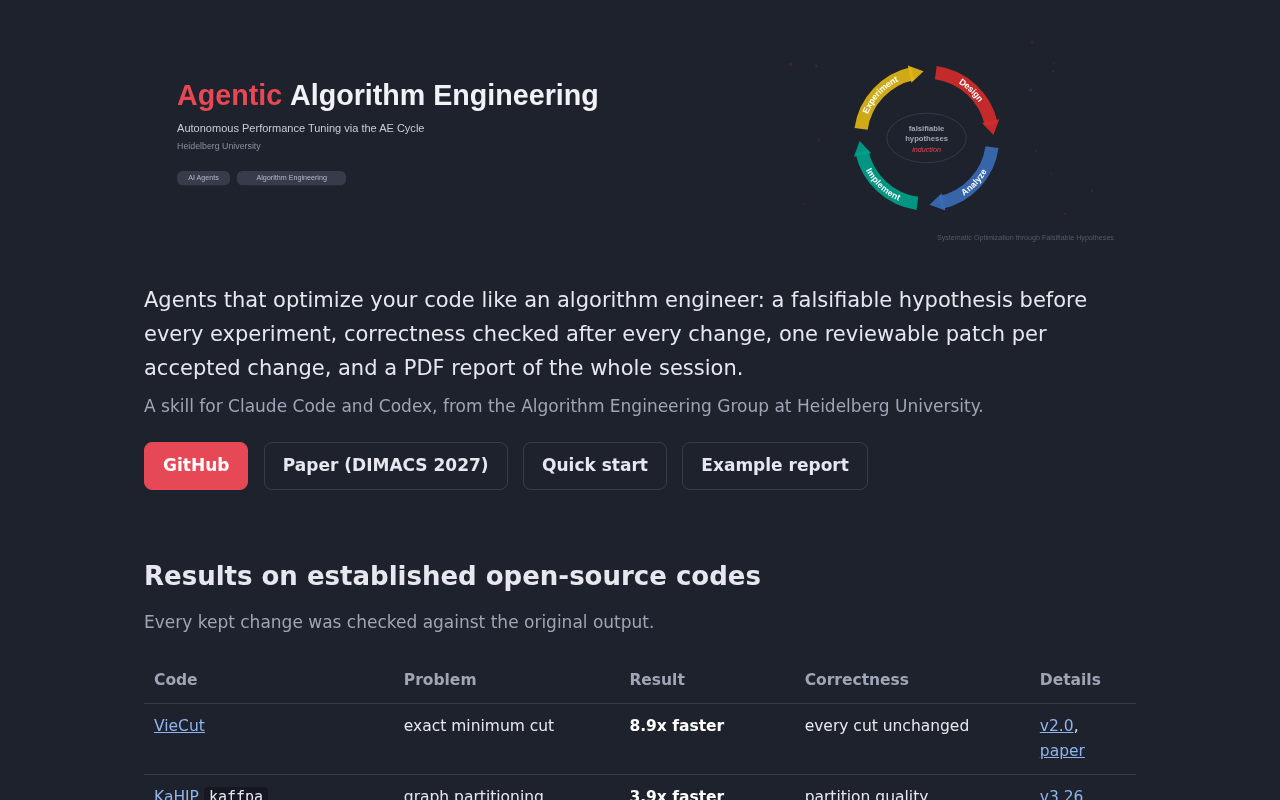
This HN project proposes a falsifiable hypothesis framework for AI coding agents to systematically verify code optimizations, reducing hallucinations and blind changes.
The article introduces a project on Hacker News titled "Show HN: An agent skill that optimizes code with falsifiable hypotheses." Its core is to require AI coding agents to propose falsifiable hypotheses when optimizing code and verify them through automated tests or profiling. Drawing on Karl Popper's philosophy of science, it forces agents to define success criteria before making changes, reducing LLM hallucinations and overconfidence and making optimization more transparent and data-backed. A typical workflow includes analyzing code, generating hypotheses, defining verification methods, executing verification, and keeping successful changes. The article also notes challenges such as high verification resource consumption, difficulty in automatically verifying some hypotheses, and hypothesis quality depending on domain knowledge, and that the project has received little attention on HN and is still an early-stage exploration.
In the field of code optimization, we often rely on intuition and experience to make changes, but the results are often hard to quantify. Recently, a project titled "Show HN: An agent skill that optimizes code with falsifiable hypotheses" sparked discussion on Hacker News, proposing a new approach that brings the scientific method into AI coding agents.

Core Idea: Making Optimization Hypotheses Falsifiable
The core of this project is "falsifiable hypotheses." Traditional code optimization may be based on vague guesses, such as "this loop might be too slow," but the agent skill requires the developer or AI to propose a clear, testable hypothesis, for example, "unrolling the loop can reduce execution time." Then automated tests or profiling are used to verify whether the hypothesis holds. If the results do not match expectations, the hypothesis is falsified and the agent tries the next one. This approach draws on Karl Popper's philosophy of science, emphasizing that hypotheses must be able to be refuted by experiment.
According to the HN post, the skill aims to let AI agents systematically explore the optimization space rather than trying things at random. Each hypothesis is designed to be verifiable, thereby avoiding ineffective changes.
Karl Popper's falsifiability is a core concept in the philosophy of science, originating from his book The Logic of Scientific Discovery. Popper argued that a theory is scientific not because it can be verified (since induction cannot exhaust all cases), but because it is in principle refutable. For example, the proposition "all swans are white" is difficult to verify, but a single black swan can falsify it. Conversely, unfalsifiable statements like "it may or may not rain tomorrow" have no scientific value. In the context of code optimization, a falsifiable hypothesis means specifying an observable metric (such as execution time, memory usage, or error rate) and an expected direction, and designing an experiment to try to overturn it. If the experimental data contradict the hypothesis, the hypothesis is falsified, thereby avoiding the confirmation bias of "it seems to work."
Why Falsifiability Matters for AI Coding Agents
AI coding agents (such as LLM-based assistants) are prone to hallucination or overconfidence when optimizing code. They may suggest changes that seem plausible but are actually ineffective, or even introduce bugs. The falsifiable hypothesis framework forces the agent to define success criteria before making changes. This is similar to test-driven development (TDD), but focuses more on verifying hypotheses about performance or quality attributes.
In this way, every optimization step taken by the agent is backed by data, reducing blind spots. At the same time, it makes the optimization process more transparent, allowing developers to review each hypothesis and verification result.
"Hallucination" in AI coding agents refers to large language models generating content that seems plausible but is factually wrong or unexecutable, such as inventing nonexistent APIs, incorrectly inferring performance bottlenecks, or giving logically coherent but practically ineffective optimization suggestions. Because LLMs are essentially generating text based on probability rather than truly understanding code semantics, they tend to be overconfident in the certainty of their own suggestions. The falsifiable hypothesis framework transforms the agent's output from an "assertion" into a "prediction to be tested" by forcing the agent to declare before making a change, "if observing that metric X does not improve Y%, then the hypothesis is falsified." This borrows from the idea in test-driven development (TDD) of "writing a failing test before implementing functionality," but TDD focuses on functional correctness, whereas falsifiable optimization focuses on non-functional attributes (performance, memory, maintainability, etc.). This framework also makes it easier for human reviewers to trace the agent's reasoning chain.
Workflow in Practice
Although project details are limited, a typical workflow can be inferred: the agent first analyzes the code, identifies potential optimization points, and then generates a series of falsifiable hypotheses, each accompanied by a verification method (such as benchmarking, unit tests, or static analysis). Next, the agent verifies the hypotheses one by one, keeping successful changes and discarding failed ones. The entire process is automated, and all hypotheses and results are recorded.
This skill can be integrated into existing AI coding tools to help developers optimize performance-critical code more efficiently.
Benchmarking is a common means of verifying performance hypotheses, but methodological details matter: benchmarks should isolate the code under test as much as possible, control environmental variables (such as CPU frequency, cache state, and background load), and run multiple times to take statistics (such as median or percentile) to reduce noise. Unit tests are used to verify functional correctness hypotheses, for example, "all existing tests still pass after refactoring." Static analysis tools (such as linters and complexity analyzers) can verify code quality hypotheses, such as "cyclomatic complexity is reduced." In a falsifiable hypothesis workflow, each hypothesis should come with explicit acceptance/rejection criteria (for example, "p-value < 0.05" or "execution time reduced by at least 10%") to avoid subjective post-hoc interpretation of results. During automated execution, the agent also needs to record the context of each experiment so that it can be reproduced and audited.
Potential Challenges and Limitations
The falsifiable hypothesis method is not a silver bullet. First, verifying hypotheses may require substantial computational resources, especially performance benchmarks. Second, some optimization hypotheses are difficult to verify automatically, such as those involving code readability or maintainability. In addition, the quality of the hypotheses generated by the agent depends on its domain knowledge; if the hypothesis itself is unreasonable, the verification process may waste time.
Moreover, the HN post had only 20 upvotes and 2 comments, indicating that the skill is still an early-stage exploration with limited community feedback. Its actual effectiveness remains to be tested through more practice.
Conclusion
Introducing falsifiable hypotheses into AI code optimization is an interesting direction that enhances the rigor and interpretability of optimization. Although information is currently limited, this idea is worth watching, especially for teams pursuing reliable AI coding assistants. In the future, we may see more agent skills that incorporate the scientific method.
One-line Summary
This HN project proposes a falsifiable hypothesis framework to let AI coding agents systematically verify code optimizations, reducing hallucinations and blind changes.
Paragraph Summary
The article introduces a project on Hacker News titled "Show HN: An agent skill that optimizes code with falsifiable hypotheses." Its core is to require AI coding agents to propose falsifiable hypotheses when optimizing code and verify them through automated tests or profiling. This approach draws on Karl Popper's philosophy of science, forcing the agent to define success criteria before making changes, thereby reducing LLM hallucinations and overconfidence and making the optimization process more transparent and data-backed. A typical workflow includes analyzing code, generating hypotheses, defining verification methods, executing verification, and keeping successful changes. The article also notes that the method faces challenges such as high verification resource consumption, difficulty in automatically verifying some hypotheses, and hypothesis quality depending on domain knowledge, and that the project has received little attention on HN and is still an early-stage exploration.
Related articles

Nothing CMF Buds 2A Drops to $17.89 on Black Friday: A New Low for ANC Earbuds
Nothing CMF Buds 2A wireless earbuds Black Friday deal: just $17.89 on Amazon, about $11 off retail and a record low. ANC earbuds at an entry-level price.

When AI Creation Gets Accused of "Spitting": Hacker News Heats Up Over the Glaude Controversy
A Hacker News post, "Spitting in the Face of Glaude," sparks debate on AI creation transparency and attribution ethics. This analysis examines the blurred creator identity behind the controversy and offers practical advice for AI content production.

Akai Embraces Custom Firmware: MPC Sample 1.4 Lets Users AI-Program Their Sampler
Akai embraces the modding community with MPC Sample 1.4 firmware, supporting vibe-coded custom firmware and effects. We analyze the impact of this open strategy on music hardware and AI-assisted programming.