Opus 5.5 and GPT SOL/LUNA Launch Simultaneously: AI Model Wars Enter the Price-Performance Era

AI model wars shift to price-performance as Opus 5.5, SOL, and LUNA launch with aggressive new pricing tiers.
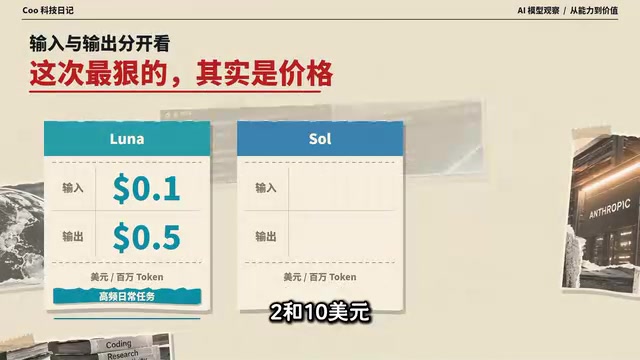
Anthropic launched Opus 5.5 at $4/$20 per million tokens, while OpenAI simultaneously released SOL ($2/$10) and LUNA ($0.1/$0.5), bringing pricing strategy to the forefront of AI competition. Opus 5.5 delivers near-flagship capability at a lower cost for complex tasks; SOL targets cost-conscious developers; and LUNA opens up massive-scale, high-frequency use cases. This round of releases signals a clear shift from competing purely on capability ceiling to competing on cost per unit of capability — and tiered model routing is poised to become the dominant cost optimization strategy for enterprises and developers alike.
AI Model Wars Enter a New Phase
Anthropic's Opus 5.5 and OpenAI's latest models launched at virtually the same time, and both flagship products share a common signal: capabilities keep climbing while prices are being pushed lower and lower. According to analysis from content creators, this marks a shift in the competition among leading AI labs — from simply racing to be "the most powerful," to a new era where the winner must be "powerful, affordable, and actually useful."
For the past few years, the logic driving competition among top players came down to a single dimension: capability ceiling. Whoever could do better at coding, reasoning, and agentic tasks held the upper hand. But this latest round of near-simultaneous releases has brought pricing strategy front and center, with tiered pricing now covering distinctly different use cases.
Anthropic Opus 5.5: Flagship Capability, Reduced Price
According to available information, Opus 5.5 matches the performance of the previous flagship (Claude 5.1 / Faber 5.1) across most tasks, but comes in at just $4 per million input tokens and $20 per million output tokens. In other words, Anthropic has chosen the path of "bringing down the price of flagship-level capability first."

The core of this approach is to anchor dominance in high-complexity, demanding workloads. For tasks that require long context windows, complex reasoning, or high-quality output, Opus 5.5 still sits in the premium tier — but compared to previous models at a similar capability level, the value proposition has improved significantly.
OpenAI SOL and LUNA: Aggressive Price Differentiation
OpenAI went even further this round, launching two models — SOL and LUNA — alongside the top-tier Astra to form a complete pricing ladder.
SOL targets complex coding and agentic tasks, priced at $2 per million input tokens and $10 per million output tokens. The pitch is "strong enough, but cost-controlled" — aimed at developers who need solid capability without breaking the bank.
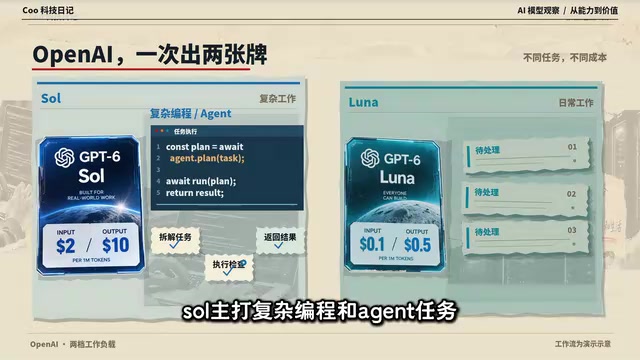
LUNA is even more aggressive, with pricing as low as $0.1 per million input tokens and $0.5 per million output tokens. This pricing essentially removes the cost barrier for large-scale, high-frequency API usage — ideal for scenarios where per-call quality requirements are modest but call volumes are enormous.

For users who need OpenAI's maximum capability, Astra remains the top-tier option. Together, the three products span the full spectrum from maximum performance to minimum cost.
What is a Token? A token is the basic unit by which large language models process text. Roughly speaking, 100 Chinese characters correspond to about 150–200 tokens, while 100 English words correspond to about 130 tokens. Pricing in "per million tokens" is the industry-standard billing unit for API access. Actual costs depend on the length of each input/output multiplied by the number of calls. At LUNA's rate of $0.1 per million input tokens, processing 1 million Chinese characters (approximately 1.5–2 million tokens) costs less than $0.20 — making high-frequency, lower-complexity workloads like document processing, content moderation, and data labeling essentially negligible in cost.
Two Strategies: Capability-First vs. Cost-First
Looking at both companies' lineups side by side, a clear strategic divergence emerges:
- Opus 5.5 ($4/$20): Emphasizes high capability for complex workloads. Prices have dropped, but it remains a premium-tier product.
- SOL ($2/$10): Balances solid performance with cost control, covering mid-to-high-end developer use cases.
- LUNA ($0.1/$0.5): Extreme low-cost positioning for massive-scale, high-frequency calling.
- Astra: OpenAI's most powerful flagship, still occupying the top tier.
Different price tiers are now serving genuinely different use cases. This means enterprises and developers can no longer default to "just use the most powerful model" — they need to do the math: is this particular task worth paying for the most expensive option?
Price-Performance Becomes the Next Battleground
The signal from this round of releases is clear: the competitive dimension for AI models is expanding from "capability ceiling" to "cost per unit of capability." As the flagship capabilities of multiple providers converge, pricing and real-world delivery become the new differentiators.
For end users, this is good news — the same budget can now unlock more powerful models, or the same level of capability costs significantly less. Tiered model routing (using cheaper models for simple tasks, reserving flagship models for complex ones) will increasingly become a mainstream cost optimization strategy.
The next round of competition may no longer hinge on a single question of "who's the strongest," but rather on who can simultaneously be powerful, affordable, and genuinely useful. Whoever finds the optimal balance across all three is most likely to earn lasting loyalty from developers and enterprises.
Note: This article is based on information from a single source. Model names and specific pricing should be verified against official announcements.
What is Tiered Model Routing? Tiered Model Routing is a cost optimization architecture in which different subtasks within the same workflow are dynamically routed to models of varying capability tiers based on complexity. For example, a customer service system might use a low-cost model for intent classification and FAQ responses, only escalating to a flagship model when handling contract interpretation or complex complaints. This approach requires additional routing logic and quality-check mechanisms at the application layer, but in high-volume scenarios it can reduce overall API costs by 50–80%. As model pricing tiers become more refined, this type of hybrid calling strategy is expected to spread from large engineering teams to small and mid-sized developers.
Related articles

Why Does the Tesla Roadster Need to Fly? A Deep Dive into Musk's Wild Demo
Tesla's Roadster launch showed wall-climbing, upside-down driving, and flying stunts—but The Vergecast notes the demo car may lack a battery, the Rocket version is invite-only and not street-legal, and the website terms don't guarantee delivery. After nine years of delays, why does this car still need to exist?

AI Is Not a Replacement: Human-AI Collaboration Through the Lens of Factory Root Cause Analysis
Starting from factory root cause analysis, this article explains how AI accelerates evidence chain construction rather than replacing human experts, exploring the pragmatic implementation logic and business value of 'AI supporting people rather than replacing them.'

AI Agent Decision Auditing: Building an Evidence Chain in Regulated Workflows
Starting from a Reddit discussion, this article analyzes three core issues in AI agent decision auditing within regulated workflows: what fields audit records should contain, how to handle feedback latency for erroneous decisions, and how to continuously calibrate LLM judge consistency with human judgment.