Opus 5.5 Lets Me Leave Work on Time — Please Stop the Rat Race

A viral Reddit post reflects developers' conflicted feelings about AI iteration — dependent yet fearful.
The article examines a viral Reddit post titled "I'm happy with Opus 5.5. Stop everything, we don't need more," analyzing developers' complex attitudes toward continuous AI model iteration. The author notes that the poster's standard for a "good model" has shifted from benchmark scores to "doing less work while keeping my job," with Opus 5.5 sitting at the delicate balance of "strong enough but not job-replacing." The article further analyzes how benchmark-driven release cadence may lead to existing experience being nerfed, reflecting the tension between vendor competition logic and user demands for stability. The specific request to extend prompt caching to 4 hours, and the teasing remark that "pause doesn't apply to you" aimed at Google, reflect divergent user expectations across vendors. The ultimate takeaway: what matters isn't the version number, but where the time freed up by efficiency gains flows.
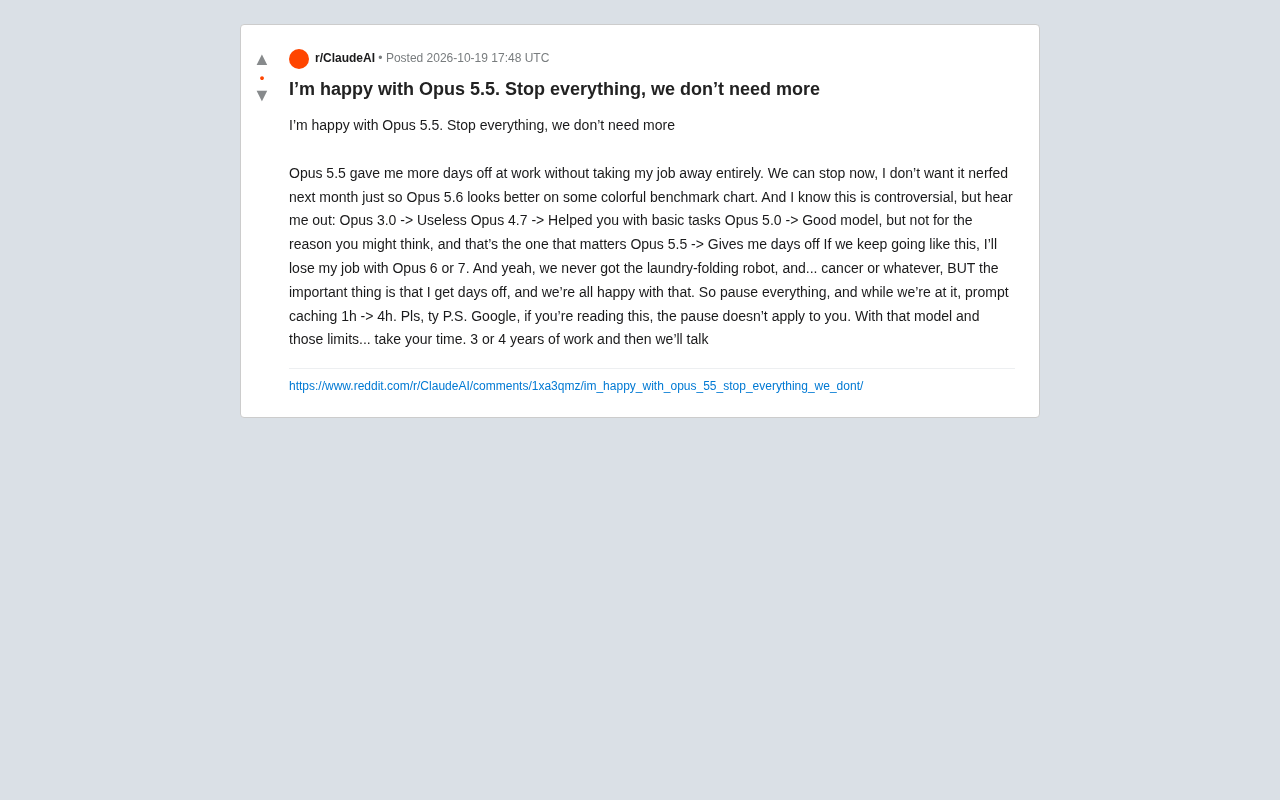
A Reddit user's post went viral, titled "I'm happy with Opus 5.5. Stop everything, we don't need more." At first glance it reads like a joke, but on closer inspection it captures the real mindset many developers now have toward AI model iterations — it's not that they don't want stronger models, but that they're afraid if models get any stronger, their jobs will be gone.
The Collective Anxiety Behind a Single Post
The user's logic is straightforward: Opus 5.5 gave him a few extra days off at work, but his job is still there. So he says, we can stop now, no more upgrades — he doesn't want an Opus 5.6 next month just to look good on some "fancy benchmark chart" while cutting into the experience he has now.
He offers a rather tongue-in-cheek version evolution timeline: Opus 3.0 wasn't very useful; Opus 4.7 could help with some basic tasks; Opus 5.0 was a good model, but possibly good for reasons different from what you'd think; and by Opus 5.5, it directly gave him the freedom to take time off. Then he adds: at this rate, when Opus 6 or 7 comes out, the job will really be gone.
This passage quickly resonated in the comments, and the reason isn't hard to understand. Every step up in model capability, when it lands on specific roles, often means entire blocks of tasks get taken away. Work that used to take one person three days now gets done in half a day — on the surface it's an efficiency gain, but in reality the boss starts wondering: do we still need that many people in this role?
"Time Off Without Losing the Job" Is the Ideal State
The most interesting part of the post is how the author's definition of a "good model" has changed.
He no longer measures models by benchmarks, reasoning depth, or code pass rates, but by a very personal standard: does this model let me do less work while keeping my job secure?
This actually represents the real demands of a segment of frontline users. People aren't resisting technological progress; they just want the benefits of that progress to flow to them — the extra time belongs to them, rather than becoming grounds for layoffs. Opus 5.5 happens to sit at this delicate balance point: strong enough to share the workload, but not so strong that the company thinks the role can be eliminated entirely.
So when he says "we can stop now," it's less technological conservatism and more a kind of self-preserving satisfaction.
Why People Fear "the Next Version"
The post repeatedly mentions benchmarks, and that's not incidental. The current release cadence of model vendors is largely driven by leaderboards — a new version has to beat the previous generation on various evaluations by a clear margin to have a story to tell. And to differentiate on scores, model behavior, output style, and even certain capability boundaries may all be adjusted.
For ordinary users, this means two things. First, a model that was previously smooth to use may become "unruly" or "overly conservative" after an upgrade; second, the direction of capability improvement may not be the direction you need. The author's concern about being "nerfed" refers precisely to this kind of operation — sacrificing existing experience in order to ship a new version.
From the vendor's perspective, constant iteration is a competitive necessity; from the user's perspective, stability and predictability are sometimes more important than benchmark scores. The tension between these two demands is laid out on the table in a half-joking way in this post.
Benchmark is a standardized evaluation set and metric commonly used in machine learning, such as MMLU (multidisciplinary knowledge), HumanEval (code generation), GSM8K (mathematical reasoning), and so on. Vendors typically select a set of public leaderboards as a showcase for model capability and compare score improvements over the previous generation at release. The problem is that leaderboard scores and real-world experience aren't always consistent: a model may adjust its output distribution to score high on specific question types, leading to verbosity, evasion, or over-formatting in open-ended tasks. In addition, leaderboards themselves may be targeted for optimization — so-called "leaderboard gaming" — making score improvements not equivalent to actual capability gains. This is precisely the hidden risk referred to by the "fancy benchmark chart" in the post.
A Side Note on Prompt Caching and Google
In the latter half of the post, the tone shifts, and the author raises a specific request: extend prompt caching from 1 hour to 4 hours. This request is no joke at all — for long sessions and complex agent workflows, the longer the cache window, the better the cost and latency performance, which is a real engineering pain point.
Finally, he specifically calls out Google: if you're reading this post, "pause" doesn't apply to you. According to him, given Google's current model and quota limits, they should keep their heads down for another three or four years, and then we'll talk. This remark is teasing, but it also indirectly reflects the difference in user expectations across vendors — telling the leader to stop, and urging the chaser to catch up.
Prompt caching refers to caching repeated prefix content in a conversation (such as system prompts, long documents, tool definitions) on the server side, so that subsequent requests hitting the cache don't need to recompute this portion of tokens, thereby reducing latency and cost. Mainstream vendors typically set a cache TTL, such as Anthropic's 5 minutes or 1 hour, after which the cache expires and must be rewritten. For multi-turn long sessions, complex agent loops, or scenarios that repeatedly call the same background material, the longer the cache window, the lower the per-request cost and first-token latency. Extending the window from 1 hour to 4 hours means fewer cache rebuilds and more stable long-task performance — an improvement direction that closely matches real engineering needs.
What This Post Is Really Saying
It's easy to laugh it off as a joke. But it touches on a reality that is unfolding: when the pace of AI capability growth exceeds the pace of job structure adjustment, the mindset of frontline users becomes contradictory — relying on tools for efficiency while fearing the consequences of that efficiency.
Models will continue to iterate, and Opus 5.6 will most likely arrive. What's truly worth paying attention to isn't the version number itself, but where the time freed up by efficiency gains ultimately flows. Does it become more rest, or fewer jobs? That's a question model vendors can't answer.
Related articles

AgentCore in Practice: Connecting Custom Tools and MCP Servers to Agents
DebuggerCafe tutorial shows how to connect custom tools and MCP servers to Amazon Bedrock AgentCore agents, covering tool contract design, MCP reuse, and production concerns.

816B Parameters Scores Only 39? The Real Cost-Effectiveness of the Open-Source LLM Parameter Race
Meta's 816B Muse Spark Open scores just 39 on Artificial Analysis, while 180B Qwen3.8-Flash-Next scores 40. This article analyzes 11 open-weight models' parameters vs. scores, exploring the real impact of activated parameters, quantized size, and deployment cost.

Aerial Manipulators: The Next Step for Drones from 'Seeing' to 'Changing'
Starting from a Reddit discussion, this article analyzes the technical challenges, potential applications, and deployment bottlenecks of aerial manipulators, exploring the key challenges for drones moving from environmental perception to physical manipulation.