Opus 5.5 Sparks Debate: How Did They Build a Model That's Both Smarter and Cheaper?

A Reddit post captures users shifting from benchmark scores to real-world performance as their AI yardstick.
A Reddit user's awestruck reaction to a model reportedly called "Opus 5.5" — smarter, cheaper, and not benchmark-gamed — sparked wide discussion. The post identified three counterintuitive points and speculated about Recursive Self-Improvement (RSI). This article unpacks those observations, explains why the RSI leap is premature, and points to more grounded engineering explanations: MoE architectures, inference optimization, and post-training quality. The real takeaway is a shifting user standard — from leaderboard scores to genuine usability and value.
A Reddit Post That Asked the Right Question
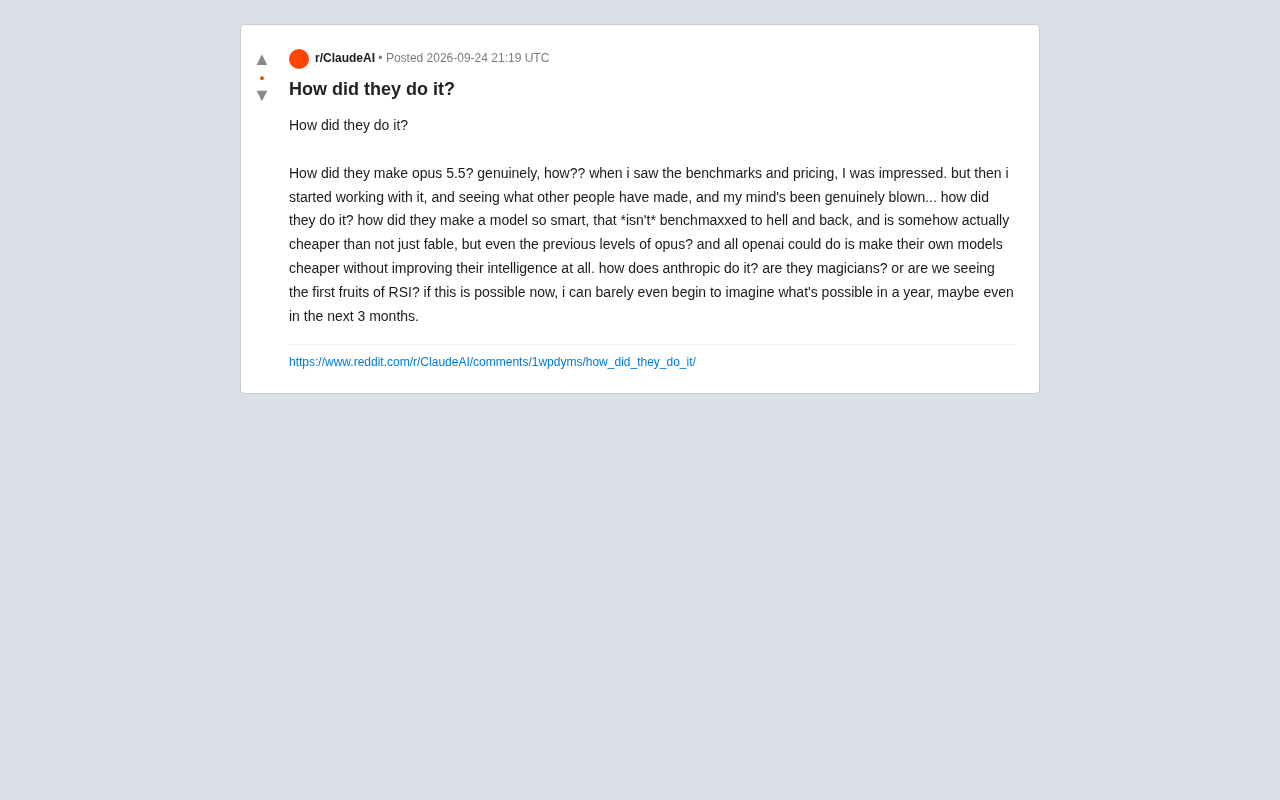
After trying out a model reportedly called "Opus 5.5," a Reddit user posted something close to genuine bewilderment: "How did they do it?" The excitement in their words was hard to miss — drawn in first by the benchmarks and pricing, then floored by hands-on use and by what others were building with it. Their verdict: "my mind's been genuinely blown."
The post resonated not because it offered answers, but because it put its finger on one of the most counterintuitive phenomena in today's AI race: a model that's simultaneously smarter, cheaper, and hasn't fallen into the benchmark-gaming trap.
Three Counterintuitive Points Users Noticed
Stronger — Without Being "Benchmaxxed"
The poster made a point of using the word "benchmaxxed" — community shorthand for models that are over-optimized for benchmark performance but fall apart on real tasks. Many models look great on paper and disappoint in practice. What stood out here, according to this user, was that the new model felt strong in actual use, not just in test scores. That alignment between benchmark performance and real-world utility is exactly what everyday users are hardest to fool about — and care about most.
Cheaper, Not More Expensive
The pricing was equally puzzling. By the user's account, the new model costs less than a tier they called "Fable" — and even less than "previous levels of Opus." The conventional assumption is that better performance means higher compute costs and higher prices. A "smarter and cheaper" combination blows that linear logic apart.
Comparing the Competition
The post also took a shot at OpenAI: "all OpenAI could do is make their own models cheaper without improving their intelligence at all." In this user's view, the competition managed to cut prices but not improve capability. That contrast only deepened their curiosity about how Anthropic pulled it off.
Worth noting: everything above reflects one Reddit user's subjective experience and opinions. Model names, pricing comparisons, and other specifics haven't been verified by official sources or corroborated elsewhere. Take it with appropriate skepticism.
"Are They Magicians — or Are We Seeing the First Fruits of RSI?"
The most thought-provoking part of the post was the user's two-pronged guess: "are they magicians? or are we seeing the first fruits of RSI?"
RSI stands for Recursive Self-Improvement — the idea that an AI system could use its own capabilities to accelerate the development of the next generation of models. It's a charged concept in AGI discussions, because if it holds, capability gains could enter an exponential acceleration loop.
The user ran with the thought: "if this is possible now, i can barely even begin to imagine what's possible in a year, maybe even in the next 3 months."
That leap — from "impressive product experience" to "RSI must already be happening" — reflects a pattern common in today's AI community: when technological progress exceeds intuitive expectations, people reach for the most dramatic explanation available to fill the cognitive gap.
The core logic of Recursive Self-Improvement (RSI) goes like this: if an AI system is smart enough, it can design a smarter successor, which can design an even smarter one, and so on — a positive feedback loop of accelerating capability. The concept was first articulated by mathematician I.J. Good in 1965, who called it an "intelligence explosion." In practical engineering terms, AI-assisted AI research is already happening — language models generating training data, optimizing hyperparameters, even helping write code. But that's a long way from "true RSI." Current AI-assisted research still relies on human researchers to make key decisions; there's no closed loop operating outside human control. Jumping from "impressive capability jump" to "RSI is underway" conflates two very different things: AI participating in the research process (already industry standard) versus AI autonomously and recursively improving itself (still a theoretical scenario).
A Calmer Take: More Plausible Explanations for a Capability Leap
Attributing "smarter and cheaper" to RSI makes for a compelling story, but from an engineering standpoint, there are far more grounded explanations worth considering:
- Architecture and training improvements: Mixture of Experts (MoE), more efficient attention mechanisms, and better data mixture ratios can all meaningfully improve effective capability without proportionally raising costs.
- Inference cost optimization: Distillation, quantization, and smarter inference scheduling can dramatically lower per-token serving costs — and that curve is largely independent of the intelligence curve.
- Data quality and post-training: High-quality alignment and post-training work often improves real-task performance more than simply scaling parameters — and is less likely to manifest as pure benchmark gaming.
In other words, "genuinely strong without being benchmaxxed" is more likely the result of careful training data curation and alignment engineering than some self-evolving black box.
Mixture of Experts (MoE) is an important piece of context for understanding why "stronger doesn't have to mean more expensive." Traditional dense large language models activate all parameters for every token they process. MoE architectures split the model into multiple "expert" subnetworks and activate only a small, relevant subset during each inference pass. This means the model can have a very large total parameter count (and corresponding knowledge capacity) while keeping actual compute per inference far lower than a dense model of equivalent scale — achieving a capability leap without a proportional increase in serving costs. GPT-4 and Gemini 1.5, among others, are widely believed in the industry to use MoE or similar sparse architectures. Paired with distillation techniques that compress a large model's "knowledge" into a smaller one, these engineering approaches go a long way toward explaining why the assumed linear relationship between capability and cost has been broken so frequently in recent years.
What This Post Is Actually Worth
Strip away the wilder speculation, and this Reddit post captures a genuine industry signal: end users are starting to evaluate models based on real-world experience and cost-effectiveness, not just leaderboard numbers. When a product makes someone ask "how did they do it?" in genuine amazement, it means the experience has crossed some meaningful threshold.
For practitioners, the reminder is this: the progress that truly moves people tends to show up outside the benchmarks — in response quality, consistency, and an increasingly crucial cost-to-performance ratio. As for whether RSI is involved, that would require far more rigorous evidence than a single Reddit post.
Related articles

A Single Prompt Triggers a Global PHP Security Storm: Is AI a Savior or a Hidden Risk?
A single AI prompt triggered a global PHP security crisis affecting Wikipedia and the Internet Archive. This article reviews the incident, analyzes the OpenAI-Amazon controversy, and explores the security paradox of lowered vulnerability discovery barriers in the AI era and developer response strategies.

When AI Is Taken Away: How Reliance on Shortcuts Undermines Your Problem-Solving Resilience
A study of 1,222 people found that after using AI to answer questions, once AI was removed, people gave up on more problems than a control group that never used AI. The article analyzes the impact of AI reliance on learning resilience and metacognition, and explores design implications for AI learning tools.

Carta and NewView Partner to Let Startup Employees Cash Out Equity Early
Carta and NewView Capital partner to simplify startup tender offers, helping employees sell equity early. Analysis of the mechanism, liquidity pain points, and impact.