Opus 5.5 vs Sonnet 5.5 vs Haiku 5.5: A Complete Breakdown of Pricing and Capabilities

Anthropic's three new models compared: Haiku saves money, Sonnet balances cost and power, Opus handles the hardest tasks.
Anthropic launched Haiku 5.5, Sonnet 5.5, and Opus 5.5 simultaneously with dramatic pricing differences — Haiku 5.5 is ~20x cheaper than Sonnet 5.5 and averages 75% less than its predecessor. Sonnet 5.5 holds the same unit price as Sonnet 5.0 with halved cache read costs, and its Terminal-Bench score of 70.6% actually surpasses Opus 5.5's 66.4%. Opus 5.5 still leads in seven of eight benchmarks, primarily for open-ended, judgment-heavy tasks. The official guidance: use Opus when unsure, Sonnet for speed-cost balance, and Haiku for high-volume simple work. The key decision factor is estimating per-task cost first, then confirming the model can actually complete the job.
Anthropic has released three new models in quick succession, and one official demo lays out their differences starkly: the task was to design an egg protection device that survives a 32-meter drop without breaking, with two teams working simultaneously. The right team used Haiku 5.5 with 10 additional sub-agents, reached the top in 58 seconds, tested 86 designs, and spent just $0.14. The left team ran Opus 5.5 alone, took 3 minutes and 37 seconds, tested 25 designs, and spent $0.47. Same goal — the right team was nearly four times faster and 70% cheaper.
That said, this is a cherry-picked demo from Anthropic, so don't treat it as a universal conclusion. What actually helps you make a decision is breaking down the pricing and capabilities of each model separately.
Pricing: Starting from Cost per Million Tokens
Anthropic charges per million tokens for all four models (official list prices, before any discounts):
- Opus 5.1: $10 input / $50 output
- Opus 5.5: $4 input / $20 output
- Sonnet 5.5: $2 input / $10 output
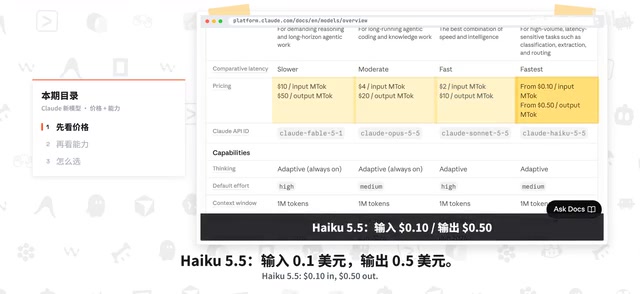
- Haiku 5.5: $0.10 input / $0.50 output
Running the same workload — 1 million input tokens and 200,000 output tokens — the math looks like this: Haiku 5.5 costs roughly $0.20, Sonnet 5.5 around $4, Opus 5.5 around $8, and Opus 5.1 a full $20. Haiku 5.5 is exactly 20x cheaper than Sonnet 5.5, which is the most intuitive way to grasp the gap between tiers.
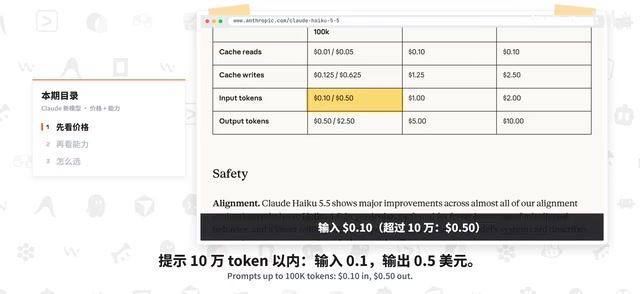
Haiku 5.5 pricing also splits into two tiers based on prompt length: for prompts under 100K tokens, it's $0.10 input / $0.50 output; beyond that, it jumps to $0.50 input / $2.50 output. Compared to the previous Haiku 4.5 (which was $1 input / $5 output), that's a 90% reduction for short prompts and 50% for longer ones. The official claim of "approximately 75% cheaper on average" accounts for the fact that the new tokenizer consumes more tokens — though Anthropic states the conclusion without showing the full calculation.
Sonnet 5.5: Same Price, Cheaper Caching
Sonnet 5.5's per-token price is identical to Sonnet 5.0 — no increase. A planned price hike for Sonnet 5.0 was previously canceled. Anthropic's reasoning is that it uses fewer tokens and runs faster (over 30% faster output than Sonnet 5.0), so "doing the same job costs up to 30% less" — but that savings comes from reduced token consumption, not a lower unit price.
Anthropic then added another benefit: Sonnet 5.5's cache read price was cut in half, dropping from $0.20 to $0.10 per million tokens. Anthropic estimates most agentic tasks will save an additional ~20% as a result.
Subscription users also receive monthly API credits: $100 for the Max 5x and 2x tiers, $200 for the 20x tier, and up to $500 for Team plans (shared across the entire team), usable on any model. Anthropic hasn't specified when these credits will be available.
Tokens are the basic unit of measurement for how large language models process text. Roughly speaking, every 4 English characters equals about 1 token; Chinese characters are denser, typically mapping to 1–2 tokens each. The "new tokenizer consumes more tokens" mentioned in the article refers to exactly this: different model versions use different tokenization algorithms, and even with identical input text, a new tokenizer may produce a higher token count, resulting in a higher bill. That's why Anthropic specifically noted that tokenizer differences were factored into the ~75% price reduction figure for Haiku 5.5, rather than simply dividing the unit prices. In practice — especially when processing large volumes of Chinese text or code — the relationship between token consumption and character count can differ significantly from English, which meaningfully affects the accuracy of cost estimates.
Prompt Caching is a mechanism that stores repeated context so subsequent requests can reuse it without reprocessing. In agentic tasks, system prompts, tool definitions, or lengthy background documents often remain unchanged across multiple turns of a conversation. Resubmitting and billing for that content every time adds up quickly. Cutting the cache read price in half means the cost of reusing that repeated content is directly halved. The ~20% savings estimate assumes the task involves substantial reusable context — purely single-turn Q&A will barely notice the difference, while multi-step automation workflows that maintain long system prompts or tool lists will benefit the most.
Capabilities: Opus for Complexity, Sonnet for Value
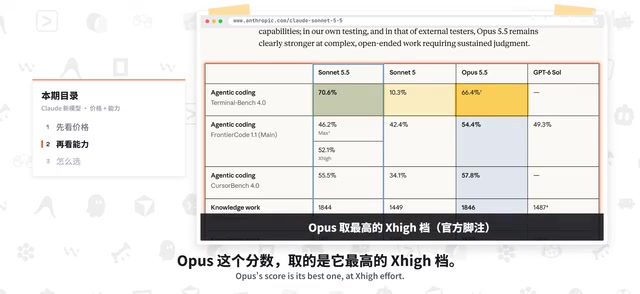
Sonnet 5.5 shows a dramatic jump in coding performance. It scored 70.6% on Terminal-Bench, compared to just 10.3% for Sonnet 5.0. Opus 5.5 topped out at 66.4% on the X-High tier — actually lower than Sonnet 5.5.
Looking at other benchmarks:
- Knowledge work test GDPval: Opus 5.5 scored 1874, Sonnet 5.5 scored 1846 — a gap of just 2 points
- Computer operation OSWorld 2.1: Sonnet 80.1% vs. Opus 81.8%
- Chart interpretation Chartography: Sonnet 5.5 reached 61.6%, up from just 15.6% for Sonnet 5.0
Sonnet 5.5 is also the first model to complete Pokémon Red using only screenshots. Opus 5.5 leads in seven out of eight benchmarks, but the margins are often just a few points. Anthropic itself acknowledges that for open-ended tasks requiring sustained judgment, Opus 5.5 is stronger — but for heavy coding workloads, Sonnet 5.5 is already sufficient, or even better. All figures were self-reported by Anthropic.
Haiku 5.5: Cheap Doesn't Mean Full-Featured
Anthropic positions Haiku 5.5 for high-volume, cost-sensitive work: summarization, data compression, database lookups, classification, and similar repetitive tasks. It's also well-suited as a coding sub-agent for Opus or Sonnet — fast enough for that role — as well as real-time customer service and browser automation.
Its improvements are substantial: the GDPval knowledge work score jumped from 735 (previous generation) to 1620; OSWorld offline sub-agent performance rose from 15.7% to 72.4%; and Terminal-Bench went from 0% to 39.2%.
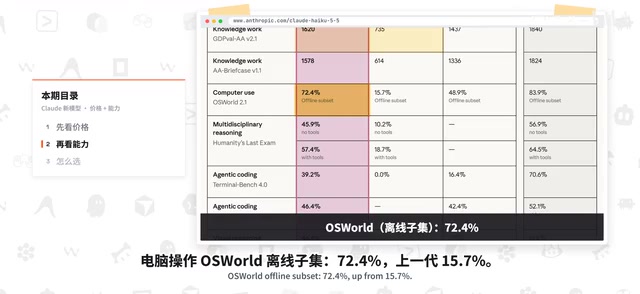
But the limits matter: Haiku 5.5's Terminal-Bench score is 31 points below Sonnet 5.5 (39.2% vs. 70.6%). Anthropic explicitly states that complex coding agent tasks should use Sonnet or Opus. Haiku 5.5 is the first Haiku to support adjustable thinking intensity. In Anthropic's performance-vs-cost charts across three thinking levels, the highest scores always belong to Sonnet 5.5. The egg drop demo at the start of this article is exactly what Haiku 5.5 looks like as a sub-agent — and it's now available directly in Claude Code.
The benchmarks mentioned — Terminal-Bench, OSWorld, and GDPval — are evaluation frameworks designed either by third parties or by Anthropic internally. Terminal-Bench measures a model's ability to complete programming tasks in a command-line environment, including debugging and scripting; OSWorld evaluates how well a model can control a real desktop OS using screenshots and action commands; GDPval focuses on knowledge work scenarios including analysis, writing, and research. It's worth noting that all these scores were self-reported by Anthropic and have not been independently reproduced by third parties. Benchmarks also have inherent limitations — a model's performance on a specific test set doesn't always translate directly to real-world business performance. The most reliable approach when selecting a model is to run a small-scale test on your own actual tasks.
How to Choose: Estimate Cost First, Then Ask If It Can Get the Job Done
Anthropic's official documentation keeps it simple:
- When in doubt, start with Opus 5.5
- For speed and efficiency, use Sonnet 5.5 — Anthropic calls it "the best combination of speed and intelligence"
- For high-volume, simple, fast tasks, use Haiku 5.5
All four models support a 1-million-token context window. Note that Haiku charges at the higher rate for prompts over 100K tokens, so don't fixate on the "20x cheaper" headline figure. The more practical approach is to estimate the cost of a single task run first, then determine whether that model can actually complete it — because if it can't, cheap is still expensive.
Related articles

Should U.S. College Fraternities Be Banned? A Researcher's Incisive Observations
Why not just ban U.S. college fraternities? A researcher finds the key resistance comes from decision-makers' own fraternity identities and schools' "willful ignorance."

Microsoft Discovery: Accelerating Scientific Discovery with AI Agents
Microsoft's Discovery platform runs specialized AI agents to help researchers screen and prioritize the most promising compounds and experimental paths, reducing experiments and accelerating scientific discovery.

Cambridge Heavy Industries Secretly Develops Desktop-Scale Nuclear Fusion Device
Cambridge Heavy Industries is secretly developing a desktop-scale laser-driven nuclear fusion device, targeting the equipment supply market for fusion power plants. This article analyzes its miniaturization technology path, commercialization logic, and unique positioning in the fusion startup wave.