Opus 5.5 Wrongly Blocks Biology Question, Reigniting Debate Over AI Safety Filters
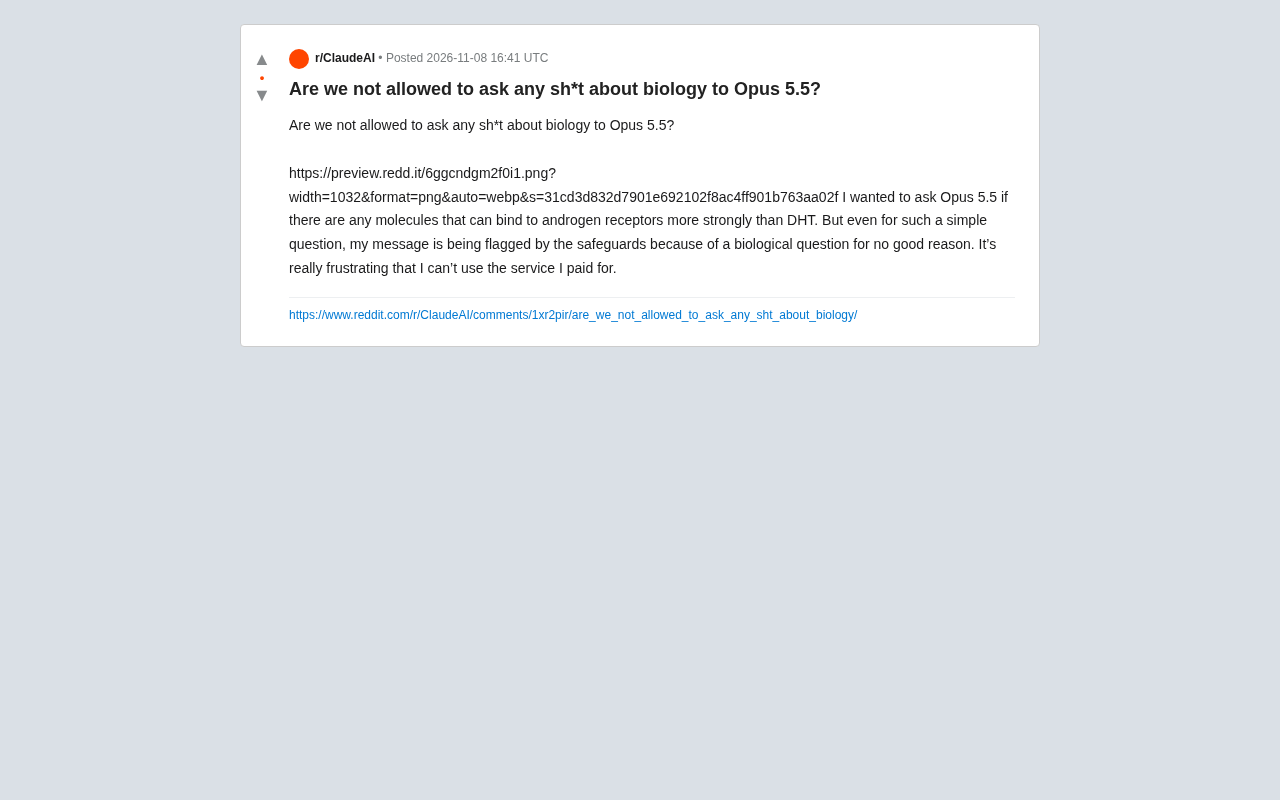
Opus 5.5 wrongly blocked an academic question about DHT receptor binding, exposing the bluntness and collateral damage of AI safety filters in biology.
A Reddit user asked Opus 5.5 whether molecules exist that bind to the androgen receptor more strongly than DHT—a typical biochemistry question—but the system's safety mechanism blocked it. The article reviews the incident and analyzes how safety filters based on keywords and intent classification over-generalize terms like hormones and receptors into sensitive topics, noting that this "better safe than sorry" strategy avoids abuse but sacrifices the experience of legitimate research users. Community discussion is divided: some users report similar false positives, while others argue the platform has the right to set limits but should improve transparency. The article concludes by recommending that providers introduce domain-aware classifiers and rapid feedback mechanisms to continuously tune the balance between safety and openness.
A Reddit user asked Opus 5.5 whether there exist molecules that bind to the androgen receptor more strongly than DHT, but the query was blocked by the system's safety mechanism. Why would such an ordinary scientific question trigger the AI's sensitivities? The incident exposes the bluntness and collateral damage of large-model safety filtering in the biology domain, and has also raised questions among paying users about service usability.
Incident Recap: A Simple Molecular Question Gets Flagged
According to the Reddit user, he simply wanted to know whether there are molecules with stronger binding affinity to the androgen receptor than DHT (dihydrotestosterone). This is a typical biochemistry question, falling within the scope of structural biology or medicinal chemistry discussion. However, Opus 5.5's safety mechanism flagged the message as content requiring interception on the grounds that it involved a "biology question." The user was deeply frustrated that the service he paid for could not be used for normal academic discussion, and questioned, "Are we not allowed to ask Opus 5.5 anything biology-related?"
DHT (dihydrotestosterone) is the active metabolite produced when testosterone is converted by 5α-reductase. Its affinity for the androgen receptor is approximately 2 to 10 times that of testosterone, making it the most potent endogenous androgen in the human body. In medicinal chemistry, evaluating the binding strength of a molecule to a receptor typically uses metrics such as the dissociation constant Kd or IC50. Synthetic molecules stronger than DHT do indeed exist, such as certain non-steroidal androgen receptor modulators and designer steroids. Therefore, the question the user raised is very common in structural biology and early-stage drug discovery, and inherently involves no illegal or harmful content.
Why Do Safety Filters Wrongly Flag Biology Questions?
Large-model safety protections are typically based on keywords and intent classification. Terms such as androgen receptor and DHT may be associated with hormonal regulation, performance-enhancing substances, or even controlled drugs, causing the system to over-generalize them into sensitive topics. This "better safe than sorry" strategy avoids abuse but also sacrifices the experience of legitimate research users. Especially for paying professional users, such misjudgments directly diminish the value of the tool.
Large-model safety classifiers generally consist of two parts: a rule layer based on keywords or regular expressions, and a fine-tuned intent classification model. The former responds quickly and is highly interpretable, but is easily triggered by combinations of technical terms; the latter relies on the distribution of training data and is prone to false positives for academic contexts that are scarce in the training set. The fields of biology and medicinal chemistry make extensive use of words like "receptor," "binding," "enhance," and "synthesis." When these words co-occur with topics such as hormones or neurotransmitters, classifiers often misjudge them as potential abuse intent, resulting in so-called over-blocking.
Resonance and Divergence in the User Community
The post sparked discussion on Reddit. Some users reported encountering similar situations, such as being asked to "change the subject" when asking about medicinal chemistry or neuroscience questions; others argued that the platform has the right to set boundaries but should improve transparency and provide appeal channels. According to some comment analyses, Opus 5.5's filtering rules may be particularly sensitive to combinations of words like "binding," "receptor," and "molecule," lacking the ability to recognize academic context. This divergence reflects the enduring tension between AI safety and usability.
False-positive blocking is a widely studied trade-off problem in safety engineering. Increasing recall means more legitimate requests are wrongly flagged, while reducing false positives may let borderline content through. Common mitigation approaches in the industry include: tiered policies based on user identity or payment level, introducing domain classifiers for secondary adjudication of academic questions, and providing human review and appeal channels. Transparency is equally critical—explaining to users why content was blocked and how to appeal can significantly reduce the trust loss caused by misjudgments.
Implications for AI Service Providers
This incident is not an isolated case. As AI penetrates deeper into scientific research scenarios, safety filtering needs more fine-grained contextual understanding rather than simple matching. Service providers could consider introducing domain-aware classifiers to relax restrictions on questions with clear academic intent, while establishing rapid feedback mechanisms. For users, reporting false blocks through official channels can also help drive rule optimization.
Conclusion
This blocking incident with Opus 5.5 once again reminds us that the balance between safety and openness requires continuous tuning. While protecting users from harmful content, legitimate scientific curiosity should not become a casualty.
Related articles

AI Detection False Positive Controversy: Writer Accused of Using AI, Who Should Bear the Burden of Proof?
A 2026 Commonwealth Short Story Prize regional winner was flagged by Pangram as 100% AI-generated but cleared after drafts were reviewed. The case exposes AI detection false positives and the burden-of-proof dilemma facing creators.

How Stanford Teaches AI-Native Engineering: Inside CS146S
Stanford's CS146S course confronts AI one-click assignment generation, exploring AI-native engineering education. Mihail Eric shares how to treat AI as an engineering partner and build system design and code review skills, offering a new model for engineering education.

Stanford's AI-Native Engineering Course: How to Teach Programming in the Age of Agents
Stanford CS146S course reform: Mihail Eric brings open-source maintainers into the classroom, having students propose changes in unfamiliar real codebases, exploring AI-native engineering teaching in the age of agents, shifting from writing code to cultivating engineering decision-making skills.