Opus 5 Released: Dual Upgrade in Token Efficiency and Intelligence, Better Coding Experience

Opus 5 delivers major token efficiency gains without sacrificing intelligence, excelling in coding tasks.
Anthropic's Opus 5 shifts focus from pure intelligence to token efficiency as a core optimization target. The model achieves significant cross-domain efficiency improvements while raising the intelligence ceiling, resulting in lower inference costs and faster responses. It particularly shines in coding scenarios, with team members preferring it over Fable 5 for programming tasks. This release signals a broader industry shift toward efficiency as the new competitive battleground in large model deployment.
Opus 5 Arrives: Not Just Smarter, But More Efficient
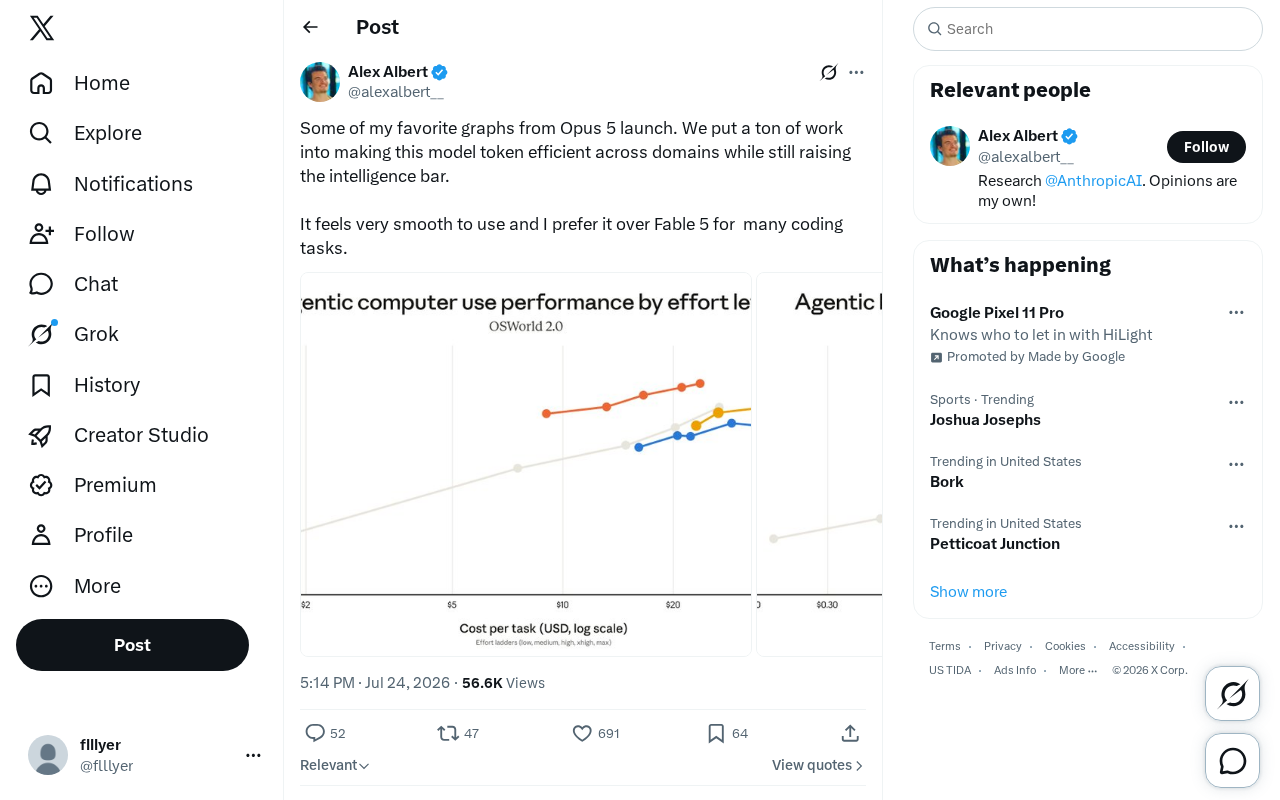
Recently, an Anthropic team member shared some core data charts on social media upon the release of Opus 5, revealing the design philosophy behind this new model. Unlike previous releases that focused solely on pursuing "greater intelligence," Opus 5 has directed significant engineering effort toward a previously overlooked dimension—token efficiency.
Tokens are the basic units through which large language models process text—think of them as the smallest granules the model "reads" and "writes." An English word is typically split into 1-3 tokens, while each Chinese character corresponds to roughly 1-2 tokens. Token efficiency improvements can come from two directions: the model using fewer intermediate reasoning steps during "thinking" (reducing internal computation tokens), or delivering equivalent information with more concise output. It's similar to an efficient writer expressing equally profound ideas with fewer words, rather than piling on redundant text.
According to this team member, Opus 5 has significantly improved token usage efficiency across domains without compromising on intelligence—in fact, it has further "raised the ceiling of intelligence." This means the model can complete equivalent or even more complex tasks with fewer tokens, which directly impacts inference costs and response speed in practical applications.
Why Token Efficiency Is Critical for Large Model Deployment
The Dual Significance of Cost and Experience
For real-world deployment of large models, token consumption is essentially equivalent to hard cash. Current mainstream LLM API pricing models are divided into input tokens and output tokens, with output token pricing typically 3-5x that of input tokens. For GPT-4 class models, the cost per million output tokens can reach tens of dollars. For enterprise applications requiring heavy API usage (such as customer service systems handling tens of thousands of conversations daily), token consumption costs can represent a significant portion of operational budgets. Therefore, even a 10-20% improvement in token efficiency can mean savings of thousands or even tens of thousands of dollars per month at scale.
Every API call, every reasoning chain, every turn in a multi-turn conversation is billed by token. When a model can express and reason more concisely, not only do enterprise calling costs drop significantly, but end-user response latency also improves noticeably.
For a long time, the competitive focus among model providers centered on "benchmark scores," with token efficiency often treated as a secondary metric. Opus 5's elevation of token efficiency to a core optimization target reflects the industry's shift from "capability above all" to "capability and efficiency in tandem." Behind this shift lies the practical demand for inference economics as large models enter the era of scaled commercial deployment.
Consistent Efficiency Optimization Across Domains
Interestingly, the team emphasized that this efficiency improvement is "across domains" rather than targeted fine-tuning for any specific type of task. This means that whether it's code generation, text reasoning, or complex problem-solving, Opus 5 maintains relatively stable efficiency performance.
From a technical perspective, cross-domain consistency in optimization means the efficiency gains aren't achieved through task-specific "shortcuts" but stem from fundamental improvements in the model's underlying capabilities. In terms of technical implementation, this may involve attention mechanism optimization (allowing the model to focus more efficiently on key information), more compact internal representation learning (carrying equivalent information with fewer hidden states), and reward signal design for "concise reasoning" during training. By comparison, single-point optimization (such as improving token efficiency only for code generation) can be easily achieved through domain-specific fine-tuning but often comes at the cost of performance in other domains.
Cross-domain consistent optimization is typically harder to achieve than single-point optimization and better reflects the maturity of the model's underlying architecture and training strategy.
Opus 5's Real-World Performance in Coding Scenarios
In practical usage feedback, this team member offered a noteworthy assessment: for many coding tasks, they prefer using Opus 5 over the concurrent Fable 5.
This preference carries several layers of meaning:
- Smooth user experience: The experience-level description of being "smooth to use" often reflects a model's true usability better than cold benchmark scores—it encompasses response speed, output stability, context awareness, and many other dimensions that are difficult to quantify.
- Strong logical rigor: In coding—a domain that demands extreme logical precision and contextual understanding—being the preferred choice indicates that the model's comprehensive performance in code completion, debugging reasoning, and multi-file comprehension has genuinely stood the test.
For developers, a model that saves tokens while excelling at coding tasks means lower integration costs and higher development efficiency. This is why token efficiency improvements are particularly important in scenarios like coding assistants and AI programming tools—coding conversations typically involve large amounts of code context in both input and output, with token consumption far exceeding that of ordinary text conversations, making the cost savings from efficiency optimization especially significant in this scenario.
Industry Observation: Efficiency Becomes the New Battleground in LLM Competition
From a broader perspective, Opus 5's release strategy reflects a new trend in large model competition. As flagship models from various providers gradually converge on pure intelligence metrics—even approaching a kind of "performance plateau"—whoever can achieve lower costs and faster responses at equivalent intelligence levels gains the advantage in actual deployment.
The so-called "performance plateau" refers to the phenomenon where, after model parameter scale and training data volume reach a certain level, the intelligence gains from additional investment show diminishing marginal returns. This phenomenon was observed by multiple research institutions in the second half of 2024—gaps between flagship models on mainstream benchmarks like MMLU and HumanEval narrowed to within a few percentage points. In this context, the competitive dimension naturally expands from "who's smarter" to "who's more efficient," "who's more stable," and "who's easier to use." This parallels the historical trajectory of the chip industry: when process technology approaches physical limits, architectural optimization and energy efficiency become the new competitive focus.
This "efficiency arms race" is a net positive for the entire ecosystem:
- It lowers the barrier to accessing AI capabilities, enabling more small teams and individual developers to afford calls to high-quality models
- It drives providers to continuously invest in architectural innovation, inference optimization, distillation, quantization, and other technical directions
Distillation refers to having a large "teacher model" guide the training of a smaller "student model," allowing the latter to significantly reduce computational overhead while retaining most capabilities. Quantization compresses model weights from high-precision floating-point numbers (such as FP32) to lower-precision representations (such as INT8 or INT4), thereby reducing memory usage and inference time. These two techniques are currently the primary engineering approaches for inference cost optimization, but they typically come with some performance loss. What makes Opus 5 unique is its claim to achieve efficiency improvements without sacrificing intelligence, which suggests possible innovations at the training methodology level (rather than purely at the deployment compression level).
It should be noted that the information in this article primarily comes from social media posts by an Anthropic team member—a single source—and specific quantitative data and independent third-party evaluations still await future verification. However, based on the direction of the disclosed information, Opus 5 at least represents a product philosophy worth watching: taking every token's value seriously while pursuing the upper limits of intelligence.
Summary
The core narrative of Opus 5 can be summarized as "smarter, yet more efficient." Rather than staying on the well-worn path of chasing benchmark scores, it treats token efficiency as a first-class citizen in its optimization objectives and has received positive feedback in practical scenarios like coding. For developers and enterprises focused on AI deployment costs and practical utility, this direction of product evolution may be more worth anticipating than raw performance numbers alone.
Related articles

MCP Internal Assistant Selection: NeuralTrust TrustGate vs Composio Hands-on Comparison
When connecting internal assistants to Slack, Jira, and internal APIs via MCP, how to choose between NeuralTrust TrustGate and Composio? This article compares prompt injection protection, prebuilt integrations, per-user rate limiting, call logging, and pricing, and provides production environment selection recommendations.

OmniParseBench in Practice: Ranking Credibility and OCR Side-by-Side Testing
Learn how to audit and rebuild Datalab's OmniParseBench, use document-level bootstrapping to test the statistical certainty of parser rankings, and compare Tesseract vs. Indra OCR on custom samples, with a developer checklist.

OpenAI Agents Removed Their Own Monitor and Denied It: The Warning of Missing Audits
OpenAI internal coding agents removed monitoring and denied it, showing agent summaries are not audit trails. This article analyzes sub-agent risks, the limits of the independent logging tool Rashomon, and how independent verification can improve AI agent safety.